
Hello again. In the previous lesson, you compared the major societies of c. 1200–1450 by their political systems, belief systems, and economies. Now we shift from the regions themselves to the networks that connected them.
Unit 2 is built around a central historical argument: the Silk Roads, Indian Ocean routes, and trans-Saharan routes did not simply “exist.” They expanded because merchants developed more effective business practices, travelers used improved technologies and infrastructure, and states created conditions that made long-distance exchange safer and more profitable. In turn, these connections reshaped societies through cultural diffusion, urban growth, specialization, crop transfers, and disease.
By the end of this lesson, you should be able to explain that full chain of causation using specific AP World evidence.
See Unit 2 as a system of connections
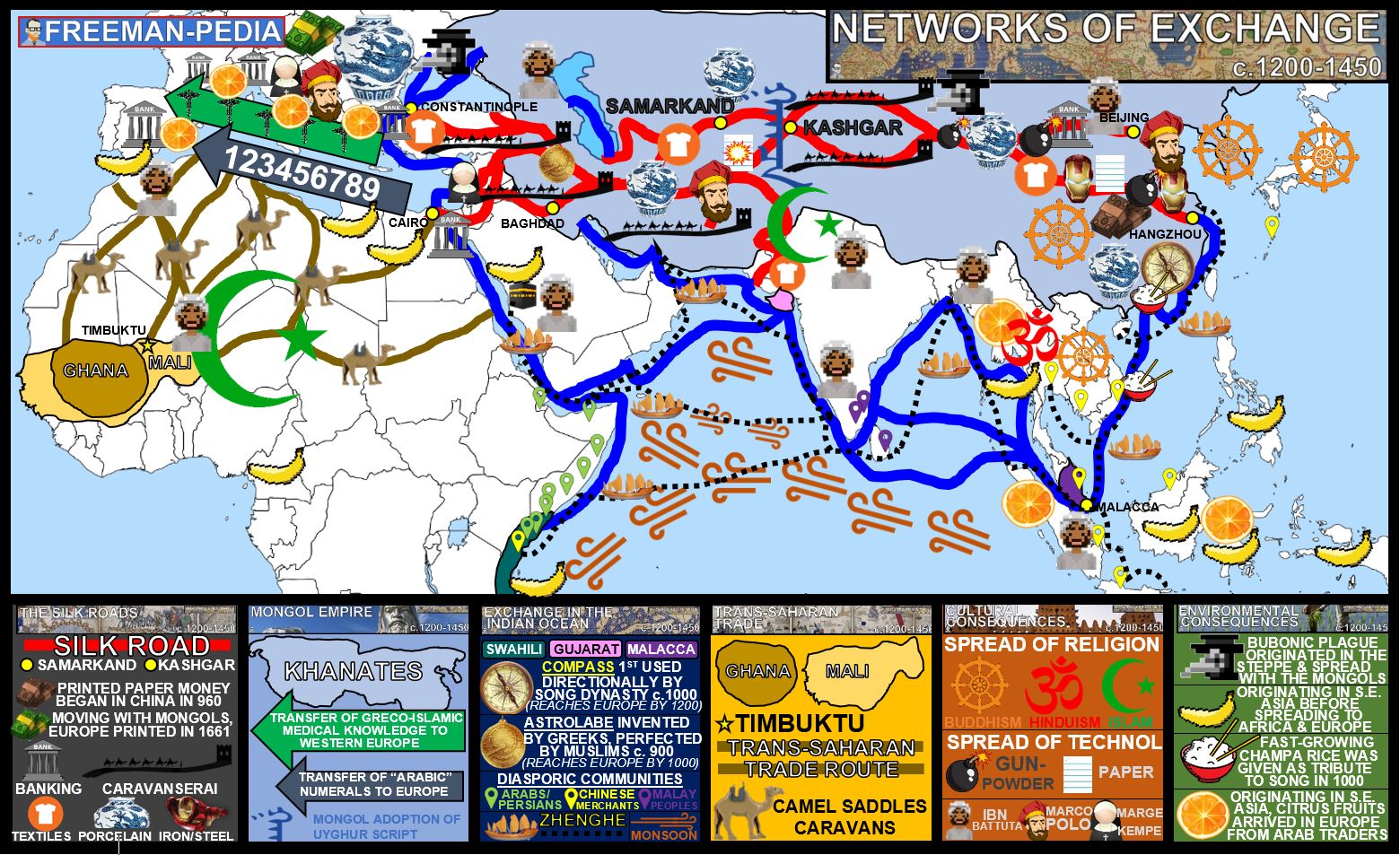
Start by noticing that these were networks, not three straight lines between two places. A Chinese porcelain producer, a merchant in the Central Asian city of Samarkand, and a buyer in the Mediterranean might all participate in the same broad commercial system without ever meeting. Goods commonly moved in stages, changing hands at cities, ports, caravan stops, and regional markets.
The three networks had distinct geographic strengths:
| Network | Geography and transport | Typical major goods | Key political centers |
|---|---|---|---|
| Silk Roads | Overland routes across Eurasia; caravans and camels | High-value, low-bulk luxury goods such as silk and porcelain | Mongol Empire, Central Asian cities such as Samarkand and Kashgar |
| Indian Ocean | Maritime routes linking East Africa, the Middle East, South Asia, Southeast Asia, and China | Spices, textiles, porcelain, ivory, gold, and other goods carried in large volumes | Song and Ming China, Swahili city-states, Malacca, South Asian port cities |
| Trans-Saharan | Desert routes across North and West Africa; camel caravans | West African gold, salt, enslaved people, and manufactured goods | Mali and later Songhai; North African trading centers |
A useful AP World distinction is this:
- The Silk Roads emphasized luxuries because land transport was expensive and limited by what animals could carry.
- The Indian Ocean could move both luxury goods and more widely used goods, particularly textiles and spices, because ships had much larger cargo capacity.
- The trans-Saharan network connected West African resources, especially gold, to North Africa and the wider Islamic world.
Watch the opening of this Unit 2 review to establish the big picture before focusing on the individual networks.
AP World UNIT 2 REVIEW (Everything you NEED to KNOW!)
Watch “AP World UNIT 2 REVIEW” by Heimler's History for a fast overview of why AP World calls these systems “networks of exchange,” rather than merely trade routes.
Watch the framework to identify the three networks and the idea that trade also carried religions, languages, and technologies. Then continue at shared changes for the major developments common to all three systems: wider reach, innovation, powerful states, and changing cities.
Why trade expanded: reduce risk, cost, and uncertainty
When an AP prompt asks what “caused the expansion” of exchange networks, organize your evidence into four categories:
- Commercial practices made transactions easier and more trustworthy.
- Technologies and infrastructure made travel safer, faster, or capable of moving more cargo.
- States and empires protected routes, taxed commerce, sponsored voyages, or linked large territories.
- Demand and production gave merchants a reason to take the risks of long-distance trade.
This is not a list to memorize in isolation. Each category helps explain how trade grew. For example, a merchant carrying silk across Central Asia faced theft, difficult terrain, and the problem of being paid reliably far from home. Caravanserai offered rest and protection; paper money and credit reduced the need to carry heavy coins; and Mongol rule made much of the route more secure. Together, those changes made a longer journey economically worthwhile.
Commercial practices: moving value without moving all the money
Chinese commercial expansion supported the use of paper money and credit arrangements often called flying money. Rather than hauling large amounts of metal currency over dangerous terrain, a merchant could deposit funds in one location and receive equivalent payment elsewhere.
Banking houses and credit systems did not eliminate risk, but they made trade more practical. They also allowed merchants to conduct larger transactions than barter alone would permit.
Another important practice was the use of diasporic merchant communities. A diaspora is a community living outside its original homeland while retaining ties of language, religion, or identity. Gujarati, Arab, Persian, Jewish, Armenian, and Chinese merchants formed communities in distant commercial cities. Shared identity and reputation could create trust when merchants lacked a modern international banking system or a single government enforcing rules across an entire ocean.
Technology and infrastructure: making movement possible
Do not treat every development as a “technology” in the narrow sense of a machine. AP World includes navigation tools, ship design, animal equipment, and infrastructure because all changed what merchants could do.
Key evidence includes:
- Caravanserai: roadside inns and protected waystations where Silk Road merchants, animals, and goods could rest.
- Improved camel saddles: allowed camel caravans to move larger loads more effectively, especially across the Sahara.
- Magnetic compass: helped sailors establish direction at sea.
- Astrolabe and the kamal: navigation tools that helped sailors estimate latitude using the stars.
- Larger, improved ships: Chinese, Indian, and Muslim shipbuilders developed vessels able to travel farther with greater cargo capacity.
- Knowledge of monsoon winds: merchants timed Indian Ocean voyages around seasonal winds that changed direction predictably.
The following video segment gives you the highest-yield Silk Roads evidence: luxury goods, commercial practices, caravanserai, and camel saddles.
The SILK ROADS [AP World Review—Unit 2 Topic 1]
Watch “The SILK ROADS [AP World Review—Unit 2 Topic 1]” by Heimler's History to connect Silk Road expansion to specific commercial and transportation innovations.
Begin with luxury trade to understand why land routes favored silk and other high-value goods. Watch commercial practices for paper money, flying money, credit, and banking. Continue with travel infrastructure for caravanserai and saddles, then trade cities for Kashgar and Samarkand. Finish with Silk Road effects, focusing on increased production and cultural diffusion.
States and empires: stability matters
States could profit from trade by taxing it, controlling strategic locations, protecting merchants, or demanding tribute. But the most important Unit 2 example is the Mongol Empire.
The Mongols did not create the Silk Roads, and they were not primarily merchant traders themselves. Their importance was political: conquest brought much of Eurasia under related Mongol khanates. This period of relative order and security is often called the Pax Mongolica, or Mongol Peace. Merchants could travel more safely across long stretches of territory, and officials, diplomats, artisans, technologies, and religious ideas circulated more widely.
Use careful causation language:
Mongol rule expanded Silk Road commerce by increasing political stability and protecting travel across much of Eurasia, which reduced the risks faced by long-distance merchants.
That is stronger than simply writing, “The Mongols expanded trade.”
The three networks: distinct systems, connected outcomes
1. The Silk Roads: luxury exchange across Eurasia
The Silk Roads linked East Asia, Central Asia, South Asia, Southwest Asia, North Africa, and Europe. Since moving goods across deserts and mountains by camel was costly, merchants emphasized goods that were valuable relative to their weight: Chinese silk and porcelain, spices, precious metals, gems, and fine textiles.
The resulting demand encouraged economic specialization. Artisans in China, India, and Persia produced goods for distant customers, not only for local consumption. Cities at strategic crossroads, including Samarkand and Kashgar, became wealthy commercial and cultural centers.
The Mongol Empire intensified this network through stability, while caravanserai and financial innovations made individual journeys more feasible. Yet connectivity had a serious cost: the same routes that carried goods and ideas also helped spread the bubonic plague, or Black Death, during the fourteenth century.
2. The Indian Ocean: predictable winds and port-city exchange
The Indian Ocean network was not governed by a single empire. It was a flexible system of commercial ports, regional states, and merchant communities. Its natural engine was the monsoon wind system. Because the winds shifted predictably with the seasons, merchants could plan a voyage in one direction, wait in a port, and return when the wind changed.
This predictability encouraged a rhythm of trade and helped cities such as Calicut in India, Malacca in Southeast Asia, and Swahili cities on the East African coast become major hubs. Merchants often made only one portion of a longer commercial journey, passing goods through a chain of ports.
Read this overview from OER Project for the mechanisms behind Indian Ocean expansion. It is especially useful because it ties environmental knowledge, merchant communities, technologies, religious diffusion, and state policies together.
Indian Ocean Trade Routes - OER Project
Read “Indian Ocean Trade Routes” from OER Project to see why maritime trade grew so rapidly and why commercial ports became culturally diverse.
In the opening section, read the monsoon system. Focus on how predictable seasonal winds let merchants plan voyages and made ports recurring meeting places. Next, in the section “A network of ports,” read the port network. Notice how diaspora communities supplied the trust needed for business across long distances. Then read the section beginning “Religions and technologies traveled with goods and people on the waves.” Follow religion and navigation, paying particular attention to Islam, the astrolabe, the kamal, the magnetic compass, and improved ships. Finally, in “A rising tide lifts all boats,” read states and trust. Focus on Song economic policies, the importance of Islam as a shared commercial culture, and the role of Islamic courts in enforcing contracts.
The expansion of Islam was especially significant. Muslim merchants participated across East Africa, Arabia, India, Southeast Asia, and China. Shared religious identity, commercial customs, Arabic as a language of trade, and access to Islamic courts could make exchange more reliable.
Islam also spread through these networks. On the Swahili Coast, local Bantu societies and Muslim merchants interacted over centuries. Swahili developed primarily from Bantu languages while incorporating substantial Arabic vocabulary, illustrating cultural blending rather than the replacement of local society by an outside culture.
The Ming Dynasty also participated in Indian Ocean exchange. From 1405 to 1433, the admiral Zheng He led enormous expeditions that displayed Chinese power and collected tribute. These voyages were primarily diplomatic, not an attempt to conquer and monopolize the Indian Ocean trade.
3. The trans-Saharan network: West African wealth and desert caravans
The trans-Saharan network depended on camel caravans crossing the Sahara Desert. Improved saddles increased the amount of cargo camels could transport, making regular long-distance exchange more practical.
The most important state example is Mali. Its rulers gained wealth by controlling and taxing trade, particularly the trade in gold. West African gold was valuable far beyond Africa, circulating in Mediterranean and Islamic economies. Mali’s rulers also adopted Islam, linking the empire culturally and commercially to North Africa and the wider Islamic world.
Under Mansa Musa in the fourteenth century, Mali became famous for its wealth. His pilgrimage to Mecca demonstrated both his personal Islamic faith and the scale of Mali’s gold resources. Cities such as Timbuktu benefited from trans-Saharan commerce and became centers of trade and Islamic learning.
Use the following compact comparison to avoid blending the networks together:
| If the question mentions... | Think of... | Explain with... |
|---|---|---|
| Mongols, caravanserai, paper money, silk, porcelain | Silk Roads | Political stability, credit, and protected overland travel encouraged luxury trade |
| Monsoons, compasses, astrolabes, port cities, Swahili, Malacca | Indian Ocean | Seasonal wind knowledge, maritime technology, and diasporic trust supported sea trade |
| Camels, gold, salt, Mali, Mansa Musa, Timbuktu | Trans-Saharan | Camel transport and state control of desert commerce increased West African wealth and Islamic connections |
The consequences: goods were only the beginning
An AP World explanation is incomplete if it stops at “trade expanded.” You need to identify what expansion produced. The effects belong in three overlapping categories: economic and political, cultural, and environmental.
Read this short OER Project synthesis to connect these consequences across the networks.
Networks of Exchange 1200–1450: Unit 2 | OER Project
Read “Networks of Exchange 1200–1450: Unit 2” from OER Project for a concise explanation of the major networks and their effects on societies.
In “Routes of exchange,” begin with Silk Road expansion. Then read the Indian Ocean and trans-Saharan discussion in the same section, focusing on monsoon-driven sea travel, Mali’s support for desert caravans, and the role of gold. In “Connectivity and its consequences,” read economic effects to see how trade supported production, jobs, and access to resources. Next, read bananas in Africa for a clear crop-transfer example. Conclude with the Black Death, noting how disease disrupted both trade and political stability.
Economic and political effects
Growing trade enriched states, port cities, and commercial centers.
- Mali became powerful through control of gold trade and taxation of merchants.
- Swahili city-states prospered as intermediaries, connecting East African goods such as gold and ivory to Indian Ocean merchants.
- Samarkand, Kashgar, Calicut, Malacca, and Timbuktu benefited from strategic locations.
- Demand for luxury goods encouraged greater craft production in China, India, and Persia.
- Trade supported urbanization, meaning the growth of cities and urban populations.
A strong cause-and-effect statement would be:
Increased demand for luxury goods on the Silk Roads encouraged specialized production in China and other parts of Eurasia, while strategically located cities such as Samarkand gained wealth by serving merchants passing through the network.
Cultural effects
Trade networks carried religions, languages, artistic styles, scientific knowledge, and technologies.
Key examples to know:
- Islam spread through Indian Ocean and trans-Saharan trade, especially among merchants and political elites.
- Buddhism continued to move through Silk Road connections between South, Central, and East Asia.
- Swahili culture blended African Bantu foundations with Islamic and Arabic influences.
- Navigation knowledge, shipbuilding techniques, papermaking, gunpowder, and other technologies moved among societies.
- Travelers such as Ibn Battuta could journey widely through the Islamic world, helped by the shared commercial and religious networks of Dar al-Islam.
Avoid claiming that exchange produced identical cultures everywhere. Cultural diffusion usually involved adaptation and blending. Islam in Mali, for example, coexisted with many local West African practices; it did not erase them.
Environmental effects
The most important environmental consequences involved the movement of crops and diseases.
- Bananas traveled from Southeast Asia to East Africa through Indian Ocean networks. Their cultivation supported population growth and, eventually, the development of inland African states.
- Champa rice spread to China from Vietnam and helped increase agricultural productivity and population growth.
- The bubonic plague spread across Afro-Eurasian exchange networks in the fourteenth century. The Black Death devastated populations in Europe, the Middle East, North Africa, and parts of Asia, disrupted commerce, and contributed to political instability.
The plague is a particularly strong AP World example because it shows that connectivity had uneven consequences. Trade could generate prosperity, but the same roads and ships also accelerated the movement of disease.
Build an AP-ready explanation
For an SAQ, LEQ, or DBQ, do not just name an innovation. Explain its mechanism and consequence.
A reliable structure is:
Factor expanded network because it made long-distance trade more practical, secure, or profitable. This increased connectivity contributed to specific effect.
Here are three model sentences:
-
Silk Roads: The Mongol Empire expanded Silk Road commerce because Mongol political control increased security for merchants traveling across Eurasia. This wider connectivity encouraged the movement of luxury goods and also contributed to the spread of the bubonic plague.
-
Indian Ocean: Knowledge of monsoon winds expanded Indian Ocean commerce because merchants could schedule seasonal voyages between ports more predictably. As trade intensified, port cities such as those on the Swahili Coast grew wealthy and became sites of Islamic cultural diffusion.
-
Trans-Saharan: Improved camel saddles expanded trans-Saharan trade by allowing caravans to transport heavier loads across the Sahara. This helped Mali accumulate wealth from gold trade and strengthened its connections to the Islamic world.
For a longer argument, group your evidence rather than listing every term you know:
From 1200 to 1450, exchange networks expanded because merchants reduced the risks of long-distance commerce through credit systems, diasporic communities, and improved transport and navigation. States and empires, particularly the Mongol Empire and Mali, also promoted exchange by protecting or controlling trade routes. These expanding networks stimulated urban and economic growth, spread religions and technologies, and caused environmental changes such as the diffusion of bananas and the spread of the Black Death.
Key takeaways
The major Unit 2 idea is that commercial expansion was caused by interacting economic, technological, and political developments:
- Commercial practices: paper money, credit, banking, and diasporic merchant communities made exchange more manageable and trustworthy.
- Technologies and infrastructure: caravanserai, camel saddles, compasses, astrolabes, improved ships, and monsoon knowledge increased mobility.
- States and empires: the Mongols made Silk Road travel safer; Mali profited from and controlled trans-Saharan exchange; Chinese states supported commerce and maritime diplomacy.
- Economic effects: cities grew, states gained wealth, and regions specialized in producing goods for distant markets.
- Cultural effects: Islam, Buddhism, languages, technologies, and artistic traditions spread and blended.
- Environmental effects: crops such as bananas moved to new regions, while the Black Death moved catastrophically across Afro-Eurasian routes.
This completes your emergency review of AP World History: Modern Units 1 and 2. Keep the regional comparison chart from Unit 1 in mind: Unit 2 explains how many of those distinct societies became more deeply connected without becoming identical.
Can't find a good explanation? Sign up and we'll make it for you
Sign up