Hello! Welcome back.
In our previous lesson, we explored how to fine-tune video generation models using LoRA to create specialized content, whether for a particular artistic style or a specific motion. While this gives us control over what is in our videos, it doesn't automatically guarantee that the video is coherent. You can generate a sequence of beautiful frames that, when played together, flicker, morph unnaturally, or lose track of objects.
This is the challenge of temporal consistency.
This lesson directly addresses the learning outcome: Implement temporal consistency techniques to improve video quality. We will dissect the methods models use to ensure that a video is a smooth, continuous sequence, not just a slideshow of related images.
We will cover:
- The fundamental problem of temporal inconsistency.
- Architectural solutions that build consistency into the model's core structure.
- Modular and fine-tuning approaches that add temporal awareness to existing models.
- Specific attention mechanisms designed to maintain object identity across frames.
- A practical, training-free technique you can implement at inference time to immediately improve video quality.
1. The Challenge of Temporal Consistency
A video is more than a collection of frames; it's a sequence where each frame is causally and visually linked to the ones before it. An image generation model, even a great one, thinks one frame at a time. When you ask it to generate a video, it might produce slight, random variations in each frame that result in a flickering effect, or it might forget the exact appearance of an object from one frame to the next.
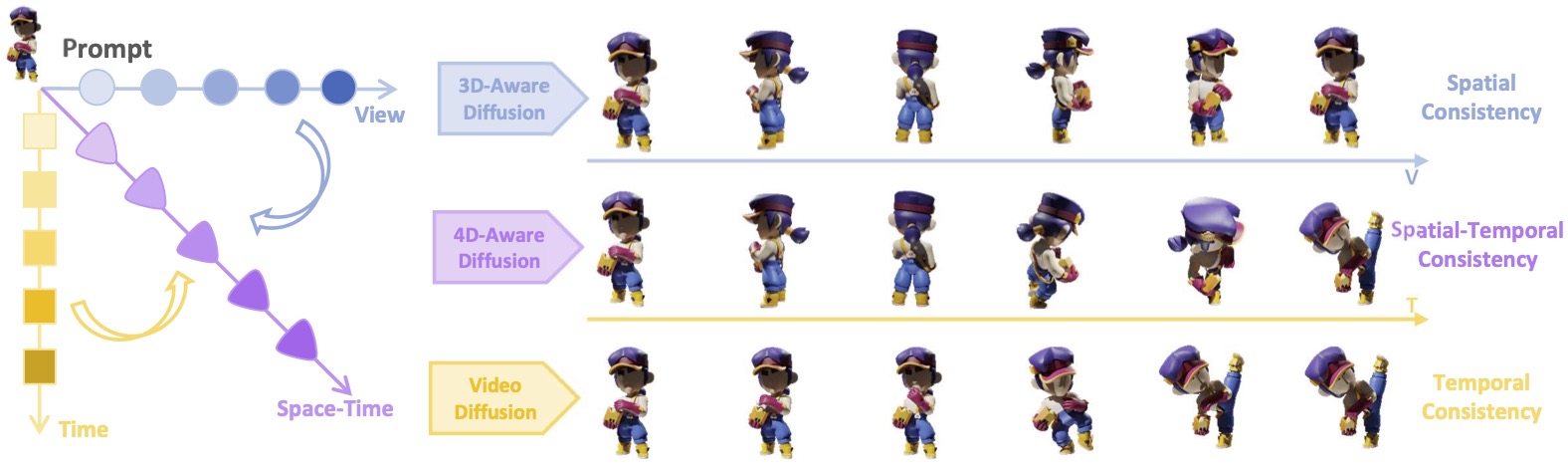
To solve this, models need mechanisms to "remember" what happened in previous frames and use that context to generate the current one. Let's explore how they do this.
2. Architectural Solutions: Building in a "Memory" of Time
The most fundamental way to achieve temporal consistency is to design the model architecture to explicitly handle the time dimension. This usually involves factorizing (separating) spatial and temporal processing. Instead of trying to learn everything about a 3D volume (width, height, time) at once, the model processes space and time in distinct steps.
Method 1: Spatio-Temporal Layers in U-Nets
Many early and successful video models are based on the U-Net architecture. To make them video-aware, their 2D layers are "inflated" into 3D.
A common approach is to replace standard 2D convolutions with factorized layers:
- A Space-Only Convolution: A 3D convolution that only operates on the height and width of each frame independently (e.g., a
1x3x3kernel). This gathers spatial information within each frame. - A Time-Only Layer: A temporal attention or 1D convolution layer that operates across the time dimension. This allows pixels at the same spatial location to communicate across frames, propagating appearance and motion information.
Diffusion Models for Video Generation
The blog post 'Diffusion Models for Video Generation' by Lilian Weng provides a detailed technical overview of these architectures. We will focus on the initial approaches that modify the U-Net.
Please read the section 'Model Architecture: 3D U-Net & DiT' to understand how Video Diffusion Models (VDM) factorize space and time. Then, in the next section 'Adapting Image Models to Generate Videos', read about 'Make-A-Video' and its 'Pseudo-3D' layers, which offer another clear example of this factorization.
As you read, note these two key patterns:
- VDM: Adds a dedicated temporal attention block after each spatial attention block.
- Make-A-Video: Stacks a temporal 1D convolution layer after each spatial 2D convolution layer.
Both achieve the same goal: they force the model to explicitly consider temporal relationships after processing spatial features.
Method 2: Spatio-Temporal Attention in Transformers
The same principle of factorization applies to Transformer-based video models, like the Diffusion Transformer (DiT) we've seen. Instead of just having self-attention, these models use alternating layers of spatial and temporal attention.
The video below explains this concept and its implementation beautifully.
Video Generation with Diffusion Transformers | Generative AI
The video 'Video Generation with Diffusion Transformers' provides a clear, code-oriented explanation of how a Transformer architecture can be adapted for temporally consistent video generation.
Watch the segment from 08:43 to 12:41, which details spatial and temporal modeling. Then, watch from 16:00 to 17:12 to understand the role of temporal positional embeddings.
This is where your computer science background is particularly useful. The core trick is tensor reshaping. A video tensor might have the shape (Batch, Frames, Patches, Dimensions).
- For Spatial Attention, the model reshapes the tensor to
(Batch * Frames, Patches, Dimensions). It treats each frame as a separate item in a larger batch and performs standard self-attention across the patches within each frame. - For Temporal Attention, it reshapes to
(Batch * Patches, Frames, Dimensions). Now, it treats each patch location as a separate item and performs attention across theFramesdimension. This allows the model to track how a specific part of the scene changes over time.
To make this work, the model also needs Temporal Positional Embeddings, which are added to the frame representations to give the model an explicit sense of "frame 1," "frame 2," and so on, preventing it from mixing up the order.
Test your understanding!
You are designing a video diffusion model. You notice that objects in your generated videos have consistent shapes but tend to flicker in color from one frame to the next. Which architectural component would you investigate or strengthen to address this?
a) The spatial convolution layers.
b) The temporal attention layers.
c) The VAE decoder.
d) The text encoder.
Show answer
The most likely culprits are (b) and (c).
- (b) The temporal attention layers: These are directly responsible for ensuring features (like color) are propagated consistently across frames. Weak temporal attention could cause the model to "forget" the correct color from one frame to the next.
- (c) The VAE decoder: As noted in the
Video LDMandSVDpapers, a VAE trained only on images can introduce flicker when decoding a sequence of video latents. Fine-tuning the decoder with temporal layers can directly mitigate this.
(a) is less likely, as the shapes are consistent, suggesting spatial processing is working well. (d) is irrelevant to frame-to-frame visual consistency.
3. Modular and Fine-Tuning Approaches
Building a new architecture from scratch is expensive. A more common strategy is to adapt a powerful, pre-trained text-to-image (T2I) model for video.
AnimateDiff: Injecting a Motion Module
AnimateDiff is a popular and effective framework that does exactly this. The idea is simple but powerful:
- Take a frozen, pre-trained T2I model (like Stable Diffusion).
- Insert small, new "Motion Modules" into its U-Net architecture (typically after the spatial attention and ResNet blocks).
- Train only these motion modules on a large dataset of video clips.
The T2I model provides the ability to generate high-quality, diverse images from text. The motion module, having been trained on real videos, learns general motion priors and injects temporal consistency into the generation process.
Text-to-Video Generation with AnimateDiff
The Hugging Face documentation for AnimateDiff gives a concise overview of this approach.
Read the 'Overview' and the 'AnimateDiffPipeline' sections. Focus on the core concept: inserting a motion modeling module into a frozen T2I model.
Cross-Frame Attention
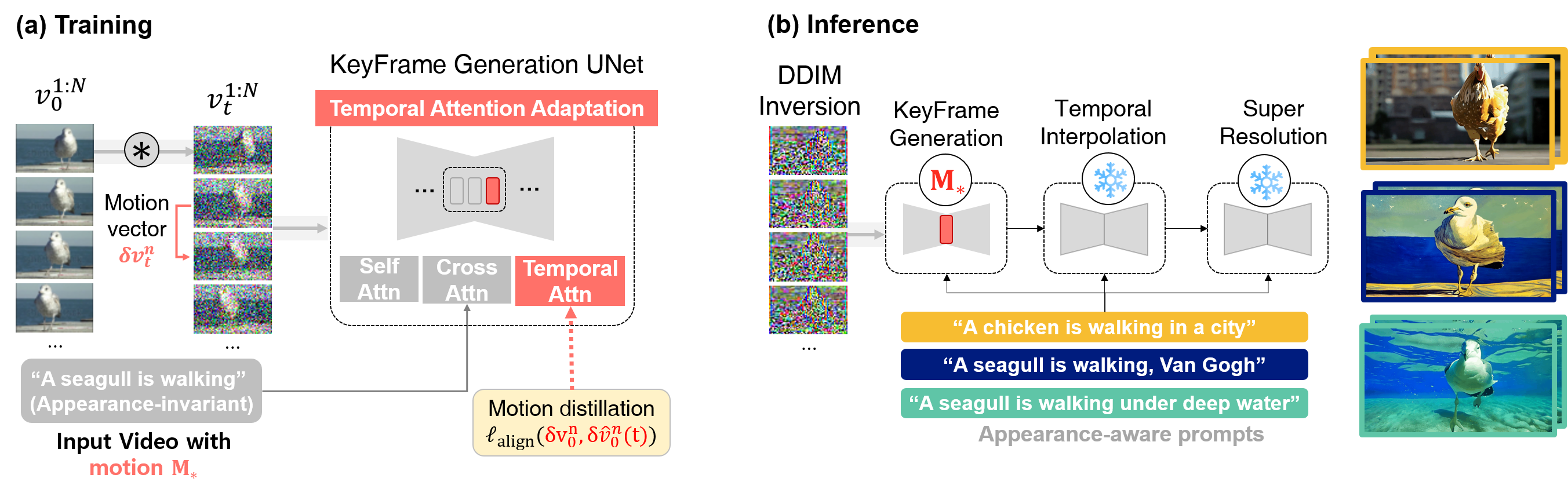
Another technique, which can even be implemented without training, is to modify the model's self-attention mechanism. Text2Video-Zero proposes a clever trick:
- During the generation of frame
k, instead of letting its features attend to other features within the same frame (Q_kattends toK_k), you force it to attend to the features of the first frame (Q_kattends toK_1).
This simple change forces the model to constantly refer back to the first frame for information about object appearance, identity, and shape, dramatically improving consistency.
4. Implementation: Improving Consistency at Inference Time with FreeInit
So far, we've discussed architectural changes and training strategies. But what if you want to improve the temporal consistency of an existing video model without retraining it? This is where FreeInit comes in. It's a training-free method that works at inference time.
The Problem FreeInit Solves: In diffusion models, generation starts from random noise, z_T. For video, we typically start with a batch of independent noise tensors, one for each frame. This independence can cause the model to generate slightly different structures or textures in each frame, leading to high-frequency flickering.
The FreeInit Solution: FreeInit iteratively refines the initial noise to make it more temporally correlated. In simplified terms, it works like this:
- Initial Pass: The model generates a low-quality video using a few sampling steps.
- Noise Filtering: It analyzes the frequency spectrum of the initial noise (
z_T) that produced this video. It applies a low-pass filter (like a Butterworth filter) to the noise in the frequency domain. This smooths the noise, removing the high-frequency components that often cause flicker. - Iteration: It uses this "smoothed" noise as a new starting point and runs the full generation process.
This process essentially "pre-conditions" the initial noise to encourage a more temporally smooth output, all without touching the model's weights.
The best part is that libraries like diffusers have made this extremely easy to implement.
Text-to-Video Generation with AnimateDiff
The AnimateDiff documentation also has an excellent section on FreeInit, including a direct code implementation.
Read the section 'Using FreeInit'. Pay close attention to the code example and the comparison image showing the output with and without it enabled. This is our key implementation for this lesson.
As you can see from the resource, applying FreeInit is as simple as calling a single method on your pipeline object before running inference.
Here is the core logic in Python using the diffusers library:
import torch
from diffusers import MotionAdapter, AnimateDiffPipeline, DDIMScheduler

# 1. Load your base model and motion adapter as usual
adapter = MotionAdapter.from_pretrained("guoyww/animatediff-motion-adapter-v1-5-2")
model_id = "SG161222/Realistic_Vision_V5.1_noVAE"
pipe = AnimateDiffPipeline.from_pretrained(model_id, motion_adapter=adapter).to("cuda")

# Configure a compatible scheduler
pipe.scheduler = DDIMScheduler.from_config(pipe.scheduler.config, beta_schedule="linear")

# 2. Enable FreeInit with a single line of code
# Key parameters:
# - num_iters: How many times to refine the noise. More is slower but often better.
# - method: The type of filter to use ('butterworth' or 'gaussian').
pipe.enable_free_init(
    num_iters=4,
    use_fast_sampling=True,
    method='butterworth'
)

# 3. Run inference as you normally would
output = pipe(
    prompt="a panda playing a guitar, on a boat, in the ocean, high quality",
    num_frames=16,
    num_inference_steps=25,
    generator=torch.Generator("cuda").manual_seed(42),
)

# 4. (Optional but recommended) Disable it after use if you plan to reuse the pipeline
pipe.disable_free_init()

frames = output.frames[0]
# ... save frames to a gif or mp4
This snippet demonstrates a complete, practical implementation for improving temporal consistency. The enable_free_init call is the key takeaway, providing a powerful, "free" quality boost at the cost of slightly increased inference time.
Conclusion
In this lesson, we demystified temporal consistency and explored the diverse range of techniques used to achieve it. You now understand how to build, adapt, and refine video models to produce smooth, coherent, and believable motion.
Key Takeaways:
- Temporal consistency is a core challenge in video generation, distinct from just generating high-quality individual frames.
- Architectural solutions often rely on factorizing spatio-temporal processing, using separate layers for within-frame (spatial) and across-frame (temporal) computation.
- Modular approaches like AnimateDiff are highly effective, injecting learned motion priors into powerful frozen text-to-image models.
- Attention mechanisms can be manipulated, for example with cross-frame attention, to enforce object identity and appearance over time.
- Inference-time techniques like FreeInit offer a powerful, training-free way to improve video quality by refining the initial noise distribution, and are simple to implement.
Preview of the Next Lesson:
We have now covered generating, fine-tuning, and ensuring the quality of AI-generated videos, including for specialized and NSFW content. This power brings with it significant responsibility. In our next lesson, we will pivot from the "how" to the "should we," as we analyze the ethical and legal considerations surrounding generated media. We'll discuss deepfakes, copyright, and the societal impact of these powerful technologies.