Hello! Welcome to the next lesson in our journey through generative AI.
In the previous lessons, we delved into the world of large language models, exploring how to fine-tune them for uncensored output and how to apply "jailbreaking" techniques to bypass the safety filters of closed, black-box models. Today, we pivot back to the visual domain, moving from text to the significantly more complex challenge of video generation.
This lesson directly addresses the learning outcome: Implement a text-to-video generation model using a diffusion-based approach.
Given the complexity of training such models from absolute scratch, our focus will be on understanding the core architectural principles and diving into a detailed implementation walkthrough. You'll learn how the concepts from our earlier modules on Diffusion Models, VAEs, and the Transformer architecture are extended and combined to create motion. We will explore the two dominant architectural families for this task—3D U-Nets and Diffusion Transformers—and analyze how they are implemented in code.
1. The Challenge of Generating Video
Generating a video is not as simple as generating a sequence of images. A video has a crucial temporal dimension that introduces significant new challenges.
So you think you know Text to Video Diffusion models?
To begin, let's watch a brief segment from the video 'So you think you know Text to Video Diffusion models?' by Neural Breakdown with AVB. It provides an excellent overview of the unique difficulties in video generation compared to image generation.
Watch the first 3 minutes and 30 seconds of the video. Pay close attention to the three main challenges it outlines.
As the video explains, the primary hurdles are:
- Temporal Consistency: Objects, characters, and backgrounds must remain coherent and behave realistically across frames. A model can't just generate a series of high-quality but disconnected images.
- Computational Demand: A single second of video can contain 16, 24, or even more frames. This dramatically increases the amount of data the model must process and generate compared to a single image, leading to a massive spike in computational and memory requirements.
- Data Scarcity: High-quality, large-scale datasets of video clips paired with accurate text descriptions are far rarer and more expensive to create than text-image pairs. This forces researchers to find clever ways to leverage existing image datasets and unlabeled video data.
To tackle these challenges, two main architectural paradigms have emerged, both extending the diffusion models we've already studied: 3D U-Nets and Diffusion Transformers. Let's explore how each is implemented.
2. The U-Net Approach: Extending into the Third Dimension
The U-Net architecture is the workhorse of most popular image diffusion models, like Stable Diffusion. The most intuitive way to adapt it for video is to "inflate" its 2D operations to handle 3D data (time, height, width).
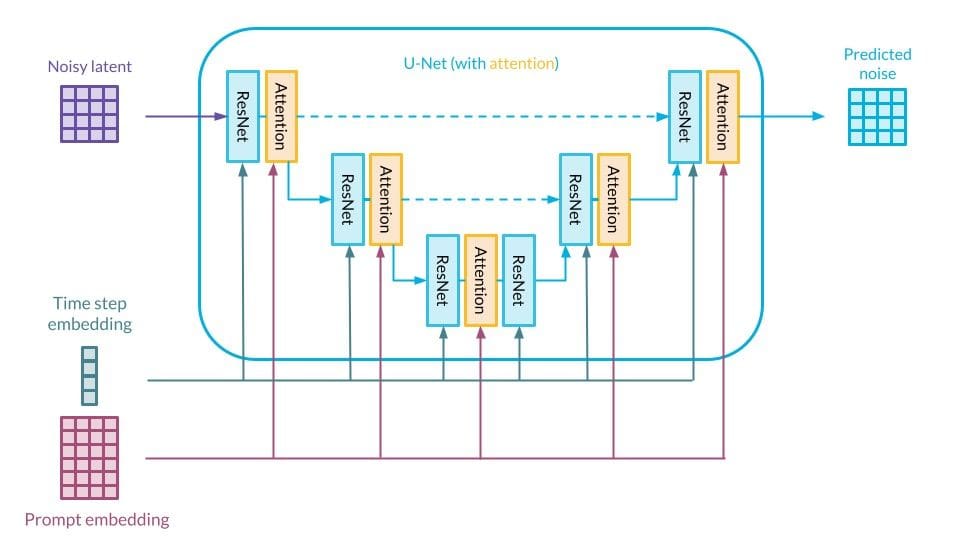
The core ideas behind creating a 3D U-Net for video are:
- 3D Convolutions: Replace standard 2D convolutional layers (which operate on height and width) with 3D convolutional layers that also operate across the frame/time dimension.
- Factorized Attention: A full 3D attention mechanism (where every pixel in every frame attends to every other pixel in every other frame) is computationally prohibitive. Instead, models factorize attention into two separate, more efficient steps:
- Spatial Attention: Attention is performed within each frame independently. This is the same as the attention in an image model.
- Temporal Attention: Attention is performed across the frames for each pixel location. This allows the model to gather information about motion and maintain object consistency over time.
The GitHub repository text2video-from-scratch provides a clear, from-the-ground-up implementation of this U-Net-based approach.
text2video-from-scratch GitHub Repository
Let's examine the key components of a 3D U-Net implementation. Please read the following sections from the repository's README file. Focus on understanding how the architecture is designed to handle video data.
Read the following sections: Step by Step Implementation: Get a high-level overview of the main components. Flow of our architecture: Understand the data flow from input video to output. UNet3D Block: This is the most important part. Read the explanation and carefully review the Unet3D class code. You don't need to understand every single line, but try to identify where the temporal_attn and spatial_attn are applied in the forward pass within the downsampling and upsampling blocks. Notice how it interleaves these operations.
The key takeaway from the code is how the forward method of the Unet3D class processes the video tensor x. In both the downs (downsampling) and ups (upsampling) loops, you can see a sequence of blocks being applied: a Resnet block, a spatial_attn module, and a temporal_attn module. This explicit separation of spatial and temporal processing is the standard technique for making video U-Nets computationally feasible while capturing the necessary information for coherent video generation.

3. The Transformer Approach: Video as a Sequence of Patches
While U-Nets are powerful, another class of models, inspired by the success of Vision Transformers (ViT) and models like OpenAI's Sora, uses a Transformer as the core denoising network. This approach is often called a Diffusion Transformer (DiT).
The core idea is to treat video generation as a sequence-to-sequence problem:
- Latent Space: First, an encoder (from a VAE) compresses each video frame into a lower-dimensional latent representation. This makes the subsequent steps much more computationally efficient.
- Spacetime Patching: The sequence of latent frames is broken down into non-overlapping blocks, or "patches," that cover both space and time. Think of these as small 3D cubes of the latent video.
- Transformer Processing: This sequence of spacetime patches is fed into a Transformer. Just like in an LLM, the Transformer uses self-attention to learn relationships between all the patches.
- Denoising: The Transformer is trained to predict the noise that was added to these patches. By iteratively denoising a random set of patches, it generates a clean sequence of latent patches, which can then be decoded back into video frames.
Since you're familiar with Python and Transformer architectures, we'll dive into a detailed implementation walkthrough that adapts a DiT from images to video.
Video Generation with Diffusion Transformers | Generative AI
The video 'Video Generation with Diffusion Transformers' by ExplainingAI offers an exceptionally clear and detailed code walkthrough of this process. We'll focus on the most critical parts that demonstrate the adaptation for video.
Please watch the following segments carefully: Adapting Patching for Video (03:49 - 08:43): This section explains how the input video is transformed into patches and how positional embeddings are handled. The 'uniform frame patch embedding' is the key method used. Spatial and Temporal Attention (08:43 - 12:41): This is the most crucial concept. Pay close attention to how the input tensor is reshaped before being passed to an attention layer to control whether attention is computed spatially (within a frame) or temporally (across frames). Forward Pass Implementation (36:40 - 44:06): This walkthrough of the forward method brings all the concepts together in code. Focus on the main loop where the model alternates between a 'spatial layer' and a 'temporal layer', and notice the rearrange operations that happen in between. This is the practical implementation of factorized attention in a Transformer.
The logic demonstrated in the video for handling spatial and temporal attention via tensor reshaping is a powerful and common pattern in video AI models.
To break it down:
- Let's say our data tensor has the shape
(batch_size, num_frames, num_patches, hidden_dim). - For spatial attention, we want each patch to attend to other patches within the same frame. We can achieve this by merging the batch and frame dimensions:
(batch_size * num_frames, num_patches, hidden_dim). Now, the standard self-attention mechanism will operate along thenum_patchesdimension, accomplishing our goal. - For temporal attention, we want each patch to attend to the patches at the same spatial location but in different frames. We can do this by swapping the frame and patch dimensions and then merging:
(batch_size * num_patches, num_frames, hidden_dim). Now, self-attention will operate along thenum_framesdimension.
This clever reshaping allows the use of a standard Transformer attention block to perform two very different but essential types of modeling.
Test your understanding!
Imagine you are designing a video diffusion model. You notice that objects in your generated videos seem to "forget" what they are from one frame to the next (e.g., a red car suddenly becomes blue). Which specific component of the architectures we've discussed is likely failing or needs to be strengthened, and why?
Show answer
The temporal attention mechanism is the component that needs to be addressed. Its entire purpose is to model relationships across frames. By attending to the same spatial region in previous frames, the model learns to maintain an object's identity, color, and shape over time. If a red car turns blue, it means the model isn't effectively using the temporal context from earlier frames to constrain the generation of the current frame. Strengthening the temporal attention layers or ensuring they are learning meaningful relationships would be the primary way to fix this issue of temporal inconsistency.
Conclusion
In this lesson, we've unpacked the complex task of building a diffusion-based text-to-video model. You've seen that while the challenge is significant, the solutions are elegant extensions of architectures you're already familiar with.
Key Takeaways:
- Video generation's main challenges are ensuring temporal consistency, managing high computational costs, and overcoming data scarcity.
- The 3D U-Net approach "inflates" the standard image U-Net by adding 3D convolutions and factorized spatial and temporal attention layers to process video.
- The Diffusion Transformer (DiT) approach treats video as a sequence of spacetime patches in a latent space and uses a Transformer to denoise this sequence, again relying on a separation of spatial and temporal modeling.
- A key implementation detail in both architectures is the factorization of attention, where separate mechanisms handle relationships within frames (spatial) and across frames (temporal) to make the problem tractable.
Preview of the Next Lesson:
Now that you have a solid understanding of the underlying architecture of text-to-video models, we are ready to move on to customization. In the next lesson, we will address the learning outcome: Fine-tune a video generation model for specialized or NSFW content. We will take a pre-trained model like Stable Video Diffusion and learn the techniques and workflows required to adapt it to generate specific styles, subjects, or themes not well-represented in its original training data.