Hello! Welcome to the next lesson in our final module, "Scaling Operations with Systems and People."
In our last session, we created a detailed Standard Operating Procedure (SOP). You now have the skill to document any process in your business with clarity and precision. That was the "how." Today, we tackle the "what."
The goal of this lesson is to identify key business functions suitable for delegation (e.g., customer service, social media posting). As a solo entrepreneur, your time is your most valuable asset. The key to scaling from a one-person operation to a global business is to stop doing everything yourself and start building systems that others can run. This lesson will give you a clear framework for deciding which tasks to hand off so you can focus on strategic growth.
1. The Mindset Shift: From "Doer" to "Business Owner"
When you start a business, you wear all the hats: marketer, customer service rep, bookkeeper, and fulfillment specialist. This is necessary at first, but it quickly becomes a bottleneck. To scale, you must transition from doing the work to designing the work for others to do.
Many entrepreneurs fear that outsourcing means losing control. However, when done correctly, the opposite is true. By delegating repetitive, low-value tasks, you gain the time and mental space to focus on the high-value activities that only you, the owner, can do.
Let's begin with an article that frames this challenge and introduces the core principle of effective delegation.
Outsourcing Tasks in High-Ticket eCommerce Without Losing Control
The article 'Outsourcing Tasks in High-Ticket eCommerce' from Drop Ship Lifestyle addresses the common fear of losing control and provides a simple, powerful rule for what to delegate.
Read the introduction and 'Step 1: Identify What to Outsource (and What to Keep)'. Focus on the distinction between tasks you should keep and tasks you can safely outsource. This will be our guiding principle.
The key takeaway is a simple but powerful rule:
- Keep: High-level strategy and key relationships (e.g., negotiating with suppliers, setting marketing strategy).
- Delegate: Repetitive, time-consuming execution (e.g., placing orders, answering common customer questions).
Your IT background gives you an advantage here; you can think of it as separating the core architecture of your business (which you design) from the routine scripts and processes that run on it (which you delegate).
2. Identifying Common Delegable Functions in E-commerce
Now that we have our guiding principle, let's identify the specific business functions that are prime candidates for delegation. For a dropshipping or multi-marketplace business, some tasks are almost universally the first to be outsourced.
Watch this short video to see which two tasks are most commonly delegated in a growing dropshipping business.
How To Outsource Dropshipping Tasks
In his video 'How To Outsource Dropshipping Tasks', Scott Hilse gets straight to the point about the first two things you should stop doing yourself as your business grows.
Watch from the beginning to 00:32 and then from 01:18 to 01:58. Pay attention to why he identifies order fulfillment and customer service as the two most common tasks to outsource.
As the video highlights, Order Fulfillment and Customer Service are the two biggest time sinks in a growing e-commerce business. They are repetitive, process-driven, and critical to get right, which makes them perfect candidates for an SOP and a virtual assistant (VA).
Beyond these two, many other functions can be delegated. This chart shows the common distribution of tasks delegated to virtual assistants across various industries.

These categories can be broken down into specific e-commerce tasks:
-
Operations & Fulfillment:
- Processing daily orders with suppliers.
- Updating tracking numbers in Walmart Seller Central, Amazon, etc.
- Managing returns and exchanges.
- Monitoring inventory levels.
-
Customer Service:
- Answering pre-sale questions via email or chat.
- Responding to "Where Is My Order?" (WISMO) inquiries.
- Managing marketplace customer support cases.
- Responding to comments on social media posts.
-
Marketing & Social Media:
- Basic video editing for TikTok and other platforms.
- Scheduling and posting content.
- Researching trending sounds and hashtags.
- Outreach to potential affiliate or influencer partners.
-
Administrative & Research:
- Basic product research based on your criteria.
- Competitor price monitoring.
- Data entry (e.g., logging sales in a spreadsheet).
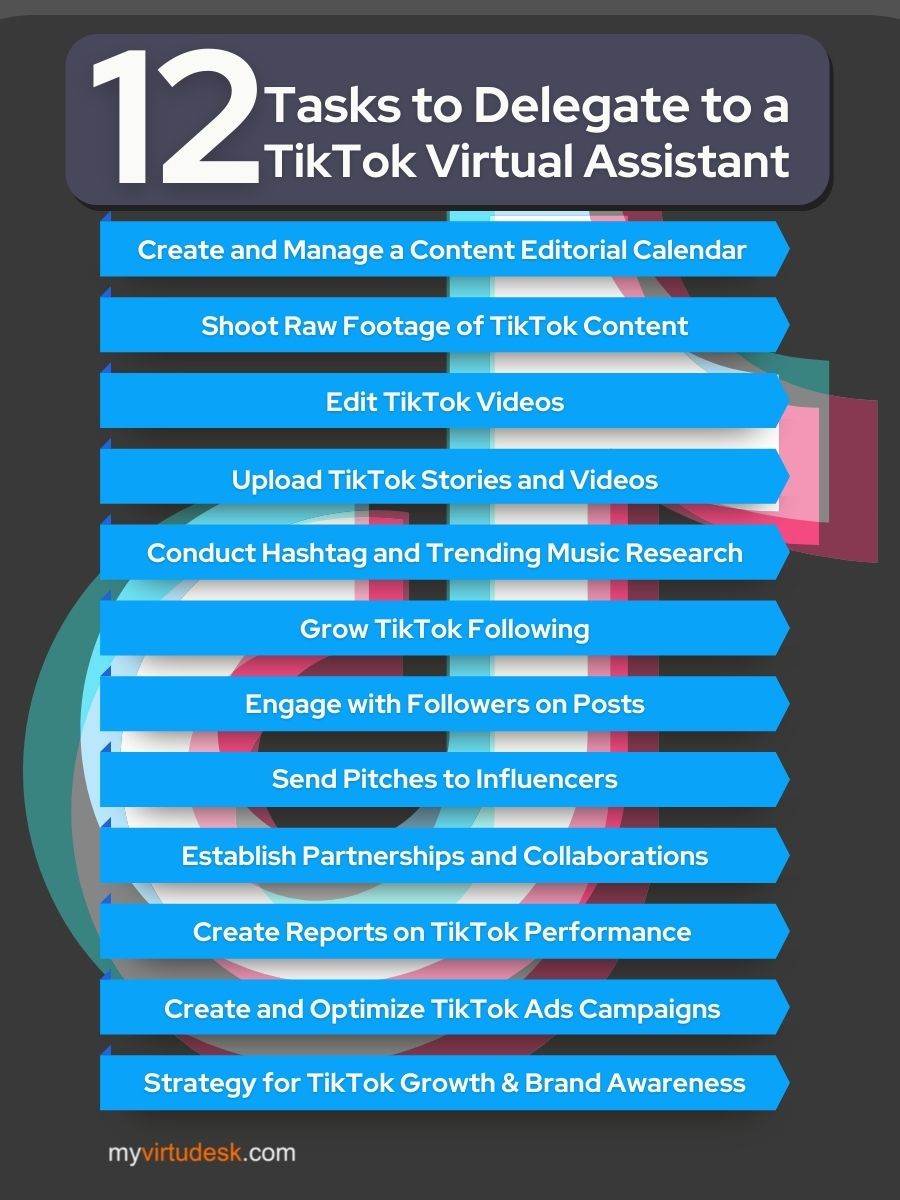
Since you're focusing on TikTok Shop, here is a specific list of tasks you could delegate to a "TikTok VA."
3. A Framework for Auditing Your Business
To systematically identify what to delegate, it's helpful to categorize all your business activities. The following article provides an excellent three-pillar framework specifically for managing a TikTok Shop in the US market, which aligns perfectly with your goals.
Master TikTok Shop Management USA the Smart Way
The article 'Master TikTok Shop Management USA the Smart Way' from EliteEcomHub offers a powerful framework for organizing your business functions. This will help you see your business as a system of interconnected parts, making it easier to identify what to delegate.
Read the sections 'The “Management Trap” Reframed: What Should You Control?' and 'Management Audit: Is your system silently failing you?'. Study the three-pillar table and answer the self-audit questions for your planned business.
The three pillars give you a way to structure your thinking:
- Compliance & Operations Engine: The back-end mechanics of your business (fulfillment, returns, compliance).
- Content & Community Hub: The front-end brand building and customer engagement (videos, comments, collaborations).
- Data & Growth Center: The strategic analysis that drives decisions (analytics, ads, profitability).
By asking the audit questions from the article, you can pinpoint weaknesses that can be solved through better systems and delegation. For example, if you find yourself manually updating inventory every day, that's a clear sign that the task belongs in the "Operations Engine" and should be automated or delegated.
4. The Keep vs. Systematize vs. Outsource Model
Now, let's put it all together into a final, actionable model. The most effective entrepreneurs don't just delegate; they also systematize and automate. Given your IT background, this approach of building efficient, automated systems where possible will be a natural fit.
The same article provides a clear breakdown.
Master TikTok Shop Management USA the Smart Way
Let's revisit 'Master TikTok Shop Management USA the Smart Way' for its final, crucial piece of advice on how to categorize every task in your business.
Read the section 'The Hybrid Management Model: What you should keep vs. systematise vs. outsource'. This provides a clear, practical model for deciding the fate of any task.
This hybrid model is your blueprint for scaling:
| Action | What it Includes | Examples |
|---|---|---|
| Keep In-House | Core strategy, brand voice, and final decisions. The things that define your unique value. | Deciding which products to sell, setting the overall marketing budget, negotiating with your top supplier. |
| Automate/Systematize | Repetitive, rule-based tasks that can be handled by software. | Using a tool to sync inventory across Amazon, Walmart, and TikTok. Setting up automated email sequences for new subscribers. |
| Outsource | Tasks that require human intelligence but are repetitive and follow a procedure (an SOP!). | First-line customer service, daily order processing, basic video editing, managing social media comments. |
Test your understanding!
Imagine you are running your e-commerce business. For each task below, decide if you would Keep, Automate/Systematize, or Outsource.
- Responding to a "Where Is My Order?" email.
- Deciding whether to expand your business to the UK market.
- Posting three pre-edited videos to TikTok at scheduled times each day.
- Finalizing a contract with a new major supplier from China.
Show answer
- Outsource. This is a classic, repetitive customer service task that is perfect for a VA following an SOP.
- Keep. This is a major strategic decision that requires your oversight as the business owner.
- Automate/Systematize. You can use a social media scheduling tool (like Buffer, Later, or TikTok's native scheduler) to do this. You don't need to pay a person to click "post" at a specific time.
- Keep. Negotiating key supplier relationships is a high-level strategic function that you should retain control over.
Conclusion
You have now learned how to shift your mindset from a "doer" to a "delegator" and have a practical framework for analyzing your business. By identifying which functions to keep, which to automate, and which to outsource, you are building the foundation for a scalable, remote, and ultimately more profitable e-commerce operation.
Key Takeaways:
- Delegate Execution, Retain Strategy: Your primary role is to work on the business, not in the business. Outsource repetitive tasks to free up your time for growth.
- Start with the Biggest Time Sinks: Order fulfillment and customer service are the most common and impactful functions to delegate first.
- Use the Three-Pillar Framework: Categorize your tasks into Operations, Content, and Data to identify areas for improvement.
- Think Hybrid (Keep, Systematize, Outsource): Not every task needs a person. Use automation where possible and reserve your own time and your team's time for what matters most.
Next Up:
Now that you know what functions to delegate, the next step is to find the right person for the job. In our next lesson, we will draft a job description for a remote virtual assistant focused on e-commerce operations, turning your delegation plan into an actionable hiring document.