Hello! Welcome to your next lesson in our final module, "Scaling Operations with Systems and People."
In our last session, we designed the master blueprint: a standardized template for your Standard Operating Procedures (SOPs). This template is the key to ensuring every process in your business is documented with clarity and consistency, which is essential for building and managing a remote team.
Today, we move from design to action. The goal of this lesson is to create a detailed SOP for one critical daily task, such as order processing or customer service response. You will take the template we built and apply it to a real-world e-commerce process, creating the very first page in your company's "operations manual." This is a foundational skill for delegating work and scaling your business effectively.
1. Choosing Your First SOP: Start with a Critical Task
Before writing, you need to decide what to document. A common mistake is to try to document everything at once or to start with an obscure, rarely-performed task. The best place to start is with a process that is either performed very frequently or is absolutely critical to your business operations.
7 Steps to Write Standard Operating Procedures that ACTUALLY Work
In this video, '7 Steps to Write Standard Operating Procedures that ACTUALLY Work', the presenter gives excellent advice on how to choose a topic for your first SOP. This will help us focus our efforts.
Watch from 01:03 to 02:00. Pay attention to the advice on picking topics that are immediately helpful and frequently performed. This ensures the SOPs you create provide immediate value and are actually used.
For a global e-commerce business like the one you're building, two tasks immediately come to mind:
- Order Processing: The daily task of taking a customer's order from a marketplace and placing it with your supplier. This is the core engine of a dropshipping business.
- Customer Service: Responding to the most common customer question: "Where Is My Order?" (WISMO).
For this lesson, we will focus on Order Processing, as it's a perfect example of a multi-step, critical daily task.
2. The Anatomy of an "Order Processing" SOP
Let's use the template we created in the last lesson to build an SOP for "How to Process a Dropshipped Order from Walmart." We will assume you have a fictional supplier called "Global Goods Inc."
Here is an overview of the entire e-commerce fulfillment process we'll be documenting a part of. Our SOP will cover the steps from receiving the order to shipping it.

Step 1: Define the Boundaries (Start and End Points)
A great SOP has a clear beginning and end. This prevents confusion and scope creep.
- Start Trigger: A new, paid order appears in your Walmart Seller Center account.
- End Point: The order has been placed with the supplier, and the tracking number has been entered back into Walmart Seller Center.
Step 2: Populate the SOP Template
Now, let's fill in each section of our template for this specific task.
- SOP Title: How to Process a Dropship Order from Walmart
- SOP ID:
FUL-001(FUL for Fulfillment) - Version:
1.0 - Owner: E-commerce Manager
- Effective Date: [Today's Date]
- Next Review Date: [Date 3 months from now]
-
1. Purpose: To ensure all dropshipped orders from Walmart Marketplace are accurately and promptly placed with our supplier (Global Goods Inc.) within 24 hours of receipt, initiating the fulfillment process.
-
2. Scope: This procedure applies to all standard, paid orders on Walmart Seller Center being fulfilled by Global Goods Inc. It does not cover Amazon FBA orders, orders fulfilled by other suppliers, or the handling of returns and refunds (see
CUST-002). -
3. Roles & Responsibilities:
- Performer: Virtual Assistant (VA) - Executes the step-by-step procedure.
- Accountable: E-commerce Manager - Responsible for the overall success of order fulfillment and for updating this SOP.
-
4. Inputs & Materials (What you need to start):
- Login credentials for Walmart Seller Center.
- Login credentials for the Global Goods Inc. supplier portal.
- Access to the shared credit card information for placing orders (e.g., via a password manager).
-
5. Outputs & Success Metrics (What "done" looks like):
- Order successfully placed on the Global Goods Inc. portal.
- Confirmation of payment to the supplier.
- Order status in Walmart Seller Center updated with the supplier's order number.
- Success Metric: Order processing time (from receipt in Walmart to placement with supplier) is less than 24 hours.
Step 3: Write the Step-by-Step Procedure
This is the core of the SOP. We will use a hierarchical format to keep it organized. Remember to use action verbs and be precise.
6. Step-by-Step Instructions:
Part 1: Verify Order in Walmart Seller Center
1.1. Navigate to Walmart Seller Center and log in.
1.2. Click on Orders in the main navigation menu.
1.3. Identify a new order with the status "Unshipped."
1.4. Copy the customer's full name, shipping address, and the SKU of the product ordered. (Tip: Use a dual-monitor setup or split-screen to make this easier).
Part 2: Place Order on Supplier Portal
2.1. Open a new browser tab and navigate to the Global Goods Inc. supplier portal. Log in.
2.2. Use the search bar to find the product by pasting the SKU copied from Walmart.
2.3. Click "Add to Cart."
2.4. Proceed to checkout.
2.5. In the shipping information fields, paste the customer's name and address. Double-check that the address is correct.
2.6. Select the standard shipping option.
2.7. Enter the shared credit card information to pay for the order.
2.8. Confirm and place the order.
2.9. Copy the new supplier order number (e.g., GG-12345).
Part 3: Update Order in Walmart Seller Center
3.1. Return to the order details page in Walmart Seller Center.
3.2. Click Update Order or a similar button.
3.3. In the "Notes" or "Supplier Order ID" field, paste the supplier order number (GG-12345). This helps track the order internally.
3.4. Save the changes. The status may remain "Unshipped" until you add tracking later.
For a professionally formatted example of a more complex order processing SOP, you can explore the following resource. It provides a link to a Google Docs template you can copy and adapt.
Standard Operating Procedures (SOPs) - SullyGarman
The article 'Standard Operating Procedures (SOPs)' from SullyGarman provides links to real-world e-commerce SOP templates. This is a great way to see how professional operators structure their documents.
In the section 'Order Processing', click the link titled '(SOP for Order Receipt)'. This will prompt you to make a copy of a Google Doc. Review the structure of this document. Notice its level of detail, covering monitoring, verification, and communication. This is a great example of a mature SOP.
3. Using AI to Accelerate SOP Creation
Given your IT background, you can appreciate how AI can dramatically speed up the documentation process. Instead of writing everything from scratch, you can record yourself performing the task and let AI create the first draft.
The process is simple:
- Record: Use a screen recording tool (like Loom, Camtasia, or OBS) to record yourself silently going through the entire order processing task.
- Transcribe: Use an AI tool to transcribe your actions. Some tools can transcribe video directly. A simple way is to narrate your clicks, get the video's audio transcript, and use that.
- Prompt: Feed the transcript to an AI like ChatGPT to generate the SOP.
This video demonstrates the exact workflow.
How to build Standard Operating Procedures (SOPs) using ChatGPT (for FREE)
This video, 'How to build Standard Operating Procedures (SOPs) using ChatGPT', shows a fantastic, practical method for turning a screen recording into a written SOP.
Watch from 00:45 to 03:00. The presenter uses a Chrome plugin called Glasp to get a video transcript, but the key takeaway is the process: record a video, get the text, and use a simple prompt in ChatGPT to generate a step-by-step procedure. This is the 'hack' to avoid writer's block.
Here’s a sample prompt you could use with ChatGPT after getting a transcript of your actions:
"You are an expert at creating Standard Operating Procedures for e-commerce businesses. Based on the following transcript of actions, write a detailed, step-by-step SOP titled 'How to Process a Dropship Order from Walmart.'
Organize it into a hierarchical format with three main parts: 1. Verify Order in Walmart, 2. Place Order with Supplier, 3. Update Walmart Order.
Start each step with a bolded action verb (e.g., Navigate, Copy, Paste). The final output should be clear enough for a remote virtual assistant with no prior experience to follow.
[Paste your transcript here]"
Important: The AI-generated text is a first draft. You must review it for accuracy, edit it for clarity, and add your own screenshots and annotations. The AI does the heavy lifting, but the human owner provides the final polish and verification.
4. Alternative Example: Customer Service SOP
The same principles apply to creating an SOP for customer service. Let's look at a template for handling a customer inquiry.
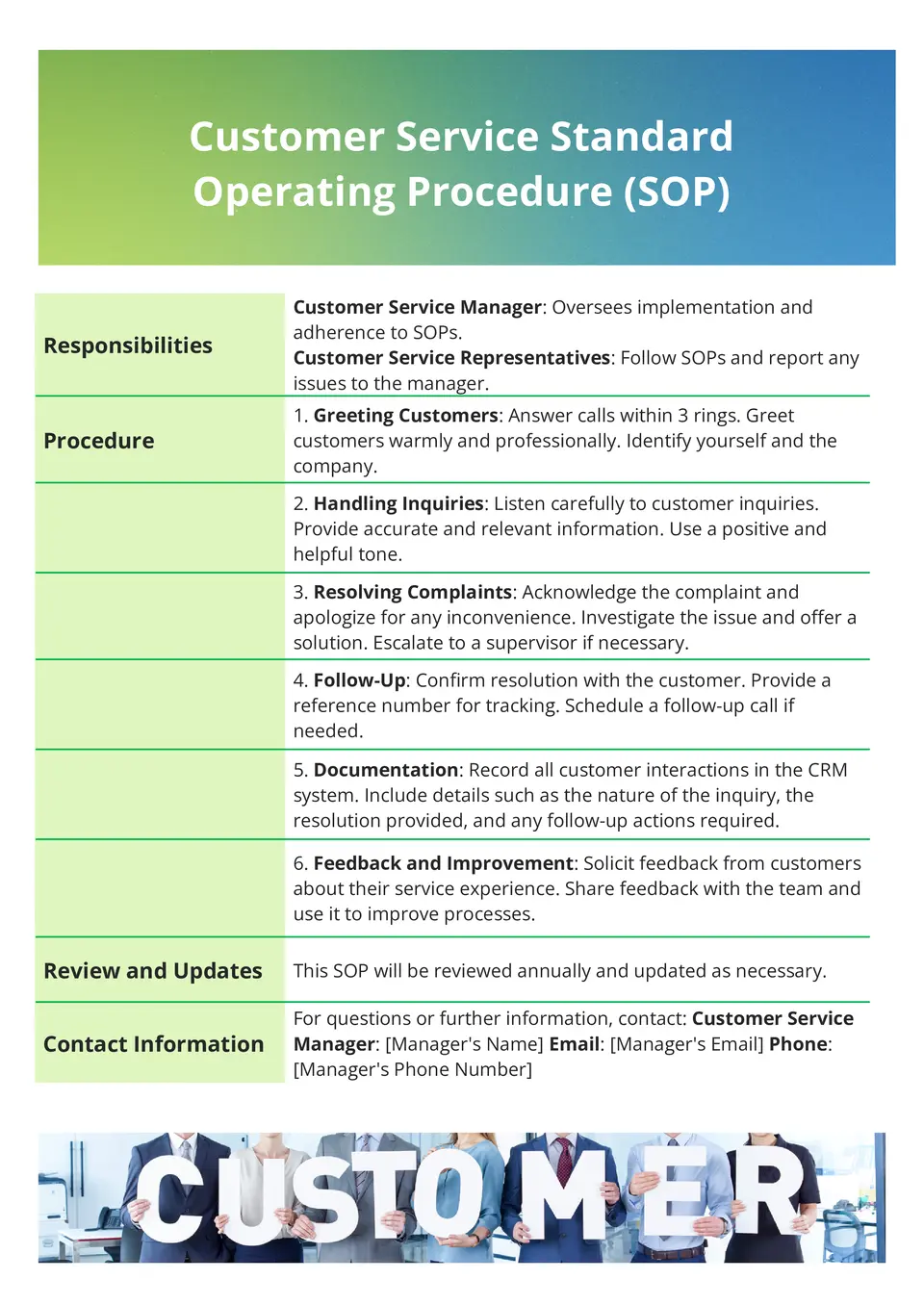
For a "Where Is My Order?" (WISMO) request, the procedure might look like this:
- Locate the order in the marketplace (Walmart/Amazon) using the customer's name or order ID.
- Find the tracking number associated with the order.
- Check the status on the carrier's website (e.g., UPS, FedEx).
- Respond to the customer using a pre-written template, providing the tracking link and current status.
- Document the interaction in your customer service log.
Test your understanding!
Imagine you need to create an SOP for a different critical task: "Adding a New Product to Walmart Marketplace."
Using the template structure, what would you write for the Purpose and what are three essential items you would list under Inputs & Materials?
Show answer
- Purpose: To ensure all new products are listed on Walmart Marketplace with accurate information, optimized content, and correct pricing, making them available for sale to customers.
- Inputs & Materials:
- Login credentials for Walmart Seller Center.
- The product's SKU, title, description, and price.
- High-quality product images (meeting Walmart's specifications).
(Other good answers could include the product's weight and dimensions, UPC/GTIN, and inventory quantity.)
Conclusion
Congratulations! You've just walked through the practical steps of creating your first detailed SOP. This document is more than just instructions; it's a valuable business asset that enables consistency, quality control, and delegation.
Key Takeaways:
- Start with Critical Tasks: Document high-frequency or high-impact processes first to get the most immediate benefit.
- Structure is Everything: Use the standardized template to ensure every SOP is comprehensive, covering purpose, scope, roles, inputs, outputs, and a clear procedure.
- Be Precise: A great SOP is unambiguous. Define clear start and end points, and use action-oriented language.
- Leverage AI: Use screen recordings and AI transcription/drafting to accelerate the creation process, but always perform a final human review.
Next Up:
Now that you know how to create a detailed SOP for a task, the next logical question is: which tasks should I delegate? In our next lesson, we will identify key business functions suitable for delegation, helping you decide where to focus your systemization efforts to free up your time for strategic growth.