
Welcome back. In the previous lesson, you classified samples as pure substances or mixtures by counting the different particle types present. The key idea was that one repeated type of particle represents a pure substance, even if each particle contains several kinds of atom.
This lesson makes the next distinction: Is that pure substance an element or a compound? You will learn to decide from both a particle diagram and a chemical formula. By the end, you should be able to justify an answer with precise evidence such as “only one atom type is present” or “two different elements occur in a fixed ratio.”
Two kinds of pure substance
An element is a pure substance made from one type of atom only. Copper, helium, oxygen, and iron are elements.
A compound is a pure substance made from two or more different elements chemically bonded together in a fixed ratio. Water and carbon dioxide are compounds.
The decisive question is not “Are the particles joined?” It is:
How many types of atom are present in each particle or repeating structure?
| If the sample contains... | It is a... | Example |
|---|---|---|
| One atom type only | Element | Oxygen, |
| Two or more atom types chemically bonded in a fixed ratio | Compound | Water, |
| More than one substance present | Mixture | Oxygen gas and hydrogen gas together |
Notice an important consequence: bonded atoms do not automatically mean a compound. Two oxygen atoms bonded together form , but both atoms are oxygen. It is still an element.
Reading particle arrangements
In particle diagrams, colours, sizes, or patterns stand for different elements. The colours are just a model convention; real atoms are not coloured spheres. Treat every repeated cluster or repeating pattern as evidence about composition.
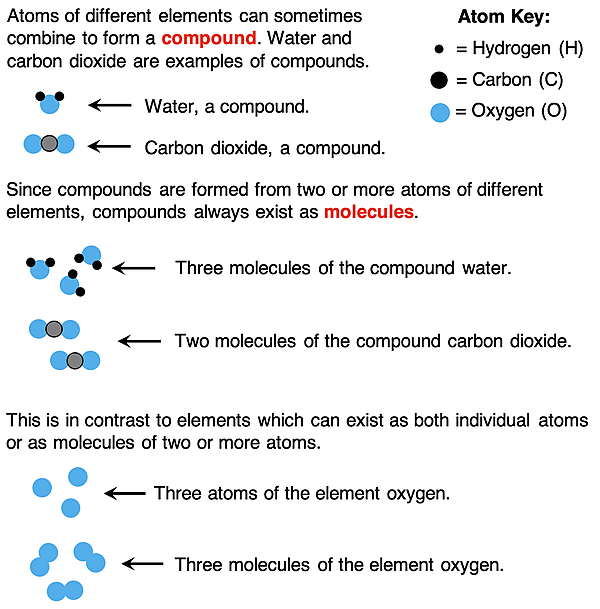
Element diagrams
A diagram represents an element if every atom shown is the same type.
This can look like either of these:
- Separate identical atoms, such as individual helium atoms.
- Groups made entirely of identical atoms, such as pairs of oxygen atoms in .
The second case is often confusing. A pair of same-coloured spheres touching represents a molecule, because it is a bonded group of atoms. But it remains an elemental molecule, not a compound, because it contains only one kind of atom.
Compound diagrams
A diagram represents a compound if different atom types are bonded together in the same fixed arrangement throughout the sample.
For example:
- Each water particle has two hydrogen atoms and one oxygen atom.
- Each carbon dioxide particle has one carbon atom and two oxygen atoms.
If every cluster is the same, the whole sample is a pure compound. The fact that there are two colours does not make it a mixture: the different atoms are chemically joined into one repeated particle.
A compound does not always appear as separate little clusters. Some compounds form a large repeating lattice rather than individual molecules. In a sodium chloride lattice, sodium and chlorine occur in a regular repeating arrangement. It is still one pure compound because the two elements occur in a consistent ratio throughout the material.
Compounds and chemical formulas | Middle school chemistry | Khan Academy
Watch “Compounds and chemical formulas” from Khan Academy to see the central distinction: different elements chemically joined make a compound, while a molecule containing only one element remains an element.
Watch compound examples for water and carbon dioxide, paying attention to the fixed atom arrangements. Then watch the oxygen case: it directly addresses why \mathrm{O_2} is an element rather than a compound. Finally, watch formula reading to connect the diagrams to chemical formulas and subscripts.
Chemical formulas: a compact composition code
A chemical formula uses element symbols and subscripts to show which atoms occur in a substance and their ratio.
Read a formula in two passes:
- Count the different element symbols.
- Read the number attached to each symbol. A missing subscript means one atom of that element.
For example:
| Formula | Atoms represented | Classification | Why |
|---|---|---|---|
| one iron atom type | Element | Only Fe appears. | |
| two oxygen atoms | Element | Only O appears. | |
| two H and one O | Compound | H and O are different elements. | |
| one C and two O | Compound | C and O are different elements. | |
| sodium and chlorine in a ratio | Compound | Na and Cl are different elements. | |
| one C and four H | Compound | C and H are different elements. |
The subscript applies only to the symbol immediately before it:
- means one carbon and one oxygen.
- means one carbon and two oxygen atoms.
Those formulas describe different compounds with different compositions. A formula is therefore not merely a name or label; it represents a particular fixed ratio of atoms.
Formula rule for this lesson
Use this reliable shortcut:
- One element symbol: element.
- Two or more different element symbols: compound.
Thus, is an element even though it has a subscript, because there is only the symbol . In contrast, is a compound because it includes both and .
Learn and try: Molecules, compounds, and chemical formulas (article) | Khan Academy
Read Khan Academy’s “Molecules, compounds, and chemical formulas” to reinforce the difference between elemental molecules, molecular compounds, crystalline compounds, and their formulas.
In the opening section, read the explanation of molecules and the paragraph beginning same element molecules. This is the basis for classifying \mathrm{O_2} as an element. Then read the section “Molecular and crystalline compounds,” especially the passage beginning crystal lattices, so you do not assume that every compound consists of separate molecules. Finish with the section “Chemical formulas show the ratios.” Start with the comparison of carbon monoxide and carbon dioxide, including why ratios matter, and read through the zinc bromide example. Focus on what each subscript says about atom ratios.
A classification routine that works
When a question gives you a particle diagram, proceed carefully:
- Identify the different atom types using the diagram key, colours, sizes, or patterns.
- Decide whether the atoms are arranged as identical groups or one repeating lattice.
- Count the atom types in one group or in the repeating pattern.
- Classify it:
- one atom type: element;
- two or more atom types bonded in a fixed pattern: compound.
When a question gives you a chemical formula:
- Locate the capital letters. Each capital letter begins an element symbol.
- Count the number of different element symbols.
- Ignore subscripts temporarily while making the element-versus-compound decision.
- Use the subscripts afterward to state the atom ratio.
For instance, take :
- The symbols are , , and .
- There are three different elements.
- Therefore it is a compound.
- Its formula shows a ratio of , which can be simplified to .
A strong response always includes evidence:
“This is an element because every particle contains only one type of atom, even though the atoms occur in pairs.”
“This is a compound because each repeated particle contains two different types of atom chemically bonded in a fixed ratio.”
Avoiding the three most common errors
1. “It has two atoms, so it must be a compound.”
Not necessarily. has two atoms, but both are oxygen. It is an element.
What matters is the number of atom types, not the total number of atoms.
2. “It has two colours, so it must be a mixture.”
Not necessarily. Identical red-and-white bonded groups throughout a diagram represent a pure compound. A mixture has two or more different substances present as separate particle types.
3. “Every compound is a molecule.”
Many familiar compounds, including water and carbon dioxide, are molecular. However, compounds such as sodium chloride form extended lattices. The broad definition to remember is more reliable:
A compound contains different elements chemically combined in a fixed ratio.
Key takeaways
- Both elements and compounds are pure substances.
- An element contains one type of atom. It may consist of individual atoms or molecules such as .
- A compound contains two or more different atom types chemically bonded in a fixed ratio.
- In a particle diagram, identify atom types first; then look for identical bonded groups or a repeating lattice.
- In a formula, one distinct element symbol means an element, while two or more distinct element symbols mean a compound. Subscripts show the number or ratio of atoms.
Next, you will return to mixtures and learn how to distinguish homogeneous mixtures from heterogeneous mixtures using observable evidence.
Can't find a good explanation? Sign up and we'll make it for you
Sign up