
Welcome back. In the last lesson, you learned that mixtures contain more than one substance, while pure substances are elements or compounds with a fixed composition. You also saw why two colours in a particle diagram do not automatically mean “mixture”: the atoms may be chemically bonded into one pure compound.
Now assume that a sample is already known to be a mixture. The next question is whether its components are spread evenly or remain in visibly different regions. By the end of this lesson, you will be able to classify mixtures as homogeneous or heterogeneous and justify your choice from observations such as layers, particles, boundaries, and uniform appearance.
The central idea: uniform or non-uniform?
A homogeneous mixture has a uniform composition throughout. Every small sample taken from it has essentially the same composition. Its components are evenly distributed, so you cannot distinguish separate parts by ordinary observation. Homogeneous mixtures are also called solutions.
A heterogeneous mixture has a non-uniform composition. Different parts of the sample have different compositions, and you can often observe separate components, layers, particles, or boundaries.
| Type of mixture | Composition | Observable evidence | Examples |
|---|---|---|---|
| Homogeneous | Uniform throughout | Appears as one continuous material or phase; no visible boundaries between components | Salt water, air, brass, ink |
| Heterogeneous | Varies from place to place | Visible pieces, layers, sediment, or boundaries between regions | Oil and water, sand and water, salad, granite |
The words themselves provide a useful reminder:
- Homo- means “same”: the mixture looks and behaves consistently throughout.
- Hetero- means “different”: different regions or components can be distinguished.
The important evidence is not whether the mixture contains solids, liquids, or gases. A mixture can be homogeneous in any state:
- Air is a homogeneous mixture of gases.
- Salt water is a homogeneous liquid mixture.
- Brass is a homogeneous solid mixture of metals, mainly copper and zinc.
Likewise, a heterogeneous mixture can contain solids and liquids, as in sand and water, or several solids, as in a salad.
Homogeneous and Heterogeneous Mixtures Examples, Classification of Matter, Chemistry
Watch Homogeneous and Heterogeneous Mixtures Examples, Classification of Matter, Chemistry from The Organic Chemistry Tutor for a compact visual introduction to the classification rule and several familiar examples.
Begin with the definitions, focusing on the connection between uniform composition and indistinguishable components. Then watch the examples, especially salt water, oil and water, brass, sand and water, air, and salad. Finish with the summary, which states the visual decision rule clearly.
Observable evidence: what should you look for?
When classifying an everyday sample, begin by inspecting it carefully. Evidence for a heterogeneous mixture includes:
-
Separate visible pieces
A trail mix contains nuts, raisins, and chocolate pieces. The components remain identifiable. -
Layers
Oil and water form two distinct liquid layers. The boundary between them shows that the liquids have not mixed uniformly. -
Sediment
In a container of sand and water, sand settles at the bottom. A sample near the bottom differs from a sample near the top. -
Different regions or colours
Granite has visibly different mineral grains. A salad has recognizably different ingredients. These are not uniform from point to point. -
Particles suspended in another material
If solid particles can be seen floating in or settling through a liquid, the sample is generally heterogeneous.
In contrast, observable evidence for a homogeneous mixture is that the sample appears consistent throughout:
- Salt dissolved fully in water produces one liquid phase; you do not see separate salt crystals.
- Food colouring mixed thoroughly in water gives a uniform colour rather than coloured streaks.
- Ink appears uniform because its components are distributed so evenly that they cannot be distinguished by eye.
- A piece of brass looks like one solid material, not separate copper and zinc regions.
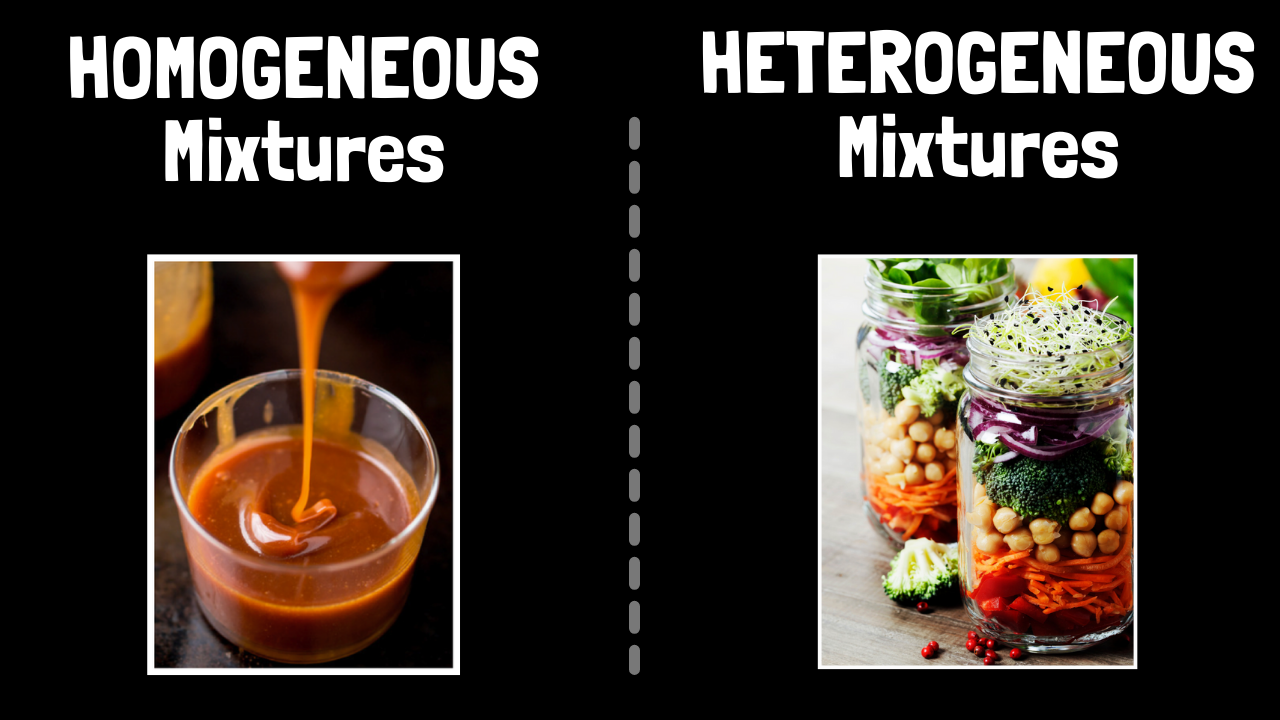
The image captures the practical rule well: the caramel sauce appears as a single, uniform material, whereas the salad has obvious components and separate regions. In a science question, state the observation before the classification:
“The salad is a heterogeneous mixture because its ingredients are visibly separate, so its composition is not uniform.”
“The salt water is a homogeneous mixture because it appears as one uniform liquid with no visible salt particles or layers.”
One phase or more than one phase?
A useful scientific term here is phase: a physically distinct, uniform region of matter.
- A glass of fully dissolved salt water has one visible phase.
- A container of oil and water has two visible phases: an oil layer and a water layer.
- Sand in water has a liquid phase and a solid region of sand.
For the level of observation used in this course, the following is a strong classification routine:
| What you observe | Most likely classification |
|---|---|
| One uniform-looking material, with no visible components or boundaries | Homogeneous mixture |
| Two or more visibly distinct regions | Heterogeneous mixture |
| Solid particles that settle out | Heterogeneous mixture |
| Recognizable ingredients or grains | Heterogeneous mixture |
There is one vital limit to this rule: a uniform appearance alone does not prove that something is a mixture. Distilled water and pure copper can each look uniform, but they are pure substances, not homogeneous mixtures.
Therefore, follow the order you have learned across the module:
- Decide whether the sample is a pure substance or a mixture.
- If it is a mixture, decide whether its composition is uniform or non-uniform.
- Use observations to justify the result.
For example, a clear sample labelled “salt water” is known to contain water and dissolved salt, so it is a mixture. Because it is uniform and has no visible separate salt, it is a homogeneous mixture. A clear piece of copper is not classified as homogeneous merely because it looks uniform: copper is an element, so it is a pure substance.
1.2 Phases and Classification of Matter - Chemistry 2e | OpenStax
Read the relevant part of OpenStax Chemistry 2e to connect the visual evidence you use in class with the more precise idea of composition varying from point to point.
In the “Mixtures” discussion, first read the paragraph beginning the heterogeneous examples. Focus on why different drops of Italian dressing can have different compositions. Then continue immediately to the next paragraph, from the homogeneous comparison. Notice that “uniform throughout” does not mean every homogeneous mixture must contain exactly the same amount of each ingredient as every other batch; it means one sample is uniform within itself.
Compare closely related examples
Some pairs are especially helpful because they contain similar substances but classify differently.
Salt water and sand water
Both samples contain a solid mixed with water. The difference is what happens after mixing.
- In salt water, salt dissolves and becomes evenly distributed. No separate salt crystals are visible in a properly mixed sample. This is homogeneous.
- In sand water, sand does not dissolve. Sand grains remain visible and often settle. This is heterogeneous.
Thus, “solid + liquid” is not enough information for classification. You must observe whether the solid remains a distinct component.
Oil and water versus alcohol and water
- Oil and water form visible layers because they do not mix uniformly. This is heterogeneous.
- Rubbing alcohol and water can form one uniform liquid phase. This is homogeneous.
Again, the state of matter does not decide the category. The deciding feature is uniform distribution.
Brass versus granite
Both are solids.
- Brass is a uniform alloy. Its main components, copper and zinc, are evenly distributed on the observable scale. It is homogeneous.
- Granite contains visibly different minerals, often appearing as differently coloured grains. It is heterogeneous.
This comparison prevents another common mistake: a mixture does not need to be liquid to be homogeneous or heterogeneous.
Writing a strong scientific justification
Avoid answers that merely name the category. Show the evidence and connect it to composition.
A reliable sentence frame is:
“This is a homogeneous/heterogeneous mixture because ________, showing that its composition is uniform/non-uniform throughout.”
Here are model answers:
| Sample | Weak answer | Evidence-based answer |
|---|---|---|
| Oil and water | “Heterogeneous because it has oil.” | “Oil and water are a heterogeneous mixture because two separate layers and a boundary are visible, showing a non-uniform composition.” |
| Air | “Homogeneous because it is gas.” | “Air is a homogeneous mixture because its gases are evenly distributed and no separate components are visible.” |
| Salad | “Heterogeneous because it looks different.” | “A salad is heterogeneous because the ingredients remain visibly separate, so different parts have different compositions.” |
| Ink | “Homogeneous because it is black.” | “Ink is homogeneous because it appears uniform throughout and its components cannot be distinguished by eye.” |
Be precise with the word visible. You do not have to identify every component by name. If the observation says there are layers, grains, or a boundary, that is sufficient evidence of a heterogeneous mixture. If the observation says the sample is evenly coloured and appears as one phase, that supports a homogeneous-mixture classification—provided the sample is known to contain more than one substance.
Common classification traps
“It is clear, so it must be homogeneous.”
Clear appearance can support a homogeneous classification, but it is not conclusive by itself. A clear material might be a pure substance. First establish that it contains multiple substances.
“It has more than one ingredient, so it must be heterogeneous.”
All mixtures contain two or more substances. If those substances are evenly distributed, the mixture is homogeneous. Salt water and air each contain several substances but are homogeneous.
“A heterogeneous mixture must have layers.”
Layers are strong evidence, but they are not required. A salad, granite, and chocolate-chip cookie are heterogeneous even without liquid layers, because their parts are visibly distinct.
“Homogeneous means only liquids.”
No. Homogeneous mixtures may be gases, liquids, or solids. Air, salt water, and brass demonstrate all three states.
“Stirring always makes a mixture homogeneous.”
Stirring may temporarily distribute components, but it does not necessarily dissolve or mix them at the particle level. Sand stirred into water still eventually settles, and oil stirred into water eventually separates into droplets or layers. It remains heterogeneous.
A concise decision method
Use this whenever a question asks you to distinguish the two mixture types:
- Confirm it is a mixture. Look for stated ingredients, multiple particle types, or information that more than one substance is present.
- Inspect its appearance. Look for visible components, boundaries, layers, grains, or sediment.
- Decide whether composition is uniform.
- Uniform throughout: homogeneous.
- Different from place to place: heterogeneous.
- State evidence in your answer. Name the observation and explain what it shows about distribution.
The core distinction is simple but powerful:
A homogeneous mixture looks like one uniform material; a heterogeneous mixture has visibly different parts or regions.
Key takeaways
- A homogeneous mixture has a uniform composition and appears as one phase; its components cannot be distinguished by ordinary observation.
- A heterogeneous mixture has a non-uniform composition, often shown by layers, particles, sediment, visible pieces, or boundaries.
- Salt water, air, ink, and brass are common homogeneous mixtures.
- Oil and water, sand and water, salad, and granite are common heterogeneous mixtures.
- First distinguish a mixture from a pure substance; uniform appearance alone does not establish that a material is a homogeneous mixture.
- A complete classification includes both the category and observable evidence.
Next, you will shift from classifying kinds of matter to describing their properties, learning to distinguish physical properties from chemical properties.
Can't find a good explanation? Sign up and we'll make it for you
Sign up