
Hello! Welcome to your final lesson in the module "Leveraging Predictive Analytics for Performance."
In our last lesson, you learned how to critique the deliverables of an internal data science project. You developed a framework for asking the tough questions that connect a custom-built predictive model to real business value. Now, we'll extend that critical mindset to the world of commercial AI-powered marketing tools.
As a marketing leader, you will constantly be pitched new AI software promising revolutionary results. Your ability to see past the hype and evaluate these tools strategically is a crucial skill. This lesson will equip you to evaluate the strategic fit of AI-powered marketing tools based on their underlying predictive models. You'll learn how to assess whether a tool is a "shiny new toy" or a genuine strategic asset that will help you drive growth.
1. The Challenge: From Glass Box to Black Box
When critiquing an internal project, you can collaborate with the data science team to understand the model's inner workings—it's a "glass box." With commercial AI tools, you're often dealing with a "black box." The vendor's model is proprietary, and you can't see the code, the training data, or the exact algorithms.
Your task is not to reverse-engineer the tool, but to develop a robust evaluation framework that allows you to "interrogate" the tool and its vendor to determine if it's the right fit for your strategy. The five-question framework from our last lesson is still your guide, but we'll adapt it for this new context.
2. A Strategic Framework for AI in Marketing
Before you even look at a specific tool, you need a way to think about the role of AI in your marketing strategy. A powerful way to categorize AI capabilities is by the type of "intelligence" they provide.
A strategic framework for artificial intelligence in marketing
The academic paper 'A strategic framework for artificial intelligence in marketing' by Huang and Rust provides an excellent, non-technical model for this. They classify AI into three types based on the tasks they perform. Understanding this will help you match the right kind of AI to the right marketing problem.
Please read the section 'Conceptual foundation' starting on page 2. Focus on the definitions of the three AI intelligences: Mechanical AI, Thinking AI, and Feeling AI, and the unique benefit each provides (standardization, personalization, relationalization).
Let's summarize this powerful framework:
- Mechanical AI (For Standardization): Automates repetitive, routine tasks. Its benefit is consistency and efficiency.
- Marketing Example: Automating the scheduling of social media posts or tracking ad spend in a report.
- Thinking AI (For Personalization): Processes data to recognize patterns, make predictions, and inform decisions. This is where most "predictive models" live. Its benefit is personalization and optimization at scale.
- Marketing Example: A product recommendation engine, a lead scoring model, or a platform like Google's Smart Bidding that predicts conversion probability.
- Feeling AI (For Relationalization): Analyzes and responds to human emotions and interactions. Its benefit is creating more natural and empathetic customer relationships.
- Marketing Example: A sentiment analysis tool that monitors brand mentions on Twitter, or an advanced chatbot that can understand user frustration.
Most modern tools are a blend of these, but they usually have a dominant intelligence. Identifying this is the first step in evaluating strategic fit. If your problem is inconsistent reporting, you need Mechanical AI. If your problem is poor ad targeting, you need Thinking AI.
3. A Step-by-Step Guide to Evaluating AI Tools
Now, let's combine this conceptual understanding with a practical, step-by-step process for evaluating a potential new tool for your marketing stack.
Step 1: Start with Your Strategy, Not the Tool
The most common mistake is getting excited about a tool's features before defining the problem it's supposed to solve.
The Ultimate AI Marketing Stack for 2025: Tools, Strategies ...
The blog post 'The Ultimate AI Marketing Stack for 2025' provides a great guide for this strategic-first approach. Let's review its foundational framework for AI implementation.
Please read the section 'Foundation: Align AI with Marketing Strategy'. Focus on the three steps: Define Clear Business Outcomes, Assess Current Capabilities and Gaps, and Establish Success Metrics.
Before you even agree to a demo, answer these questions:
- Business Outcome: What specific goal are we trying to achieve? (e.g., "reduce customer churn by 10%," "increase content production by 50%").
- Capability Gap: What is preventing us from achieving this now? (e.g., "Our team can't manually identify at-risk customers," "Our writers can't keep up with content demand").
- Success Metric: How will we know if the tool is working? (e.g., "a lift in retention rate in an A/B test," "hours saved per week").
Step 2: Select a Tool Based on Fit, Not Features
Once you have a clear problem definition, you can start evaluating potential solutions. The goal is to find a tool with the right "intelligence" and capabilities for your specific need.
How to Pick the Right AI Foundation Model
This video from IBM Technology offers a simple, six-stage framework for selecting an AI model. This same logic applies perfectly to selecting a commercial AI tool.
Please watch from 0:52 to 2:02 to understand the six stages. Then, watch from 2:58 to 5:37 to see how they evaluate models based on characteristics like accuracy, reliability, and speed. Think about how you would ask a vendor about these factors.
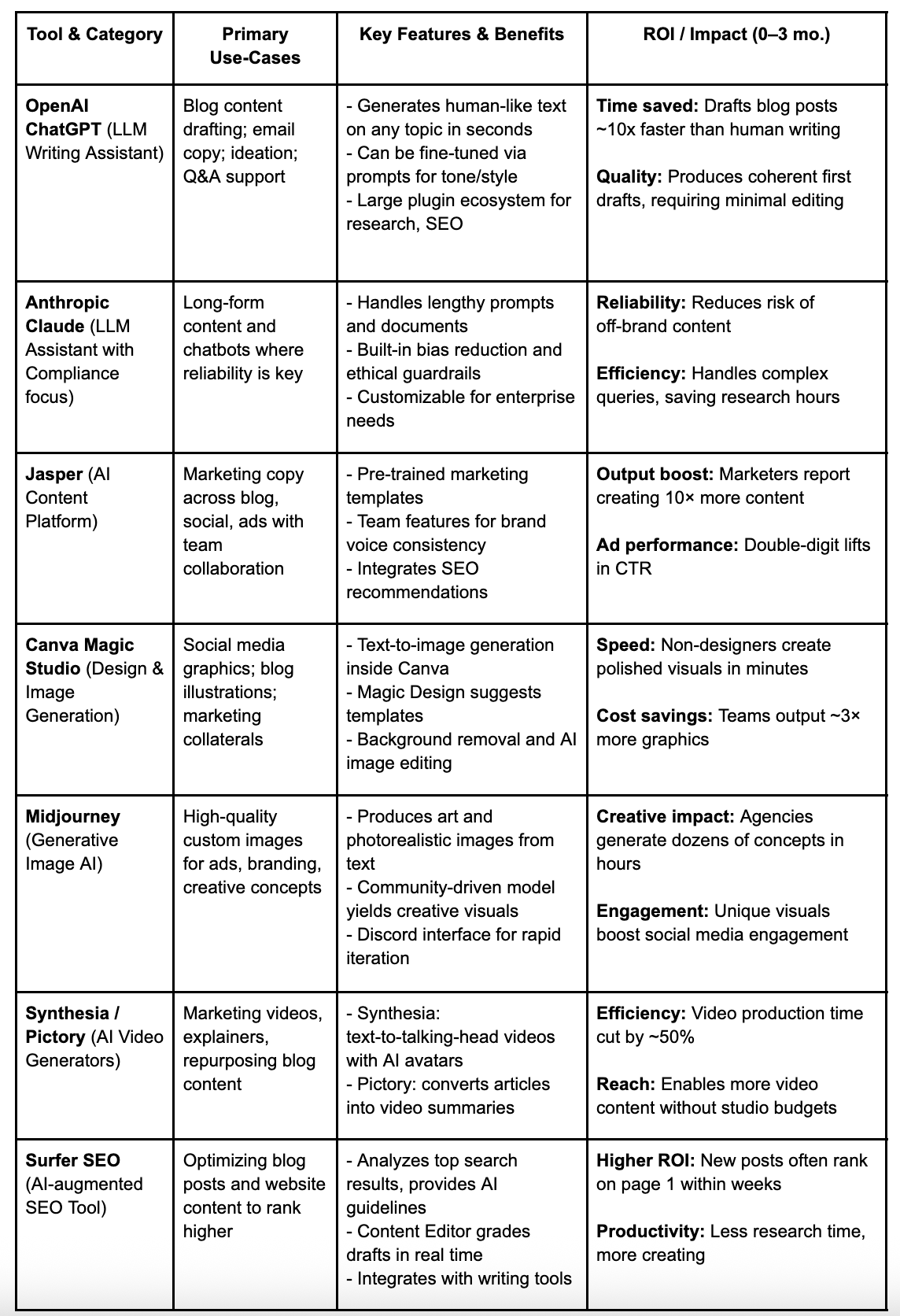
Drawing from these resources, here are the key criteria for your evaluation:
- Dominant Intelligence: Is this tool primarily Mechanical, Thinking, or Feeling AI? Does that match your problem?
- Performance:
- Accuracy: How correct are its predictions or outputs? Ask the vendor for case studies with measurable results (e.g., "improved conversion rate by X%").
- Reliability: Is it consistent? Can you trust its outputs? How does it handle bias? (This links back to our previous lesson on model risks).
- Speed: How quickly does it deliver results? Is it fast enough for real-time applications like ad bidding?
- Ease of Use & Human Oversight:
- How intuitive is the interface for your team?
- Crucially, where does human strategy fit in? A good tool should augment, not abdicate, your team's judgment.
Step 3: Assess the Integration Advantage
A powerful tool that operates in a silo is often less valuable than a less powerful one that integrates seamlessly into your workflow. Data silos are a major cause of failure for marketing tech investments.

The Ultimate AI Marketing Stack for 2025: Tools, Strategies ...
Let's revisit 'The Ultimate AI Marketing Stack for 2025' to understand why integration is so critical.
Please read the section 'Beyond Lists: Why Integration Matters More Than Individual Tools'. Pay close attention to 'The Cost of Disconnected Tools' and 'The Integration Advantage'.
Your key strategic questions here are:
- Data Flow: How does this tool get the data it needs? How does it pass its outputs to other systems? Does it have native APIs for our CRM (e.g., Salesforce), ad platforms (Google/Meta), and CDP?
- Workflow: How much manual effort is required to move information in and out of this tool?
- Total Cost of Ownership: What is the cost beyond the license fee, including implementation, training, and maintenance?
Test your understanding!
A vendor pitches you a new generative AI tool that creates "hyper-personalized" ad copy. They show you a demo where it generates 100 different ad variations in seconds. Using the frameworks from this lesson, what are three critical questions you should ask them?
Show answer
Here are three excellent questions that go beyond the surface-level demo:
- Integration Question (Thinking AI/Mechanical AI): "How does this tool integrate with our ad platforms like Google Ads and Meta Ads? Can it automatically push these 100 variations into campaigns, or is that a manual export/import process? How does it get performance data back to know which variations are working?" (This assesses the integration advantage and avoids a disconnected tool).
- Underlying Model/Reliability Question (Thinking AI/Feeling AI): "How do we train the model on our brand's unique voice and tone to ensure the copy isn't generic? What safeguards are in place to prevent the AI from generating off-brand or inappropriate content?" (This probes the "black box" and the need for human oversight).
- Strategic Fit/Business Outcome Question: "Our main goal is to improve ROAS, not just generate more copy. Do you have case studies showing how clients have used this tool to achieve a measurable lift in conversion rates or return on ad spend, not just an increase in creative output?" (This ties the tool's feature back to a core business outcome).
4. The Human-AI Balance
Finally, a core part of evaluating strategic fit is understanding how a tool will change the way your team works. The goal of AI is not to replace your talented marketers but to amplify their strategic and creative capabilities.
What Will Happen to Marketing in the Age of AI? | Jessica Apotheker | TED
In this TED talk, Jessica Apotheker discusses the future of marketing in the age of AI. She makes a crucial point about the need to balance the 'left-AI brain' (analytics) with the 'right-brain' (creativity).
Please watch from 5:02 to 7:06 and from 8:27 to 10:06. Notice the distinction she makes between using AI to unpack performance and the danger of over-relying on it for creative origination. This is the central tension you must manage as a leader.
When evaluating a tool, ask:
- Does this tool automate the tedious, repetitive work (Mechanical AI) so my team can focus on strategy?
- Does it provide insights and predictions (Thinking AI) that help my team make smarter decisions?
- Does it empower my creative team with new ideas, or does it risk making our brand sound generic and just like everyone else?
A tool with a great strategic fit is one that strikes the right balance, enhancing your team's capabilities without undermining their unique human strengths.
Conclusion
You are now equipped with a robust, multi-layered framework for evaluating AI-powered marketing tools. Instead of being swayed by flashy demos, you can lead a structured, strategic assessment to determine if a tool is a genuine asset or a costly distraction.
Key Takeaways:
- Start with strategy, not the tool. Define your business problem and success metrics first.
- Categorize the AI's intelligence: Is it primarily for Standardization (Mechanical), Personalization (Thinking), or Relationalization (Feeling)?
- Evaluate on multiple fronts: Assess the tool's performance, its integration capabilities, and the total cost of ownership.
- Prioritize the human-AI balance: The best tools amplify your team's strategic and creative strengths, they don't replace them.
- An integrated stack is the goal: A cohesive system where tools communicate is far more valuable than a collection of powerful but disconnected point solutions.
Preview of the Next Module:
This lesson concludes our module on Leveraging Predictive Analytics. You've learned how to commission, critique, and now evaluate predictive models in various forms.
In our next lesson, we will begin a new module, "Strategic Channel and Bidding Management." We'll start by applying the skills you've just learned to two of the most powerful and opaque AI systems you use every day. The lesson will explain how platform algorithms (e.g., Google Smart Bidding, Meta Advantage+) work at a strategic level. You'll learn to treat these platforms not as simple tools, but as complex AI partners that you need to manage strategically.