
Hello! Welcome to your second lesson.
In our previous session, you successfully built your personal penetration testing lab. You now have the "where"—a safe, controlled environment to practice and hone your skills. Today, we turn our attention to the "how." A professional penetration tester or bug bounty hunter doesn't just randomly try to hack things; they follow a structured, repeatable process.
This lesson addresses the learning outcome: Describe the phases of a penetration testing methodology (e.g., PTES, OSSTMM). We'll explore why having a methodology is the defining characteristic of a professional, and we'll break down the key phases of industry-standard frameworks. Understanding this strategic blueprint is the first step in learning to think like an attacker.
1. Why a Methodology is Your Most Important Tool
Before we dive into specific frameworks, let's establish why a methodology is non-negotiable. In your computer science studies, you likely learned about software development lifecycles (SDLC) like Agile or Waterfall. These frameworks bring order, predictability, and quality control to the complex process of building software.
A penetration testing methodology serves the exact same purpose for security assessments. It transforms hacking from a chaotic art into a disciplined science. The following video from HackerSploit provides an excellent explanation of its importance.
Penetration Testing Bootcamp - Penetration Testing Methodologies
Watch this video to understand why a formal methodology is crucial for any serious security professional. Pay close attention to the analogy of an aircraft's landing checklist.
Watch from 00:33 to 04:54. Focus on the core arguments for using a methodology: achieving consistent, reliable, and comprehensive results.
To summarize the key points, a formal methodology ensures your testing is:
- Comprehensive: It provides a framework to ensure you don't miss critical steps or entire areas of a target's attack surface.
- Consistent & Repeatable: It guarantees that you (or another tester) could perform the same test and achieve similar, reliable outcomes. This is vital for verifying fixes and tracking security posture over time.
- Professional & Defensible: It provides a clear, documented plan that justifies your actions and forms the basis of your final report. It's the difference between a professional engagement and unauthorized hacking.
2. The Core Frameworks: PTES, NIST, and OSSTMM
Several established methodologies and standards guide the work of security professionals. While they share common principles, they have different focuses. For your career, the Penetration Testing Execution Standard (PTES) is one of the most practical and widely recognized.
The following article from DeepStrike provides an excellent overview of the landscape and a detailed breakdown of PTES.
Penetration Testing Methodology 2025: Complete Guide
This article, 'Penetration Testing Methodology 2025', distinguishes professional methodologies from simple checklists and details the phases of PTES. It's written from a practitioner's perspective.
Please read the following sections: 'Penetration Testing Methodology' (the introduction), 'Beyond the Checklist: What is a Real Pentesting Methodology?', and 'The Penetration Testing Execution Standard (PTES): The Practitioner's Choice'. Focus on understanding the seven phases of PTES.
The 7 Phases of PTES
As you read in the article, PTES breaks down an engagement into seven distinct phases. This structure will form the backbone of your own testing process.
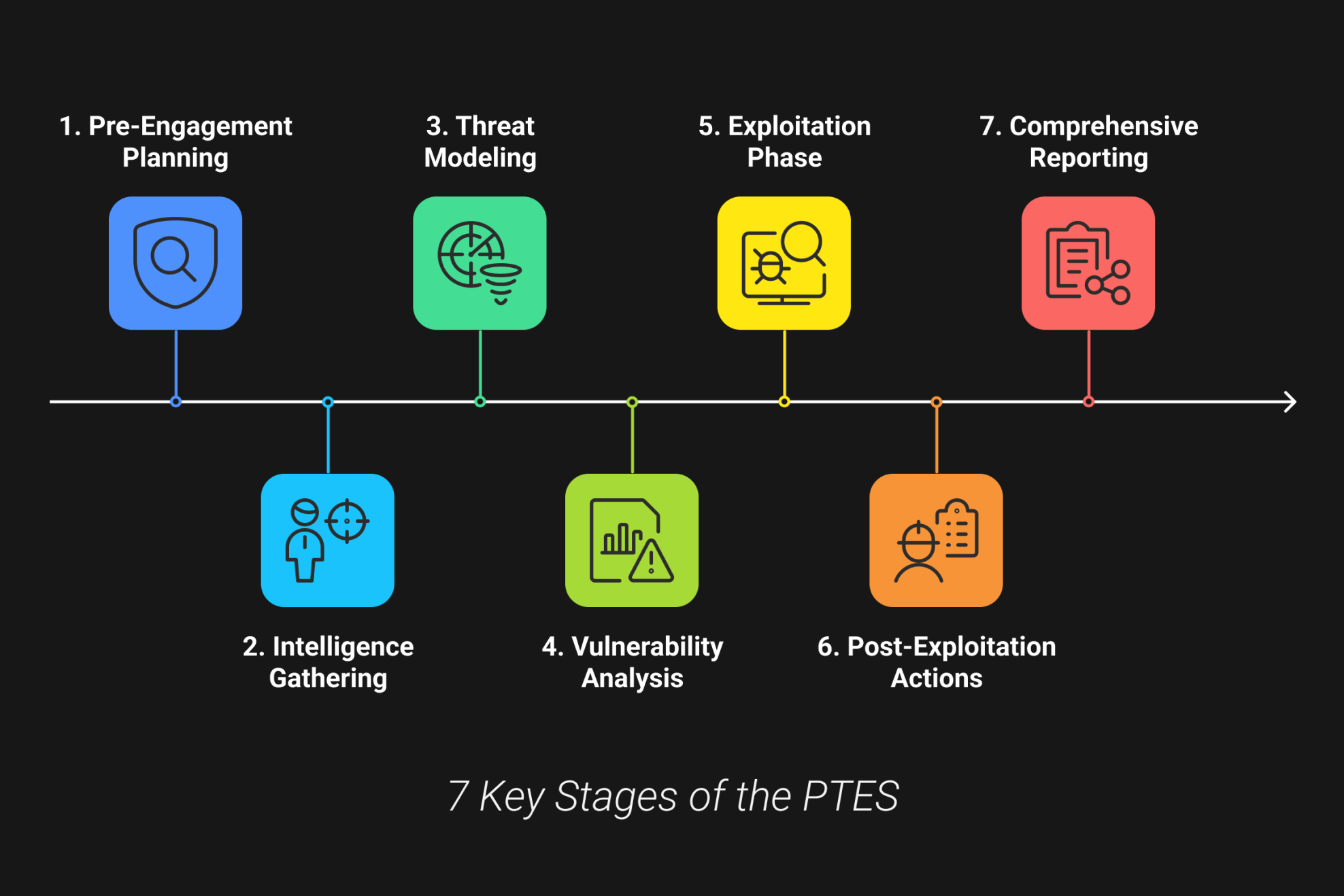
The seven phases are:
- Pre-Engagement Interactions: The most critical business phase. This involves defining the scope, goals, and "Rules of Engagement" (RoE). Most importantly, this is where you get explicit written authorization to perform the test.
- Intelligence Gathering: Passively and actively collecting information about the target to identify potential entry points. This is also known as reconnaissance or OSINT (Open-Source Intelligence).
- Threat Modeling: Analyzing the gathered intelligence to identify the most likely attack paths and prioritize targets based on business risk.
- Vulnerability Analysis: Using automated scanners and manual techniques to discover potential vulnerabilities in the target's systems.
- Exploitation: Actively attempting to leverage a discovered vulnerability to gain access. This is the phase most people think of as "hacking."
- Post-Exploitation: The "So what?" phase. Once you have a foothold, you explore what an attacker could actually do: escalate privileges, move laterally to other systems, or access sensitive data.
- Reporting: The final, and arguably most important, phase. Here, you document your findings, explain the business impact, and provide clear, actionable recommendations for remediation.
Test your understanding!
A client, eager to see results, asks you to start testing their web server immediately. They assure you the formal contract, which is currently with their legal team for review, will be signed by the end of the week. Which phase of PTES should make you pause, and why?
Show answer
The Pre-Engagement Interactions phase. This phase mandates that you must have explicit, written authorization before any testing begins. Starting without a signed contract and agreed-upon Rules of Engagement is unprofessional, legally risky, and could make you liable for any disruption or damages. A professional waits for the green light.
Other Notable Frameworks
While PTES is your practical field guide, you should be aware of other key standards.
Mastering Penetration Testing Methodology
The following article, 'Mastering Penetration Testing Methodology', provides concise definitions of several key frameworks.
Read only Section 2, 'Standards and Frameworks'. This will give you a quick summary of PTES, OWASP, NIST, and OSSTMM.
Based on your reading and to expand a bit:
- NIST SP 800-115: A more formal, documentation-heavy standard from the U.S. National Institute of Standards and Technology. It's often used in government and large enterprise environments where compliance and a detailed audit trail are paramount.
- OSSTMM (Open Source Security Testing Methodology Manual): This framework takes a broader, more holistic view. It measures operational security and includes channels beyond just data networks, such as human security (social engineering) and physical security.
- OWASP (Open Web Application Security Project): While not a full pentesting methodology, OWASP provides indispensable resources for web application security, including the OWASP Top 10 list of critical web risks and the Web Security Testing Guide (WSTG), which is the global standard for testing web apps.
As you become an expert, you won't rigidly adhere to just one methodology. You'll blend them, taking the lifecycle structure of PTES and enriching it with the technical depth of OWASP and the threat-informed approach of frameworks like MITRE ATT&CK.

3. A Practical, Consolidated Workflow
To bring this all together, let's look at a consolidated 6-step workflow that combines the best elements of these standards into a practical process you can start using. This workflow maps directly to the skills you'll be learning throughout this course.
Penetration Testing Methodology 2025: Complete Guide
Let's return to the Deepstrike.io article to see how these formal phases are applied in a typical real-world engagement.
Read the section titled 'How to Conduct a Penetration Test: A 6 Step Guide'. Notice how these steps align with the PTES phases we just discussed.
This 6-step process provides a clear map for your journey:
- Pre-Engagement & Scoping: The planning phase.
- Intelligence Gathering (Reconnaissance): You'll start doing this in the very next lesson.
- Scanning & Vulnerability Analysis: Finding the cracks.
- Exploitation: Gaining initial access.
- Post-Exploitation: Demonstrating impact and moving through the network.
- Reporting & Remediation: Delivering value.
Every practical lesson from this point forward will fit into one of these phases, giving you the skills to execute this methodology from start to finish.
Conclusion
Today you've learned the strategic framework that underpins all professional hacking. Without a methodology, a tester is just guessing. With one, they are conducting a systematic, thorough, and valuable security assessment.
Key Takeaways:
- A penetration testing methodology provides a structured, repeatable, and professional framework for security testing.
- The Penetration Testing Execution Standard (PTES) is a practical, 7-phase standard widely used by practitioners: Pre-Engagement, Intelligence Gathering, Threat Modeling, Vulnerability Analysis, Exploitation, Post-Exploitation, and Reporting.
- Other important standards include NIST SP 800-115 (for compliance/enterprise) and OSSTMM (for holistic operational security).
- In practice, you will develop a personal, hybrid methodology that blends the strengths of multiple frameworks to suit the target.
Next Lesson Preview:
You've learned the theory of the "Intelligence Gathering" phase. In the next lesson, we will put that theory into practice. You will learn how to perform passive reconnaissance using open-source intelligence (OSINT) techniques, using tools like Google Dorks and analyzing public code repositories to gather information about a target without ever directly "touching" their systems. This is the first step in every real-world attack.