Hello, and welcome to the final lesson of our course.
Over the past ten lessons, we have embarked on an intellectual journey to explore the complex landscape of justice. We began by dissecting the meta-ethical foundations of justice, distinguishing its various domains and the core tension between natural and social justice paradigms. We then traced its history, from the classical ideals of Plato and Aristotle and the natural law of Locke, through the social contract theories of Hobbes, Rousseau, and Rawls. We examined consequentialist frameworks like utilitarianism, libertarian critiques from Nozick, and then pivoted to the institutional and structural perspectives that have been a key interest for you: the balance of power in Montesquieu and Tocqueville, republican non-domination, the challenging realities of value pluralism, and the importance of procedural legitimacy.
In our last lesson, we synthesized these ideas to model two opposing societal architectures—the "mechanical" and the "organic"—analyzing how they systematically prioritize or sacrifice core values.
Today, we transition from analysis to argumentation. This capstone lesson is designed to guide you in synthesizing everything we have covered to address our final learning outcome: to formulate a reasoned argument about the 'least bad' institutional arrangements for a society of free and diverse individuals. The objective is not to find a utopian blueprint, but to construct a robust, defensible, and intellectually honest case for a particular societal architecture, acknowledging its trade-offs and potential failings.
1. The Pragmatist's Calculus: Defining Your "Least Bad"
Before designing any system, we must first define its objective function. What does "least bad" mean? As we learned from Isaiah Berlin, fundamental values can be incommensurable and irreconcilable. There is no perfect arrangement that maximizes liberty, equality, security, and prosperity for all, all the time. The task is one of pragmatic trade-offs.
A powerful framework for this kind of thinking comes from legal scholar David Kennedy, who critiques the human rights movement. While his subject is specific, his method is universal: a pragmatic, clear-eyed weighing of costs, benefits, and unintended consequences. This is the mindset required to argue for a "least bad" system.
The International Human Rights Movement: Part of the Problem?
Let's study selected sections from David Kennedy's paper, 'The International Human Rights Movement: Part of the Problem?'. His analysis provides a masterclass in the kind of pragmatic, critical thinking needed to evaluate any large-scale institutional project, including the one you are about to design.
Please read the following sections, focusing on Kennedy's method of evaluation: Start with Section I, 'THINKING PRAGMATICALLY ABOUT HUMAN RIGHTS'. Focus on his call to weigh costs and benefits in specific contexts and to evaluate projects in comparative terms. This is the core of the 'least bad' approach. Move to Section II.A, 'Human Rights Occupies the Field of Emancipatory Possibility'. Consider how any dominant framework (including your proposed one) can crowd out other valuable approaches. Then, read Section II.E, 'Human Rights Expresses the Ideology... of a Particular Western... Liberalism'. This is a crucial self-critical step: what are the hidden ideological biases of the architecture you favor? How does its 'origin story' affect its application? Finally, read Section II.J, 'Human Rights Promotion Can Be Bad Politics in Particular Contexts'. This drives home the point that no institutional arrangement is universally good; its effects are context-dependent and can even be counterproductive. Your goal is to internalize this skeptical, pragmatic lens. For any set of institutions you propose, what are the hidden costs, the crowded-out alternatives, the ideological baggage, and the contexts in which it might fail or backfire?
Applying Kennedy's pragmatic method, the first step in formulating your argument is to explicitly state your value hierarchy. For instance:
- Which values are paramount? Is it non-domination (republican liberty)? Individual autonomy (negative liberty)? Social cohesion? The promotion of human excellence (perfectionism)?
- Which values are you willing to trade off? Are you willing to sacrifice some economic efficiency for more social resilience? Some measure of equality for greater individual liberty?
- What is your primary metric of a "bad" outcome? Is it the capacity for state tyranny? The erosion of community bonds? Stagnation and lack of dynamism? The suffering of the worst-off?
Your answers to these questions will form the normative foundation of your argument.
2. Choosing Architectural Principles: From Values to Systems
Once you have defined your core values, the next step is to select the high-level architectural principles best suited to realize them. Throughout this course, we've encountered several powerful candidates. Your task is to combine them into a coherent system.
A highly structured way to think about this comes from the concept of pluralism, which you've identified as a key interest. A sophisticated legal framework for this is provided by Daniel Halberstam, who distinguishes between two types of pluralism. Your background in multi-agent systems and network theory provides a unique lens through which to appreciate this formal distinction.
National, Supranational, and Global Governance
Let's delve into Daniel Halberstam's paper 'Systems Pluralism and Institutional Pluralism in Constitutional Law'. This will provide you with a precise vocabulary to describe the architecture you want to build.
Please read the following sections: 'Introduction': This sets the stage by challenging the traditional view of constitutionalism as a closed, hierarchical system. 'Systems Pluralism' (Section III.A): Understand this as the relationship between distinct, co-existing legal systems (like the EU and its member states) that have conflicting claims to final authority but also 'mutual embedded openness' and a 'shared purpose'. This is a model for polycentric governance at a macro level. 'Institutional Pluralism' (Section III.B): This is crucial. It describes the relationship between different actors within a single system who claim authority to interpret its rules (e.g., the Madisonian model of checks and balances between the President, Congress, and the Supreme Court in the US, as opposed to a Kelsenian model with one final judicial arbiter). This is a model for implementing a balance of power internally.
Halberstam's framework allows you to be specific. Are you arguing for an architecture that features:
- Systems Pluralism? This would imply a society with multiple, overlapping jurisdictions (state, guilds, church, professional bodies) that are not neatly nested in a hierarchy, but must negotiate their boundaries. This is the modern heir to medieval constitutionalism and polycentricity.
- Institutional Pluralism? This implies that even within a single institution (like the state), you want to avoid a single "guardian of the constitution." Instead, you want competing branches to have independent interpretive authority, forcing accommodation and preventing any one branch from monopolizing power.
These pluralist principles align strongly with the republican ideal of freedom as non-domination. As a quick refresher, recall that the core of republicanism is not just preventing interference, but eliminating the capacity for arbitrary interference.
Are We Still a Free Country? The Republican Answer Might Shock You
Let's quickly revisit the core of republican freedom with the video 'Are We Still a Free Country?'. It crisply connects the principle of non-domination to the necessity of specific institutional designs.
Watch the segment from 02:32 to 04:01. It serves as a perfect summary of how the principle of non-domination translates directly into the demand for institutions like representative democracy, separation of powers, and the rule of law.
By combining principles like institutional pluralism and non-domination, you can start to form the blueprint of your "least bad" architecture.
3. The Art of Bricolage: Assembling Your Institutions
The next step is to move from abstract principles to concrete institutional arrangements. A purely idealistic or utopian model is fragile. A robust argument, in the spirit of Montesquieu, grounds its institutional design in a realistic assessment of context, culture, and human nature.
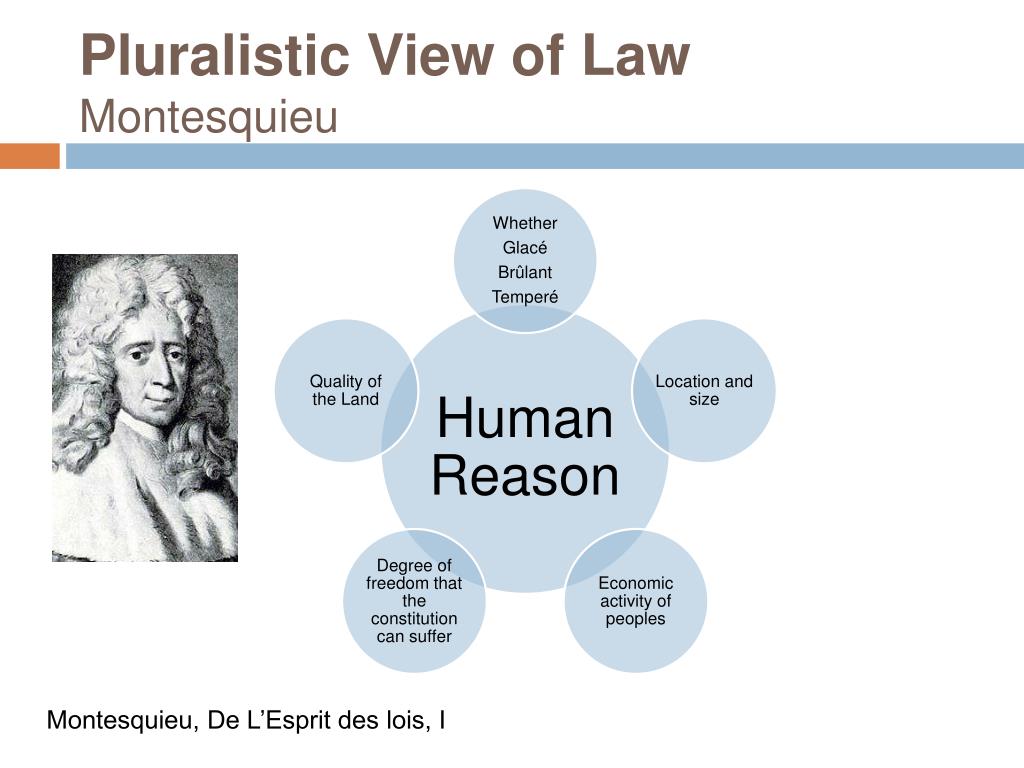
Your task is to act as a constitutional bricoleur—a tinkerer who assembles and balances proven components to fit a specific purpose.
Great Minds - Montesquieu and the Beginnings of Political Science
Let's revisit the lecture 'Great Minds - Montesquieu and the Beginnings of Political Science' to reinforce this empirical, non-utopian approach to institutional design.
Please watch two key segments: Montesquieu's Theory of the Division of Powers (29:58 - 33:46): Focus on how he saw the division of powers in England not as a perfect theoretical model, but as a practical, working system for creating an equilibrium between competing interests to preserve liberty. Influence on the American Founders (33:46 - 41:44): Pay close attention to how the American founders adopted Montesquieu's principles but had to adapt them to a new context (a large republic, not a small island). This highlights the process of pragmatic adaptation you should employ in your own argument.
Now, you can assemble your argument. For example, if your primary value is liberty as non-domination, your argument could be structured as follows:
- Thesis: The "least bad" arrangement for a free and diverse society is a Madisonian republic characterized by both institutional and systems pluralism.
- Principle 1: Institutional Pluralism. To prevent domination by the state itself, power must be divided.
- Arrangement: Adopt a Madisonian separation of powers where the executive, legislative, and judicial branches have co-equal authority to interpret the constitution within their own spheres (as per Halberstam). This creates a system of "interpretive stalemate" that forces accommodation and prevents judicial or executive supremacy.
- Principle 2: Systems Pluralism & Subsidiarity. To prevent domination by a centralized society and to foster resilience, authority must be distributed across different types of institutions at different scales.
- Arrangement: Implement the principle of subsidiarity, devolving power to the most local competent level. Foster a thick civil society of "intermediate associations" (Tocqueville) that act as buffers between the individual and the state. Formally recognize the authority of non-state institutions (e.g., professional bodies, religious organizations, private arbitration systems) in their respective domains, creating a polycentric order.
- Principle 3: Procedural Legitimacy. To handle disagreements in a diverse society, the focus must be on fair process.
- Arrangement: For areas requiring collective decision-making, utilize procedural mechanisms that favor cooperation across diversity, such as the pluralist voting systems (e.g., Quadratic Voting) we discussed in the last lesson.
This is just one example. Your own argument will depend on the values and principles you choose to prioritize.
4. Fortifying Your Argument: The Steel-Man and the Price Tag
Finally, a compelling argument for a "least bad" system must be intellectually honest about its own flaws. It must acknowledge what it is trading off—its "price tag." Here, we return to the skeptical wisdom of David Kennedy. You must apply his critique of the human rights movement to your own proposed architecture.
- What alternatives does your system "crowd out"? If you champion a system of strong local communities, does this weaken a sense of national solidarity needed for large-scale challenges?
- What are its hidden biases? Does your emphasis on proceduralism favor the educated and articulate? Does a focus on pluralist competition risk becoming a permanent state of low-grade conflict?
- In what context would it be "bad politics"? Would your proposed architecture work in a low-trust society? A society facing an existential external threat? A society with vast pre-existing inequalities?
- Does it over-promise? Acknowledge the limits of institutional design. What problems can your architecture not solve?
By explicitly addressing these questions, you are "steel-manning" your own argument—confronting the strongest possible counter-arguments. This demonstrates a comprehensive understanding and makes your final position far more robust.
Conclusion
This course was designed not to give you a final answer, but to equip you with a set of sophisticated tools to construct your own. We have journeyed from the abstract heights of meta-ethics to the practical mechanics of institutional design.
Key Takeaways for Your Final Argument:
- Be a Pragmatist: Start by defining your core values and explicitly acknowledging the trade-offs you are willing to make. There is no utopia, only "least bad" arrangements with a price.
- Choose Your Principles: Select a coherent set of architectural principles (e.g., pluralism, non-domination, proceduralism) that best serve your chosen values.
- Assemble Your Institutions: Ground your principles in concrete institutional arrangements, drawing inspiration from thinkers like Montesquieu, Tocqueville, and Madison. Be a bricoleur, not a dogmatist.
- Pay the Price: Acknowledge the weaknesses and potential failure modes of your own model. A robust argument anticipates and addresses its own critiques.
You now possess a rich and varied toolkit of concepts. The final task is to use it to build something of your own: a reasoned, nuanced, and defensible argument for the institutional arrangements that you believe offer the best hope for navigating the enduring challenge of living together as free and diverse individuals. This marks the end of our formal lessons, and I wish you the best in this final, synthesizing endeavor.