
Welcome back. You now have two useful starting records: a supported balance baseline and a seated rhythm-and-sequencing baseline. Neither says whether you are “naturally coordinated.” They describe how you performed a specific task under specific conditions on a particular day.
This lesson turns those observations into goals that are meaningful, measurable, and safe: one related to everyday movement and one related to the longer journey back to judo. The aim is not to chase a gymnast’s or dancer’s standard. It is to define evidence that your own movement control is becoming steadier, more confident, and more transferable.
A goal is a decision rule, not a verdict on ability
“I want better coordination” and “I want to return to judo” are valuable directions, but neither tells you what to practise this week or how you will recognise progress. In rehabilitation, the useful middle layer is a specific behaviour that can be observed and repeated.
Think of this as setting acceptance criteria for a small project:
- Scope: the exact movement or activity.
- Starting position: what your baseline showed.
- Constraints: your current physiotherapy restrictions.
- Evidence: what you will record.
- Review date: when you will look at the result.
A measurable goal is not necessarily numerical. “Complete two trials while remaining calm, seated steadily, and following the alternating pattern” is measurable because someone could observe whether it happened. Numbers such as seconds, repetitions, errors, or sessions are often helpful, but only if they describe something that matters.
The rehabilitation literature makes an important distinction here: goals should be challenging yet attainable, stated in behavioural terms, and broken into short-term steps that support a longer-term aim. The best near-term targets are usually process or performance goals—things within your control—rather than an outcome such as “be back at judo by June.”
Rehabilitation in Sport - Physiopedia
Read the short sections on goal setting in Physiopedia’s Rehabilitation in Sport. They explain why goals work best when they are behavioural, measurable, personally meaningful, and organised as short-term steps toward a longer-term return.
In the section on rehabilitation adherence, read the discussion of ownership and direction. Then locate the later paragraph beginning “Mental skills in sports are often viewed as part of an individual's personality” and read the goal-setting guidance. Focus especially on the contrast between a process goal and the outcome of returning to sport.
Your baseline records provide a far better reference point than an elite performer because they reflect your current movement history, injury status, environment, and task conditions. A dancer may have thousands of hours of deliberately trained balance, sequencing, rhythm, and strength behind a movement that lasts a few seconds. That is not a useful comparison group for deciding what is a sensible next step for you.
Your useful comparisons are:
- Today’s performance against your own previous record, using the same setup.
- Your performance against the movement-quality standard you and your physiotherapist have agreed.
- Your ability to use a practised skill in a real, personally relevant setting.
The five parts of a practical movement goal
Use the following structure for both everyday movement and coordination practice:
By [review date], in [fixed context], I will [specific activity] at [quantity or duration], while meeting [movement-quality and safety criterion], recorded by [simple method].
For example, a goal based directly on the rhythmic-tapping baseline could be:
In three weeks, using the same stable chair, 60-beats-per-minute cue, and right-side start, I will complete two 20-beat alternating toe-tap trials with no more than [your chosen number] alternation errors, while keeping the movement small and symptom-free. I will record errors, overall timing, and symptoms.
This is not an everyday-life goal by itself. It is a skill goal: it checks whether you are improving at a repeatable aspect of timing and sequencing.
A goal becomes more useful when it also has a transfer target: a movement that matters outside the drill. Goal-attainment scaling calls this the difference between skill acquisition and ecological application—using the skill in one’s ordinary environment.
This educational review from PMC introduces a practical method for turning a broad rehabilitation ambition into observable, individualised levels of progress. Use it as a framework, not as a requirement to create elaborate clinical paperwork.
In “General Methodology for Creating Goal Attainment Scales,” read Table I and the explanation around it. Start with the task-analysis explanation; note how individual and environmental factors shape a goal. Then, in “SMART goals: SMART GAS,” read the SMART-goal introduction. Finally, under “Goal types,” read the distinction between learning a skill and applying it in real life. Focus on the advice to keep the conditions clear and to measure one principal dimension of change at a time.
The five parts can be checked quickly:
| Part | Question to answer | Example |
|---|---|---|
| Specific activity | What exactly will I do? | Alternating toe taps; supported weight shifts; controlled sidesteps at a counter. |
| Starting level | What did my baseline show? | “Two errors in 20 beats”; “needed both hands on support”; “felt less steady late in trial two.” |
| Measure | What observation counts? | Errors, time, number of controlled repetitions, hand support, or a yes/no quality criterion. |
| Safety boundary | What must remain true? | No pivoting, no impact, no pain beyond agreed limits, no giving-way sensation. |
| Time and review | When will I retest? | The same task in three weeks, under the same conditions. |
A useful refinement from goal-attainment scaling is to change one main variable at a time. If you make a task longer, faster, less supported, and more complex all at once, you will not know what changed—or why symptoms changed.
For the moment, suitable variables might include:
- the number of accurate repetitions;
- the number of errors in the same rhythmic task;
- the amount of hand support, if this is approved;
- the consistency of movement quality across two trials;
- the amount of cueing needed to remember a short sequence.
Do not use “more difficult” as the measure. Name what will be different.
Set an everyday-movement goal from your balance baseline
Your everyday goal should connect to an activity you genuinely want to feel safer or more composed doing. It should also stay within your current permissions: low impact, no pivots or knee twisting, and only clinician-approved balance and stepping tasks.
Begin with your balance record. Look for the limiting feature, not just the best score:
- Did you need more hand support than expected?
- Did the movement become less controlled with fatigue?
- Was your weight shift smoother in one direction?
- Did you hold your breath, grip the support, or rush?
- Did confidence differ from physical stability?
Then choose one everyday context in which that feature matters. Possibilities include moving along a kitchen counter, changing position while preparing food, standing at a bathroom sink, or stepping carefully around furniture. The exact activity is yours to choose; do not select one merely because it sounds impressive.
Here is an illustrative format, not a prescription to perform a new exercise:
| Scale level | One-dimensional measure: controlled steps each way at a stable counter |
|---|---|
| Your verified current level, for example 2 controlled steps each way. | |
| 3 controlled steps each way. | |
| 4 controlled steps each way. This is the expected three-week target. | |
| 5 controlled steps each way. | |
| 6 controlled steps each way. |
Every level would keep the same conditions: the same counter, the same agreed hand support, feet facing forward, no pivot, the same calm pace, and the same symptom boundary. Only the number of controlled steps changes.
Your completed goal might read:
By [date], at my kitchen counter and using my current agreed hand support, I will complete four controlled sidesteps in each direction with my feet facing forward and no pivoting. I will stop if I notice pain beyond my agreed limit, instability, or increasing symptoms, and I will record whether the movement was controlled and calm.
The goal is measurable, but its purpose is broader than a number. It represents greater confidence and control in a familiar environment. If sidesteps are not part of your physiotherapist-approved programme, substitute a currently approved task, such as supported weight shifts or a standing balance variation.
A short weekly log is enough:
| Date | Task and setup | Result | Movement quality | Symptoms or notes |
|---|---|---|---|---|
| Quiet / controlled / rushed / needed extra support |
Avoid making “I felt good” the only measure. It is useful information, but pair it with what you actually did. Equally, do not ignore how you felt: a technically completed task that requires bracing, breath-holding, or produces symptoms is not the same quality of performance.
Make judo a staged return, not a single pass–fail event
“Return to judo” is an important long-term aim, but it is too broad to function as a near-term measurement. It also depends on clinical clearance, the nature of your knee injury, the dojo environment, and the coach’s ability to offer suitable modifications. No seated toe-tapping or supported-balance score can independently prove that you are ready for judo.
A better model separates three stages.
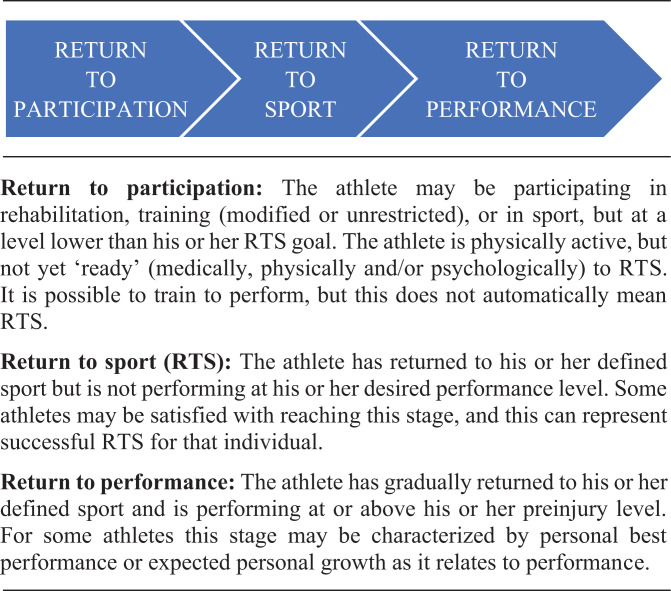
The important implication is that return to participation is real progress. It may mean clinician-approved engagement with a modified form of judo-related activity, even though you are not yet training normally or safely performing pivots, throws, falls, or sparring.
For now, formulate three separate statements.
1. Your long-term direction
This may be intentionally broad:
Long-term direction: return to judo in a form that is safe, enjoyable, and appropriate to my goals and clinical clearance.
This is a compass, not a deadline.
2. A current capacity goal
Use a measurable skill related to the movement-control demands you are building. For example:
By [date], I will repeat my supported balance baseline and my seated rhythm baseline under identical conditions, record both trials, and identify one quality feature that has become more consistent.
Or, if your physiotherapist has already approved a specific non-pivoting, judo-related posture, stepping pattern, or upper-body sequence:
By [date], I will perform the clinician-approved movement pattern for [agreed quantity] with the agreed support or supervision, no pivoting, and the stated movement-quality criterion. I will record symptoms during and after it.
That second example must be filled in with your physiotherapist’s actual instruction. Do not turn a general desire to “prepare for judo” into an unapproved twisting, falling, or partner drill.
3. A clearance-gated participation goal
This goal acknowledges that the decision is shared rather than self-awarded:
At my next physiotherapy review, I will bring my balance and coordination records, discuss the movement demands of beginner judo, and agree the criteria and earliest appropriate form of return to participation.
This is measurable and fully within your control. The answer may be “continue current rehabilitation” rather than “start class now”; that is still useful information and sound decision-making.
A brief planning activity: write two goals
Set aside about 10 minutes now. Use your actual baseline notes rather than the example figures above.
Goal A: everyday movement
Write one goal with these fixed elements:
- Meaningful setting: Where will the task matter in ordinary life?
- Approved task: What are you currently allowed to do there?
- One measure: What will change—repetitions, support, errors, cueing, or duration?
- Quality and safety rule: What has to remain true?
- Review date: Choose a date about three to four weeks away, unless your physiotherapist has specified another schedule.
Goal B: judo-return preparation
Write a goal at the correct stage:
- If you are still in rehabilitation-only territory, choose a capacity or planning goal.
- If your physiotherapist has approved modified judo-related practice, define one approved task and its quality criterion.
- If you have not yet been cleared for any judo-related movement, make the next goal about collecting evidence, discussing criteria, and preparing for a safe return-to-participation decision.
Use this final check before keeping either goal:
- Could a person who does not know me tell whether I met it?
- Does it use my own baseline rather than someone else’s ability?
- Does it fit today’s restrictions?
- Is the date plausible but not artificially cautious?
- Does the goal measure one principal change?
- Would reaching it matter in everyday life or as a genuine step toward judo?
If the answer to any safety question is uncertain, treat that uncertainty as information to bring to your physiotherapist, not as a reason to test the boundary alone.
Key takeaways
- Baselines become useful when they inform a specific next target, not when they are treated as a label for your overall ability.
- Your best comparison is your own repeatable record under the same conditions—not the visible performance of dancers, gymnasts, or experienced judoka.
- A practical goal states the activity, current context, one measurable variable, quality and safety criteria, and a review date.
- Separate a broad wish to return to judo from the present, measurable capacity goal and the clinician-guided clearance decision.
- Returning to participation in a modified, safe form is a legitimate stage of success; full return to sport and return to previous performance are later and distinct stages.
In the next module, you will look more closely at the sensory information behind balance and body-position awareness: vision, the vestibular system, and somatosensation. That will help you understand why a balance task can feel different from one day or environment to another—and how to adjust practice without exceeding your current rehabilitation boundaries.
Can't find a good explanation? Sign up and we'll make it for you
Sign up