
Hello. This course is a rapid review for your Grade 8 geography test: landscapes and landforms first, then coastal erosion, tectonic plates, and the Ring of Fire. In this first module, the main goal is to look at a photograph or map and describe what kind of geographical thing you are seeing.
Today’s distinction is simple but important: a landscape is the whole visible area; a landform is one natural physical feature within it. Getting this right will make later work on coastal arches, cliffs, volcanoes, and plate boundaries much clearer.
The central idea: a scene versus a feature
Imagine standing at a viewpoint and looking across an area. You might see mountains, a lake, trees, a valley, and perhaps roads or buildings. Everything visible together is the landscape.
A landform is one naturally formed shape or feature on Earth’s surface. Common Grade 8 examples include:
- mountain
- hill
- valley
- plain
- plateau
- canyon
- cliff
- beach
- sand dune
The easiest way to remember the difference is:
| Term | What it means | Scale | Example |
|---|---|---|---|
| Landscape | The visible character of an area, including its features | Broad: the whole scene | A mountainous coastal landscape |
| Landform | One natural feature or shape of Earth’s surface | Specific: one part of the scene | A mountain, valley, cliff, or canyon |
A landscape can contain many landforms. It can also include natural features such as rivers, lakes, soil, and vegetation. If people have changed an area, it may also include farms, roads, houses, bridges, or cities.
The key relationship is:
Landforms are parts of landscapes; landscapes are not just single landforms.
For example:
- “A mountain” is a landform.
- “A mountain landscape with a glacier, lake, and forest” is a landscape.
- “A canyon” is a landform.
- “A dry desert landscape containing canyons, cliffs, and sparse vegetation” is a landscape.
A useful test is the frame test. Ask: Am I naming one physical feature inside the picture, or am I describing the entire area inside the picture frame?
Read the definitions in context
Read National Geographic Education’s “Landscape” entry to establish the exact geographical meaning of landscape and see how landforms fit inside it.
Begin with the opening definition. Read the definition in the first section. Then move to the section beginning “A natural landscape” and read the explanation of natural landscapes, continuing through the rest of that paragraph. Focus on the phrase “collection of landforms”: it is the clearest clue that a landscape is broader than one landform.
National Geographic uses the phrase “part of Earth’s surface that can be viewed at one time from one place.” This does not mean a landscape is only what is natural. It means the landscape is the whole area being viewed and the features that give it character.
A landscape may be:
- Natural, with little or no visible human change, such as a mountain area, desert, rainforest, or coast.
- Human-modified, sometimes called a cultural landscape, such as farmland, a town, or a city.
- Mixed, which is very common: for example, a coastal area with cliffs and a beach, plus a road, café, or harbour.
The landscape versus landform distinction still works in all three cases. A city is a human landscape, but its roads and buildings are not natural landforms.
Reading a photograph geographically
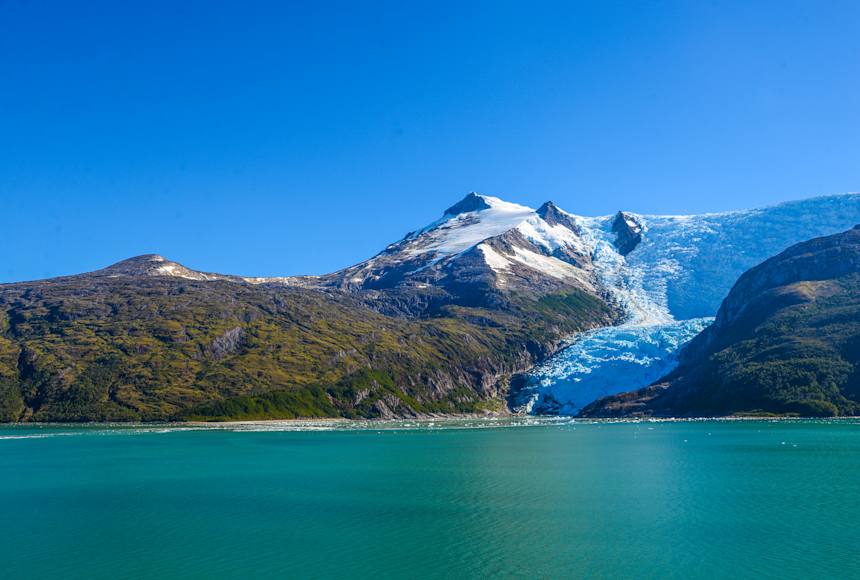
Look closely at the glacier mountain photograph. It would be incomplete to say, “This picture is a mountain.” The photograph includes far more than one mountain. A stronger geographical description is:
This is a mountainous landscape. It contains steep mountains, snow and ice, a glacier, rocky slopes, vegetation, and a large body of water.
Here, mountains are individual landforms. The phrase mountainous landscape describes the whole visible area.
Notice that “landscape” does not mean “beautiful view.” In geography, it is a precise term. A flat, industrial, dry, crowded, or damaged area can all be landscapes too.
Now consider a coast.
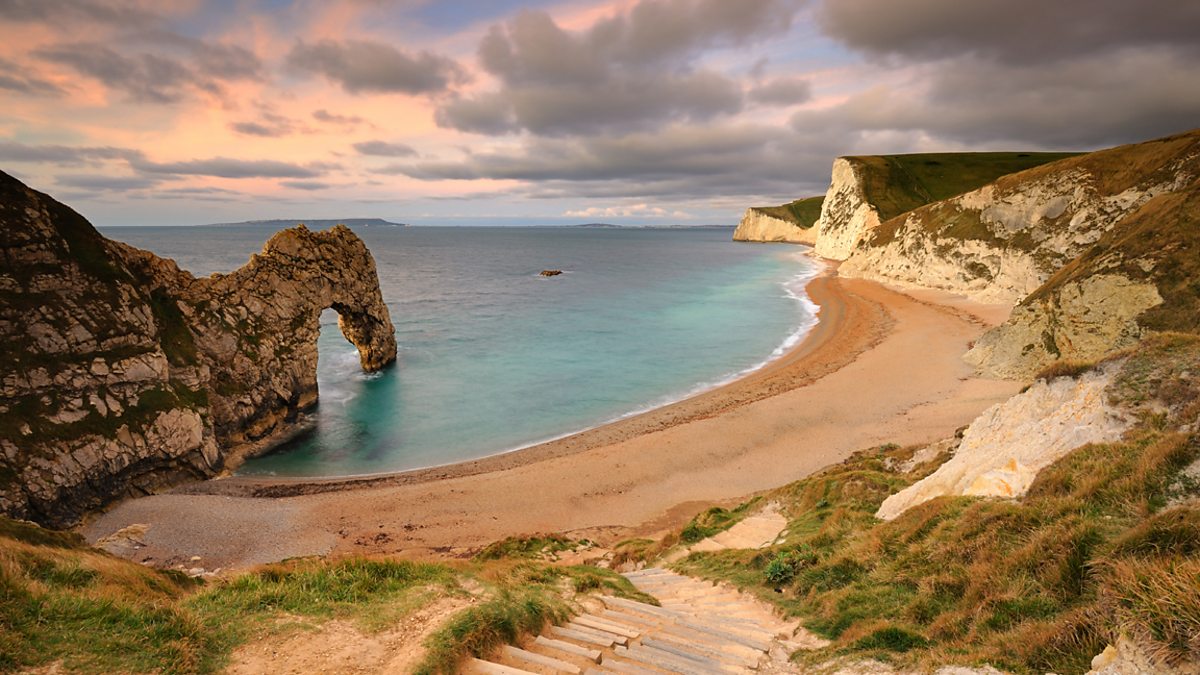
This is a coastal landscape because the whole scene includes the sea and land at its edge. Within that landscape, you can identify individual features:
- cliff: steep rock face beside the sea
- beach: area of deposited sand or pebbles
- rock arch: opening through a headland of rock
- headland: land that sticks out into the sea
Later in the course, you will learn how waves can form an arch like Durdle Door. For now, the important point is scale: the arch is one landform; the coast in the photograph is a landscape.
One landform in detail: the canyon
A canyon is a useful example because it can be confused with a landscape. A canyon is an individual landform: a deep, narrow valley with steep sides. But the area around and including it may be called a canyon landscape.
Canyon - National Geographic Education
Read the opening of National Geographic Education’s “Canyon” entry for an example of a precisely defined landform.
On the page, find the “Article Vocabulary” section beneath the photographs. Read the opening explanation, stopping before the subsection “Weathering and Erosion.” Notice how the definition describes one distinct physical feature, rather than an entire visible area.
Compare these two sentences:
-
“The Grand Canyon is a deep valley with steep sides.”
This identifies a landform. -
“The Grand Canyon region has a dry landscape with a canyon, river, cliffs, rock layers, and sparse vegetation.”
This describes a landscape.
The word region in the second sentence is a clue that the answer is about a broader area.
A reliable test-day method
When a question asks whether something is a landscape or landform, use this three-step routine.
-
Look at the scale.
Is it a whole area or view, or one specific feature? -
Look for a collection.
If the description includes several features together, it is probably a landscape. -
Check whether it names one natural shape.
A single mountain, cliff, canyon, hill, valley, or plain is a landform.
Here are some examples:
| Phrase | Correct classification | Why |
|---|---|---|
| “A steep-sided canyon” | Landform | It names one natural feature. |
| “A coastal area with cliffs, a beach, and a village” | Landscape | It describes a whole area containing several features. |
| “A broad, flat plain” | Landform | A plain is one type of natural physical feature. |
| “A dry desert with sand dunes and little vegetation” | Landscape | The desert scene includes landforms, soil, and vegetation. |
| “A cliff beside the sea” | Landform | The cliff is one feature. |
| “An urban area with roads, tall buildings, and a river” | Human-modified landscape | It describes an entire area shaped by people and natural features. |
Common mistakes to avoid
Mistake 1: Calling every natural place a landform.
A rainforest, desert, or coast can describe a type of landscape. They may contain many landforms.
Mistake 2: Calling one mountain a landscape.
In everyday conversation people may say “the mountain landscape,” but in a test, “mountain” by itself is normally an individual landform.
Mistake 3: Forgetting that landscapes can include people’s work.
A landscape is not automatically untouched nature. Fields, roads, houses, and cities can be part of a human-modified landscape.
Mistake 4: Listing features without identifying the whole landscape.
If asked to describe a landscape, begin with the landscape type, then support it with details.
A strong answer structure is:
This is a [type] landscape. It contains [two or three landforms or natural features]. It also includes [any visible human features].
For the coastal image, that could become:
This is a coastal landscape. It contains sea cliffs, a beach, and a rock arch. The grass-covered slopes show that land vegetation is also part of the view.
Make the definitions test-ready
Memorise these short versions:
- Landscape: an area of Earth’s surface that can be viewed from one place; it includes the features that give that area its character.
- Landform: a natural physical feature or shape on Earth’s surface, such as a mountain, valley, plain, canyon, or cliff.
If you forget the longer definition during the test, use this safe contrast:
A landscape is the whole area; a landform is one natural feature within the area.
You should now be able to separate the whole scene from the individual natural features inside it. A mountain landscape can contain mountains, valleys, water, ice, trees, and human features; a mountain itself is one landform. The same distinction applies to a coastal landscape and an individual cliff or rock arch.
Next, you will build on this by identifying common natural landforms in photographs and simple maps.
Can't find a good explanation? Sign up and we'll make it for you
Sign up