
Hello again. In the last lesson, you practised identifying natural features such as mountains, valleys, rivers, bays, and plains. Now you will add a second skill: deciding whether each visible feature is natural or human-made.
This matters because test photographs and maps usually show both at once. A rural scene may contain a natural river and hills alongside roads, fields, and houses. By the end of this lesson, you should be able to classify visible features accurately and give a short reason for your choice.
The main rule: would it exist without people?
Geographers often use physical feature and natural feature to mean nearly the same thing in this context. Both describe features that were created by natural processes, not built by people.
A human feature is also called a human-made or built feature. It exists because people constructed it or deliberately changed the landscape for a purpose.
A quick test-ready question is:
Would this feature be here in roughly this form if people had never lived in the area?
- If the answer is yes, it is probably a natural/physical feature.
- If the answer is no, it is probably a human-made feature.
What are human and physical features in geography?
Read BBC Bitesize’s clear explanation of the difference between physical and human features. It also introduces an important complication: not every feature that looks natural, such as a lake, is necessarily natural.
In the section “What are different features?”, read the opening definition. Then continue through the transcript, especially the example of a road beside a river and the discussion of a lake made for water storage. Next, under “Features on maps”, read the examples of countryside features. Focus on the idea that one landscape can include both physical and human features.
A mountain would exist without people, so it is a physical feature. A road must be planned and built, so it is a human feature.
| Natural or physical features | Human-made features |
|---|---|
| Mountain, hill, valley, cliff | House, school, shop, farm building |
| River, sea, natural lake, waterfall | Road, railway, bridge, tunnel |
| Beach, bay, island, forest | Field, wall, fence, harbour |
| Soil, rocks, naturally growing vegetation | Dam, reservoir, wind turbine, electricity pylon |
Notice that a human feature can be made from natural materials. A stone wall is still human-made because people chose, moved, and arranged the stones.
Do not judge by whether a place looks rural or urban
A common mistake is assuming that everything in the countryside is natural, or that everything in a city is human-made. Neither is true.
A city may contain rivers, hills, trees, soil, and parks. These are physical features or natural elements within an urban landscape. A rural area may contain farmhouses, field boundaries, roads, power lines, drainage ditches, and barns. These are human features.
The category depends on the feature itself, not the general location.
For example:
- A river running through a town is still a natural physical feature.
- A road crossing open countryside is still a human-made feature.
- A cliff beside a harbour is natural; the harbour wall is human-made.
- A forest may be natural, but a clearly planned tree plantation is a human-managed feature.
Features that can be confusing
Some features need closer thought because people may have changed them.
| Feature | Usually classify as | Important detail |
|---|---|---|
| River | Natural/physical | A river forms naturally, but a canal is dug by people. |
| Lake | Natural/physical | Check whether it is a natural lake or a reservoir created by a dam. |
| Trees | Natural/physical | Individual trees are natural living things; a landscaped park or plantation has been deliberately designed by people. |
| Field | Human-made | Soil and plants are natural, but people cleared, divided, planted, and manage the land. |
| Beach | Natural/physical | A sea wall, pier, or groyne on the beach is human-made. |
| Hill | Natural/physical | A spoil heap or artificial ski slope is human-made. |
For a Grade 8 test, use the evidence given. If a map key says reservoir, classify it as human-made. If a photograph shows straight-edged water behind a dam, that is strong evidence that people created or controlled it.
Learn to spot visual clues
Sometimes the feature is obvious: a house is built, and a mountain is natural. Other times, you need clues from the shape and pattern of what you see.
Human-made features often show purpose, order, repetition, or construction:
- straight or smoothly surfaced roads
- rectangular fields with fences, walls, or hedges
- rows of houses or regularly spaced buildings
- bridges crossing a river
- pylons and power lines
- harbour walls, piers, and sea defences
- dams holding back water
Natural features often show shapes made by land, water, weather, and vegetation:
- uneven hillsides and mountain slopes
- winding rivers
- rocky cliffs
- naturally curving coastlines
- valleys between high ground
- forests or scattered vegetation without a clearly planted pattern
These are clues, not absolute rules. A road can curve to follow a hill, and a river can be straightened by people. That is why maps should always be read with their key and labels.
On a simple map:
- A thin blue line that branches and curves naturally is often a river.
- A route shown with a road symbol, name, or route number is a road.
- A blue enclosed area labelled “reservoir” is human-made, even though it may resemble a lake.
- Groups of building symbols indicate a settlement, which is human-made.
- Field boundaries, railways, and footpaths are human features.
- Contours, mountains, rivers, and coastlines are physical features.
Read one mixed landscape carefully
Use the coastal village image below as a model for how to separate features in a real photograph.
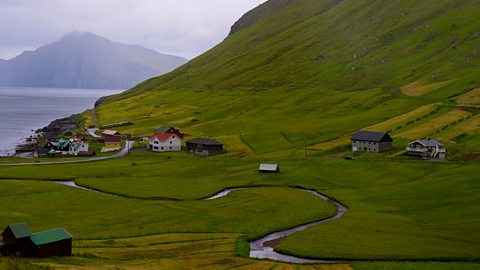
Start with the natural setting. The large green hillside is a natural landform. The sea at the left is a natural water feature. In the distance, the high, steep land is mountainous terrain. The winding stream in the foreground is also a natural physical feature.
Now look for evidence of people. The cluster of houses is a human settlement. The road connecting the buildings is human-made. The large rectangular farm buildings are human-made too. The divided areas of grassland are fields: although grass, soil, and water are natural, the boundaries and organised agricultural use show human management.
A strong answer separates the features rather than calling the entire image “natural” or “human-made”:
The hills, sea, stream, and distant mountains are natural physical features. The houses, road, farm buildings, and fields are human-made features. This is a rural landscape containing both physical and human features.
That last sentence is especially useful in a longer test response. Landscapes are usually mixtures rather than one category only.
A reliable four-step method for any photograph or map
When you need to classify a feature, work through this routine:
-
Name the exact feature.
Do not write “the picture is natural.” Instead identify “the river,” “the road,” “the houses,” or “the cliff.” -
Ask how it came to be there.
Natural processes create rivers, mountains, and beaches. Human actions create roads, buildings, and dams. -
Look for evidence.
A straight paved surface suggests a road; a water channel with bends and tributaries suggests a river. -
Use the correct category word.
Write either “natural/physical feature” or “human-made feature.”
Your answer does not need to be long unless the question asks for an explanation. For an identify question, this is enough:
The river is a natural physical feature.
If the test asks for a reason, add one piece of evidence:
The river is a natural physical feature because it is a naturally flowing watercourse, not something built by people.
Or:
The road is a human-made feature because it was constructed to allow people and vehicles to travel through the area.
Mistakes to avoid
- Calling a field natural because it contains grass or crops. A field is created and managed for farming.
- Calling every blue shape on a map a natural lake. It could be a reservoir, canal, or harbour.
- Calling every tree human-made. Trees are natural organisms, although they may be planted or arranged by people.
- Calling every feature in a national park natural. National parks can contain roads, dams, farms, visitor centres, and footpaths.
- Calling the whole landscape human-made because it contains a village. The village is human-made; the hills and river are still natural.
Key takeaways
A natural or physical feature exists through natural processes and would be present without people. Examples include mountains, cliffs, rivers, seas, valleys, and naturally growing vegetation.
A human-made feature has been built, planned, or deliberately altered by people. Examples include houses, roads, bridges, fields, dams, reservoirs, and power lines.
When a feature is unclear, use the map key, labels, and visible clues. Most importantly, classify the specific feature, not the whole landscape.
Next, you will combine the first three lessons by describing a landscape clearly using landforms, natural features, and human features together.
Can't find a good explanation? Sign up and we'll make it for you
Sign up