
Hello! Welcome back to our module on Mechanical Vibrations.
In the last lesson, we derived the fundamental equation of motion for a simple vibrating system: . We discovered that the solution to this equation describes simple harmonic motion, and we identified the single most important property of that motion: the angular natural frequency, .
Today's lesson builds directly on that foundation. Your learning outcome is to calculate the natural frequency and period for undamped free vibrations. We will explore the physical meaning of frequency and period, learn how they relate to each other, and apply these concepts to solve practical problems, including systems with multiple springs.
1. The Language of Oscillation: Frequency and Period
While emerges naturally from the mathematics, engineers often use more intuitive terms to describe how fast a system oscillates. Let's define the key quantities.
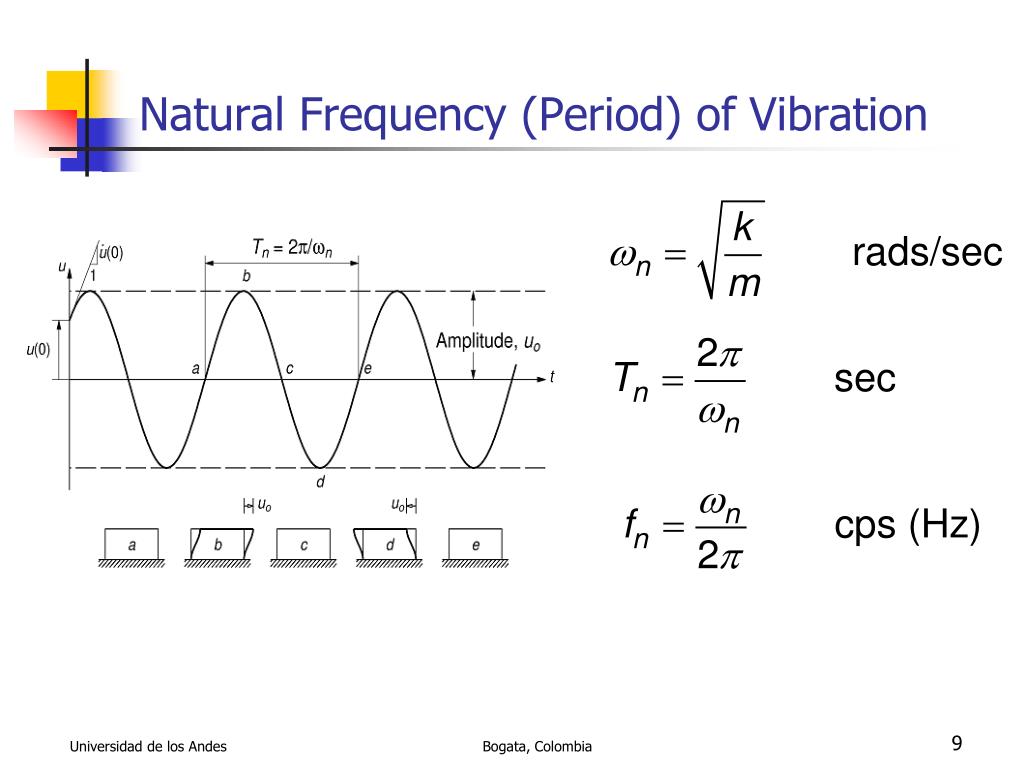
As you can see from the diagram, the motion is periodic. This leads to our first definition:
- Natural Period (): This is the time it takes for the system to complete one full cycle of vibration. For example, the time it takes for the mass to go from its highest point, down to its lowest, and back up to the highest. Its unit is seconds (s).
A more common way to describe oscillation is by how many cycles occur in a given time:
- Natural Frequency (): This is the number of cycles the system completes per second. It is the inverse of the period. Its unit is Hertz (Hz), where 1 Hz = 1 cycle/second.
Finally, we have the angular frequency we discovered last time:
- Angular Natural Frequency (): This is the frequency measured in radians per second (rad/s). Since one full cycle corresponds to radians, the relationship is:
The video below provides an excellent explanation of these related concepts.
Introduction to Undamped Free Vibration of SDOF (1/2) - Structural Dynamics
This video from 'structurefree' clarifies the relationships between angular frequency, frequency in Hertz, and the period of vibration.
Watch from 6:12 to 8:08. Pay close attention to how the presenter defines angular frequency (ωn), frequency in cycles per second (f), and period (T), and how they are all mathematically related.
2. The Key Formulas
Now we can combine these definitions with the formula for that we derived in the last lesson. This gives us a complete set of tools to analyze any undamped SDOF system.
Given a system with mass and spring stiffness :
- Angular Natural Frequency:
- Natural Frequency:
- Natural Period:
Notice the physical relationship: increasing the stiffness () makes the system vibrate faster (higher and ), while increasing the mass () makes it vibrate slower (lower and ).
Worked Example: Aircraft Instrument Panel
An instrument panel in an aircraft has a mass of 3 kg and is supported by mounts that have an effective stiffness of 2700 N/m. What are the natural frequency and period of vibration for the panel?
- Step 1: Calculate the angular natural frequency ()
- Step 2: Calculate the natural frequency in Hertz ()
- Step 3: Calculate the natural period ()
This means the panel will tend to oscillate almost 5 times per second, with each oscillation taking about 0.21 seconds. This is a critical parameter for engineers, who must ensure that this frequency doesn't match any of the engine's operating frequencies to avoid resonance.
Test your understanding!
A satellite antenna, with a mass of 10 kg, is designed to deploy on a boom. In its deployed state, the boom acts like a spring with a stiffness of 40 N/m. Calculate the period of the antenna's natural vibration.
Show answer
First, find the angular natural frequency:
Now, calculate the period, :
The antenna will oscillate with a period of approximately 3.14 seconds.
3. Systems with Multiple Springs: Equivalent Stiffness
Real-world systems are rarely as simple as one mass and one spring. Often, multiple elastic elements support a single mass. To analyze these systems, we need to find the equivalent spring stiffness ().
This concept should be very familiar from your electronics background. The rules for combining springs are analogous to those for combining capacitors.
Springs in Parallel
When springs are in parallel, they act together to resist motion. The displacement is the same for all springs, and the total force is the sum of the individual spring forces.
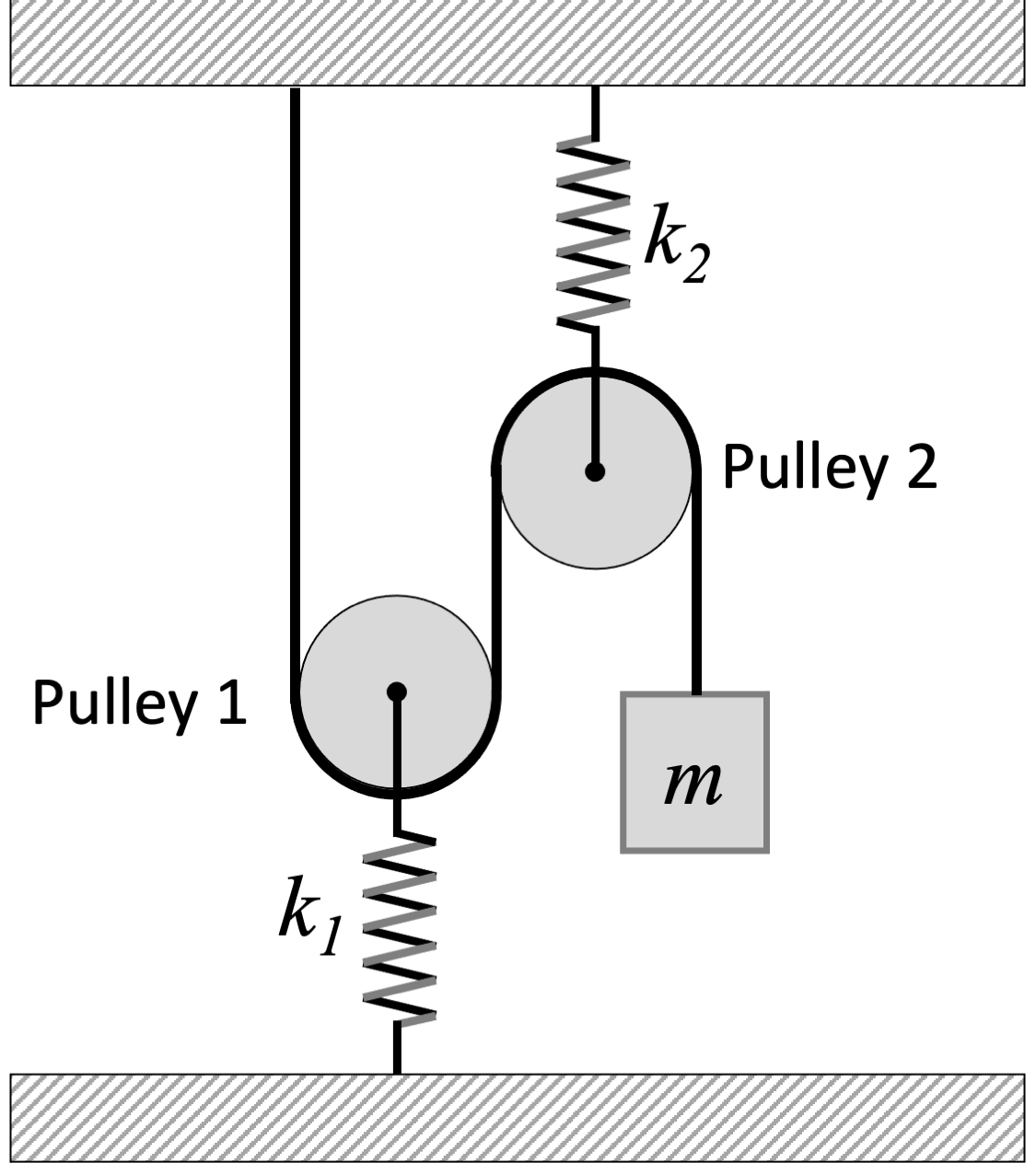
A mass supported by two springs in parallel.
The equivalent stiffness is simply the sum of the individual stiffnesses:
This is analogous to capacitors in parallel: .
Springs in Series
When springs are connected in series, the force is transmitted through each spring equally, but the total displacement is the sum of the individual spring displacements.

A mass supported by two springs in series.
The equivalent stiffness is found by summing the reciprocals:
This is analogous to capacitors in series: .
Once you calculate , you can treat the entire system as a single spring and use the same frequency formulas as before: .
The following resource provides clear derivations and several worked problems for undamped free vibrations, including systems with multiple springs.
Skim through the initial sections titled 'Undamped Free Vibrations' and the derivation of the equation of motion for a quick review. Then, focus on the 'Worked Problems', particularly 'Question 5', which demonstrates how to find the natural frequency for a system with springs in parallel. You don't need to read every problem, but see how the concept of equivalent stiffness is applied.
Worked Example: Parallel Springs
Let's adapt "Question 5" from the reading. A motor with mass kg is mounted on two springs as shown in the parallel diagram above. The spring constants are N/m and N/m. Find the system's natural frequency in Hz.
- Step 1: Find the equivalent stiffness for parallel springs.
- Step 2: Use to find the angular natural frequency .
- Step 3: Convert to natural frequency in Hertz ().
4. A Note on Torsional Vibrations
Just as objects can vibrate in a straight line (translation), they can also vibrate rotationally (torsion). Imagine a disk attached to the end of a flexible rod. If you twist the disk and let go, it will oscillate back and forth.
The physics is perfectly analogous:
- Instead of mass (), we use mass moment of inertia ().
- Instead of spring stiffness (), we use torsional stiffness ().
- Instead of linear displacement (), we use angular displacement ().
The equation of motion becomes , and the angular natural frequency is:
We will cover mass moment of inertia () in detail in Module 7, but it's useful to see now that the fundamental concept of natural frequency applies to both linear and rotational systems.
Conclusion
In this lesson, you've moved from deriving the equation of motion to using it to characterize how a system vibrates. You now have the tools to calculate the essential properties of any undamped, single degree-of-freedom system.
Key Takeaways:
- Vibrations are described by period (, in seconds), frequency (, in Hz), and angular frequency (, in rad/s). These are all interrelated.
- The fundamental formulas connect these quantities to the system's physical properties:
- For systems with multiple springs, you must first find the equivalent stiffness () before calculating the frequency. The rules for springs in series and parallel are analogous to capacitors in electronics.
Next Lesson Preview:
Our model so far, being "undamped," would oscillate forever. This is not realistic. In the real world, forces like friction and air resistance cause vibrations to die out. This effect is called damping. In the next lesson, we will introduce damping into our model and analyze the characteristics of underdamped, critically damped, and overdamped systems.
Can't find a good explanation? Sign up and we'll make it for you
Sign up