Hello! Welcome to the next lesson in our course.
In our last session, we sharpened our critical eye by evaluating a B2B white paper, identifying the specific content and design failures that cause a busy reader to lose interest. We moved from a gut feeling of "this is bad" to a precise, qualitative diagnosis.
Today, we take the next logical step from qualitative critique to quantitative proof. You can argue that one headline is better than another, but how do you prove it? The answer is A/B testing.
Our learning outcome is to design a simple A/B test for a B2B headline, email, or CTA, and define its success metrics. This skill is what separates good copywriters from great ones. It allows you to use data, not just opinion, to drive decisions and demonstrate the direct impact of your work on business goals.
What is A/B Testing?
At its core, A/B testing (or split testing) is a simple experiment. You create two versions of a single piece of content, show version A to one part of your audience and version B to the other, and see which one performs better against a specific goal.
To get a quick overview of the fundamentals, please watch the beginning of the following video from HubSpot.
How to Do A/B Testing: 15 Steps for the Perfect Split Test
This video, 'How to Do A/B Testing,' provides a clear, concise introduction to the concept, what you can test, and the goals you might have.
Please watch from the beginning until 03:52. Focus on understanding the core definition of A/B testing, the examples of what can be tested (headlines, CTAs, emails), and the types of goals you can set.
The most crucial principle, as you just saw, is testing one variable at a time. If you change both the headline and the call-to-action (CTA) button in your variation, you'll never know which change was responsible for the results.
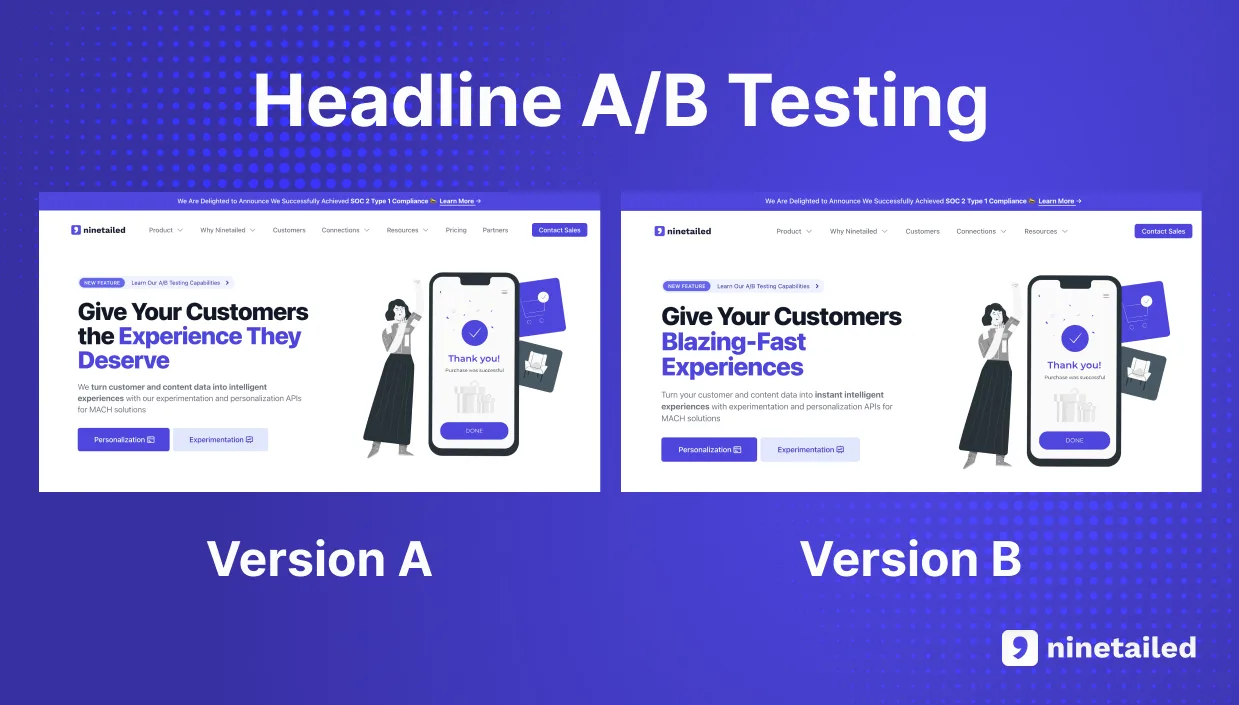
A Framework for Designing Your B2B Test
Now, let's create a repeatable process for designing a valid A/B test. For B2B, this process needs to be particularly thoughtful due to smaller audience sizes and longer sales cycles.
We will use a four-step framework. The article "10 A/B Testing Tips for B2B Campaigns" is an excellent guide for this, and we'll refer to its principles.
10 A/B Testing Tips for B2B Campaigns
The article '10 A/B Testing Tips for B2B Campaigns' provides practical, B2B-specific advice. We will use it to structure our testing framework.
Please read the introduction to get an overview. Then, focus on Tip #1 ('Define Clear Goals'), Tip #6 ('Test One Variable at a Time'), and the FAQ section ('How do you implement an AB test?'). These sections provide the backbone of our framework.
Drawing from that article and other best practices, here is a simple and effective four-step framework:
Step 1: Define Your Goal and Success Metric
First, decide what you want to achieve. A vague goal like "improve the landing page" isn't helpful. A clear goal, as the article states, is specific and measurable.
- Goal: Increase demo requests from the landing page.
- Success Metric: Conversion Rate (the percentage of visitors who complete the demo request form).
For an email test, the metrics are different. As a general rule:
- To test a subject line, your primary metric is the Open Rate.
- To test copy or a CTA inside the email, your primary metric is the Click-Through Rate (CTR).
Step 2: Formulate a Hypothesis
A hypothesis is an "if-then" statement that clarifies what you're testing and why you expect it to work. The format is: "By changing [Variable], I expect to [Desired Outcome] because [Reason]."
- Hypothesis: By changing the CTA button copy from 'Submit' to 'Get My Free Demo', I expect to increase the conversion rate because the new copy is more specific and value-oriented for the user.
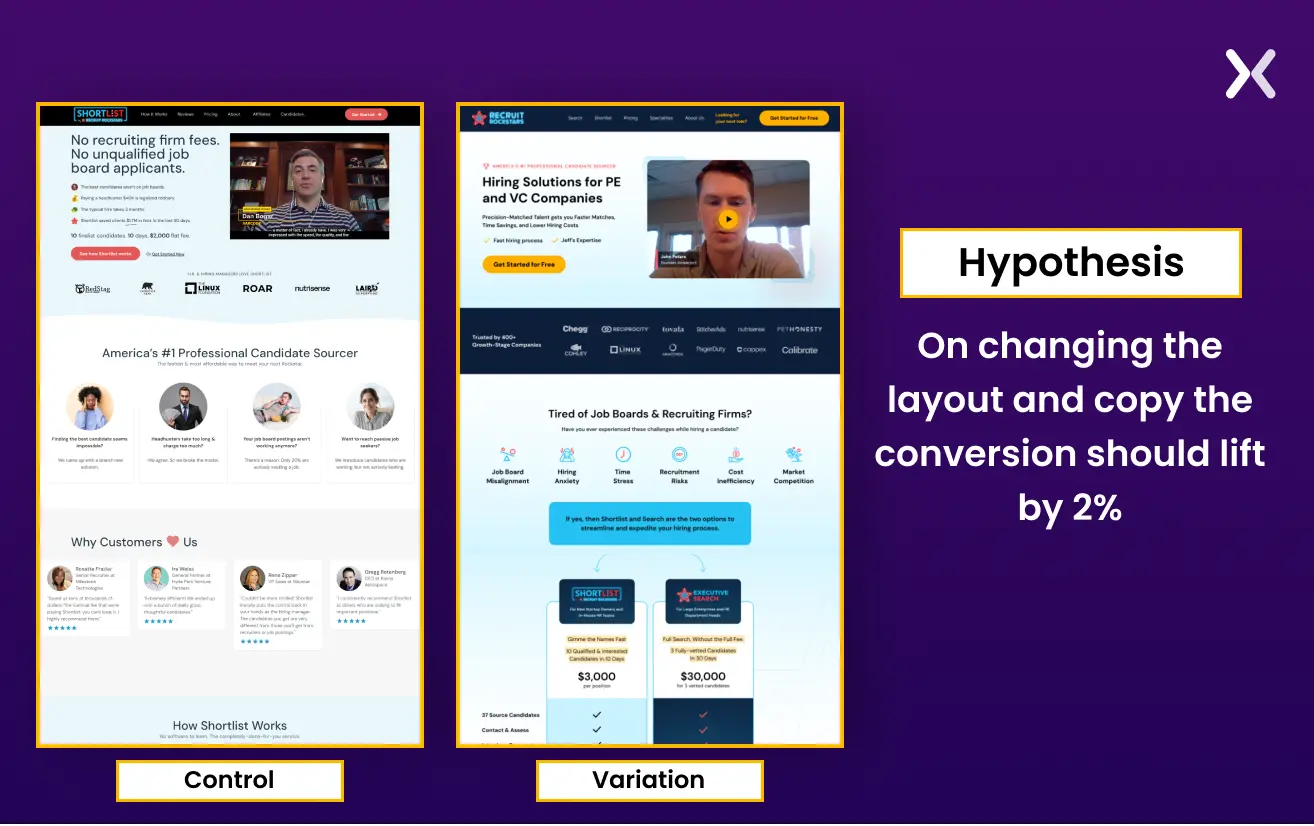
Step 3: Create Your Control and Variation
- Control (Version A): This is the original, existing version of your copy.
- Variation (Version B): This is the new version where you have changed only one variable (the headline, the CTA text, a specific paragraph, etc.).
Step 4: Define Test Parameters
This involves two key decisions:
- Audience Split: For most simple tests, you'll split your audience randomly, 50/50. 50% sees the Control, and 50% sees the Variation.
- Test Duration: B2B audiences are often smaller than B2C, so tests may need to run longer to get statistically significant results. A common starting point is 2-4 weeks to account for weekly business cycles. Don't stop the test just because one version is ahead after a day or two.
Your Turn: Design a Test
Let's put this framework into practice. This is a core skill you'll use constantly.
Scenario:
You've written a landing page for a B2B cybersecurity software company. The goal is to get qualified IT managers to download a white paper called "The 2024 Threat Landscape."
- The current headline is: "Next-Generation Cybersecurity."
- The call-to-action (CTA) button to download the paper says: "Download."
Your Task:
Using the four-step framework, design one A/B test for either the headline OR the CTA.
- State your Goal and Success Metric.
- Write your Hypothesis.
- Define your Control (A) and Variation (B).
- Briefly state your Test Parameters (audience split and a reasonable duration).
Take about 5-7 minutes to outline your test.
Debrief
Excellent. Let's review how this could look for both the headline and the CTA.
Example 1: Testing the Headline
- Goal & Metric: The goal is to increase white paper downloads. The success metric is the conversion rate of the landing page (i.e., the percentage of visitors who click the button and submit the form).
- Hypothesis: By changing the headline from a generic phrase to one that highlights the specific value of the white paper, I expect to increase the conversion rate because it will create more urgency and relevance for IT managers.
- Control & Variation:
- Control (A): "Next-Generation Cybersecurity."
- Variation (B): "Are You Prepared for the Top 5 Cyber Threats of 2024?"
- Parameters: A 50/50 audience split, running for 3 weeks to gather enough data from the target audience.
Example 2: Testing the CTA
- Goal & Metric: The goal is to increase white paper downloads. The success metric is the click-through rate on the CTA button. (You could also use overall page conversion rate, but button CTR is more direct here).
- Hypothesis: By changing the CTA from a generic command to specific, benefit-oriented text, I expect to increase the click-through rate because it clarifies exactly what the user is getting.
- Control & Variation:
- Control (A): "Download"
- Variation (B): "Get the Free Report"
- Parameters: A 50/50 audience split, running for 3 weeks.
Both of these are strong, simple, and valid tests that would provide clear, actionable insights.
Conclusion
In this lesson, you've learned the fundamental process for using data to validate your copywriting instincts. By designing simple, structured A/B tests, you can move from "I think this is better" to "I know this is better, and here's the proof."
Key Takeaways:
- A/B testing is a method of comparing two versions of your copy to see which performs better against a specific goal.
- A successful test requires a clear goal, a measurable success metric, and a focused hypothesis.
- The golden rule is to test only one variable at a time to ensure you know what caused the result.
- B2B tests often require longer durations than B2C tests due to smaller audiences and different buying behaviors.
Preview of the Next Lesson:
Designing the test is the first half of the battle. The second half is understanding the results. In our next session, you will learn how to interpret A/B test results to decide whether to iterate, scale, or discard a copy variation. We'll discuss concepts like statistical significance and how to use your findings to plan your next test.