Hello! Welcome back to our final module on testing and improving your copy.
In our last session, you learned how to design a structured A/B test by defining a goal, forming a hypothesis, and creating a control and variation. That's the first crucial half of the process. Today, we'll complete the loop by focusing on the second half: making sense of the results.
This lesson's outcome is to interpret A/B test results to decide whether to iterate, scale, or discard a copy variation. This is where data meets decision-making, allowing you to systematically improve your copy and prove its value.
From Data to Decision: A Framework for Interpretation
Once your A/B test has run its course, you'll be faced with a set of data. It's tempting to simply declare the version with the higher number as the "winner," but a professional copywriter digs deeper. The goal isn't just to find a winning headline; it's to understand why it won and what to do next.
Let's start with a foundational article that outlines a systematic process for analysis.
How to analyze A/B testing results: A simple 6-step guide
The article 'How to analyze A/B testing results: A simple 6-step guide' from Unbounce provides an excellent, clear framework. We'll use its core ideas to structure our thinking.
Please read the introduction ('What is A/B testing analysis?') and Step 2 ('Determine if your tests are statistically significant'). These sections set the stage by explaining that analysis is about more than just picking a winner and introduces the critical concept of statistical significance.
As the article points out, the first and most important question to ask is: Are these results statistically significant?
In simple terms, statistical significance tells you whether the difference in performance between your variations is due to your copy changes or just random luck. Most testing tools will calculate this for you, often showing it as a "confidence level" (you're looking for 95% or higher) or a "p-value" (you want it to be low, typically below 0.05).
If your results aren't statistically significant, you can't confidently make a decision. The test needs more time or a larger audience. But if they are significant, you can proceed to one of three key decisions.
The Three Decisions: Scale, Discard, or Iterate
Every test result, whether positive, negative, or neutral, leads to an action. Let's break down the choices.
1. Scale: The Clear Winner
This is the most straightforward outcome. Your variation (B) performs significantly better than your control (A) on your primary success metric, without causing any major problems with secondary metrics (like a drop in order value).
The decision: Implement the winning variation for 100% of your audience.
Here’s a perfect, real-world example of a small copy change that produced a clear win.

2. Discard: The Clear Loser
Sometimes, your new idea just doesn't work. Your variation performs significantly worse than the control.
The decision: Discard this specific execution. Stop the test, learn what you can from the failure (e.g., "Our audience didn't respond to this aggressive tone"), and move on to a new hypothesis.
This video explains the importance of quickly identifying and moving on from losing variations.
How to Analyze A/B Testing Results
In 'How to Analyze A/B Testing Results' by invesp, the speaker explains the practical first steps of analysis.
Watch from 00:27 to 01:04. Notice how the first step is to identify and exclude the 'clear loser' to focus your attention on more promising results.
3. Iterate: The "Maybe" or "Not Yet"
This is the most common and often most valuable outcome for a thoughtful copywriter. You should choose to iterate when:
- The test results are flat (no significant difference).
- Your variation lost, but not by a huge margin, and your original hypothesis was very strong.
- The results are mixed (e.g., click-through rate went up, but final conversions went down).
A flat or losing result doesn't always mean your idea was wrong; it often means your first execution of that idea wasn't right. This is where iterative testing comes in.
Iterative A/B Testing - A Must If You Lack a Crystal Ball - CXL
The article 'Iterative A/B Testing' from CXL is a masterclass on this topic. It argues that giving up on a strong hypothesis after one failed test is a huge mistake.
Please read the section 'If you test your hypothesis only once, you’re doing it wrong' and the 'Examples' section. Pay close attention to the case studies where initial tests failed but later iterations produced massive wins.
As the CXL article powerfully illustrates, the initial test is just the first step. If you have solid data backing your hypothesis (from customer reviews, sales calls, etc.), then a single test result shouldn't deter you. The correct action is to iterate: form a new hypothesis or a new execution of the same hypothesis and test again.
- Maybe your new value proposition was confusing. Iterate by rephrasing it for clarity.
- Maybe your new headline was good, but the call-to-action no longer matched it. Iterate by testing a new CTA to align with the headline.
Your Turn: Make the Call
Let's apply this decision framework. Imagine you're the copywriter for a SaaS company. You tested four variations of a landing page headline against your original (Control). Your goal was to increase demo sign-ups.
The testing tool provides this dashboard. Assume all results are statistically significant.
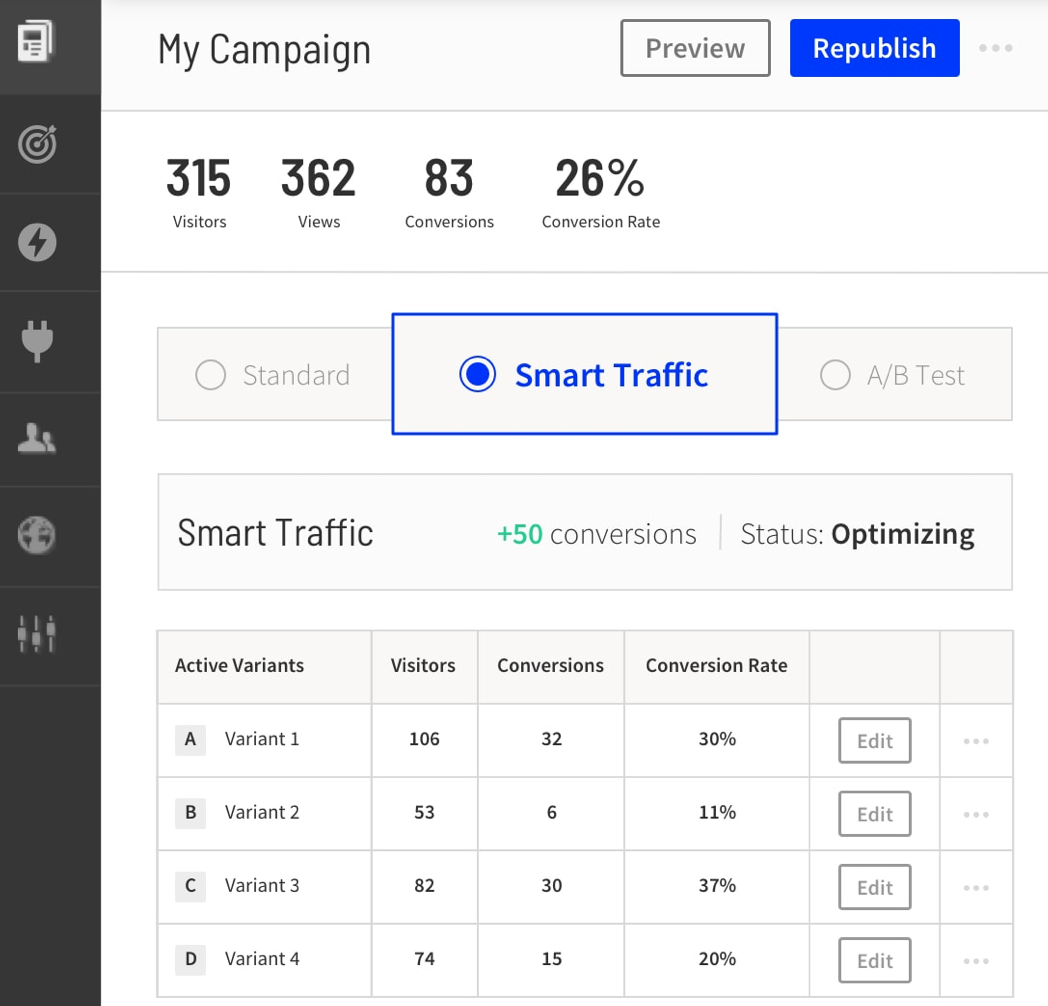
Your Task:
For each variant (B, C, and D), decide whether you would Scale, Discard, or Iterate. Briefly explain your reasoning for each.
- Variant B (11% Conversion Rate):
- Variant C (37% Conversion Rate):
- Variant D (25% Conversion Rate):
Take a few minutes to analyze the data and make your decisions.
Debrief
Here is a professional breakdown of the results:
- Variant C (37% Conversion Rate): This is a huge win compared to the control's 30%. The decision is clear: Scale. You would stop the test and direct 100% of future traffic to this new, high-performing headline.
- Variant B (11% Conversion Rate): This performed terribly, less than half as well as the control. This is a clear loser. The decision is to Discard. You would analyze the copy to understand why it failed so badly (was it misleading? too generic? offensive?) to inform future tests, but you would not test this version again.
- Variant D (25% Conversion Rate): This is the most interesting one. It's a loss, but not a catastrophic one. The decision here is likely to Iterate. Why did it underperform? Perhaps the core message has potential but the wording is slightly off. You could analyze the language and try a new version (e.g., Variant D2) in your next round of testing, or combine its idea with elements from the winning Variant C.
Conclusion
You now have a robust framework for moving from test data to intelligent action. This elevates your role from just writing words to strategically improving business outcomes.
Key Takeaways:
- Always check for statistical significance before drawing conclusions.
- A clear win with no negative side effects means you should scale the new version.
- A clear loss means you should discard that execution and learn from the failure.
- An inconclusive, flat, or slightly negative result for a strong hypothesis is an invitation to iterate and test a refined version. "Losing" tests are often your best teachers.
Preview of the Next Lesson:
Now that we know how to design and interpret tests, our final lessons will focus on refining your copy before you even test it. In our next session, we will learn how to apply a self-editing checklist to tighten B2B copy for clarity, specificity, and persuasion, increasing the odds that your next test will be a winner.