
Hello. You have now practiced locating failures through Linux resource signals, process behavior, DNS, TCP, TLS, and HTTP layers. The technical pattern has been consistent: begin with observable evidence, narrow the boundary, and avoid treating a plausible explanation as a proven cause.
This final lesson in the troubleshooting module focuses on making that reasoning visible in an interview. A strong answer is not a rapid list of commands. It is a calm, time-boxed narrative that separates facts, hypotheses, tests, decisions, and uncertainty. That is what lets an interviewer trust your judgment when evidence is incomplete.
What the interviewer is actually assessing
A troubleshooting prompt is often deliberately underspecified:
“After a deployment, users report that the API is slow. What would you do?”
The interviewer usually does not expect an instant root cause. They want to see whether you can:
- establish the expected behavior, actual behavior, scope, and urgency;
- propose a small number of plausible causes rather than guessing;
- choose the next check because it distinguishes between those causes;
- protect users through a safe mitigation when impact is high;
- revise your view when new evidence contradicts it;
- communicate a decision and its remaining uncertainty clearly.
A command list without reasoning is weak:
“I’ll check logs, CPU, memory, network, Kubernetes events, and DNS.”
It may contain useful tools, but it does not explain why that order, what each check would prove, or what you would do with the result.
A hypothesis-driven answer connects every action to a decision:
“Because the problem began immediately after a deployment and affects only one region, I would first compare error rate, latency, and deployment version by region. If errors are concentrated on the new version, I would prioritize rollback or traffic diversion while verifying pod readiness and application errors. If both versions are affected, I would widen the investigation to the shared ingress or regional dependency.”
Notice the discipline:
- The deployment correlation is an observation, not proof.
- The new-version failure is a hypothesis.
- The comparison is a test.
- Rollback or traffic shifting is a conditional action.
This short video gives a useful interview perspective: open-ended DevOps questions are intended to reveal your diagnostic thought process, not merely whether you recall a particular command.
Popular Linux Interview Questions for DevOps Interviews
In “Popular Linux Interview Questions for DevOps Interviews,” tutoriaLinux explains why broad troubleshooting prompts reveal how a candidate investigates rather than whether they can recite a single correct answer.
Watch the open ended scenario. Focus on the presenter’s point that an interviewer is evaluating how you gather evidence about a process, including its resource use, command arguments, file descriptors, and network connections.
The core loop: observation, hypothesis, prediction, test, decision
The Google SRE troubleshooting model is useful because it treats troubleshooting as structured reasoning rather than intuition alone.
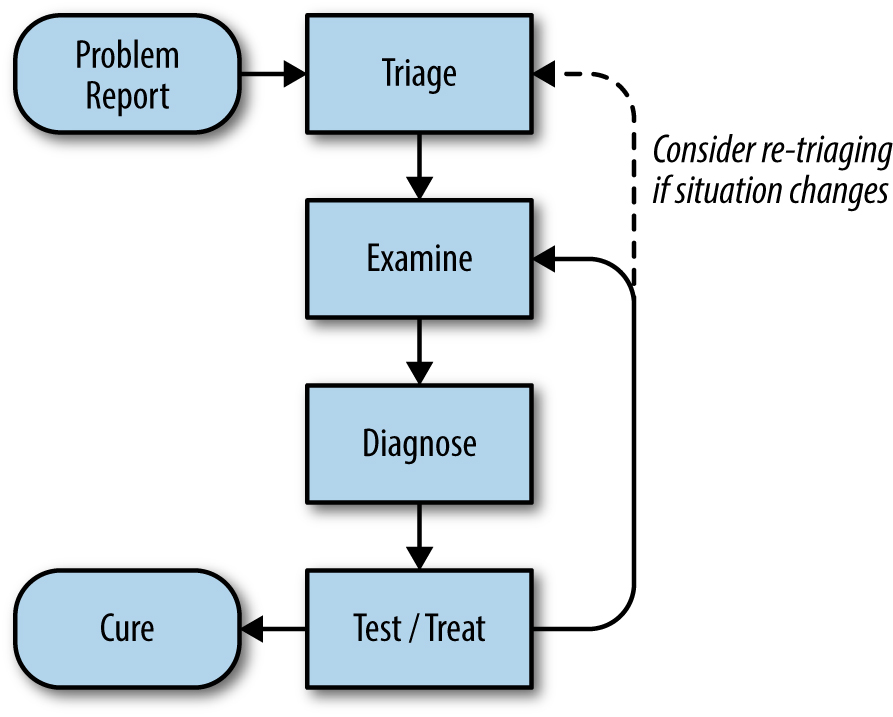
Read the conceptual model first. It will give you language for explaining your approach in a way that sounds systematic but natural.
Troubleshooting Methodology: A Learning Path
Read the opening “Theory” and “In Practice” sections from the Google SRE book. They frame troubleshooting as iterative hypothesis testing and emphasize that severity and mitigation matter before exhaustive root-cause analysis.
In “Theory,” read the core model. Then, in “In Practice,” read the “Problem Report,” “Triage,” and “Examine” subsections, beginning with the report details. Pay particular attention to the distinction between restoring acceptable service and proving the ultimate root cause.
For interview use, compress the model into five explicit moves.
| Move | What you say | What it prevents |
|---|---|---|
| Observation | “What we know so far is…” | Treating a vague report as evidence |
| Hypothesis | “My leading possibilities are…” | Anchoring on one cause |
| Prediction | “If this is true, I expect to see…” | Choosing random checks |
| Test | “I would verify that with…” | Tool dumping |
| Decision | “Based on that result, I would…” | An investigation with no operational outcome |
Use this sentence pattern repeatedly:
“Given [observed evidence], [hypothesis] is more likely because [reason]. I would check [specific evidence]. If I find [predicted result], I would [action]; otherwise, I would deprioritize that hypothesis and investigate [next alternative].”
For example:
“Given that TCP and TLS both succeed but time to first byte has risen sharply, I would consider upstream application processing or a downstream dependency more likely than a connectivity failure. I would compare load-balancer target timing with application traces for the same request ID. If the application receives the request and spends most of the duration waiting on its database call, I would focus on that dependency and consider load reduction or failover. If the application never receives the request, I would move the boundary back to the proxy-to-upstream path.”
That answer is strong because each claim has an evidence boundary.
Keep facts and assumptions visibly separate
Interview prompts often omit details you would need in production. Do not quietly invent them. State a reasonable assumption and show how it affects the plan.
| Say this | Not this |
|---|---|
| “I would first confirm whether the slowdown affects all users or one region.” | “This is probably a regional network issue.” |
| “Assuming this is customer-impacting, I would look for a reversible mitigation in parallel with diagnosis.” | “I would immediately restart all pods.” |
| “A recent deployment raises the probability of a change-related failure, but I would verify correlation before rolling back.” | “The deployment caused it.” |
| “That evidence rules out DNS for this request path, so I would not spend more time there initially.” | “DNS is definitely fine everywhere.” |
A useful rule is:
Confidence should match the evidence, not the pressure of the interview.
Say “the evidence currently localizes the issue to…” when you have narrowed a boundary. Reserve “the root cause is…” for when direct evidence supports it.
Build a short, discriminating investigation plan
The fastest investigations do not inspect every layer in order. They choose checks that sharply separate alternatives.
For a layered service, previous lessons gave you a technical map:
- no name resolution points toward DNS or resolver configuration;
- connection errors point toward routing, firewall, listener, or proxy path;
- TLS errors point toward certificate, hostname, protocol, or trust;
- an HTTP response establishes that communication reached some HTTP-speaking component;
- logs and traces determine which component handled or transformed the request.
In an interview, you do not need to recite all of that unless it fits the evidence. Instead, make each check answer a particular question.
Suppose the scenario is:
“Immediately after deploying version 2.8, around 30% of requests to
/checkoutreturn502in one AWS region. The other region is healthy.”
A weak response starts with “I would check the application logs.”
A stronger opening might be:
“I would first confirm the impact: when the failures began, whether the 30% is stable or rising, whether it is limited to one region and endpoint, and whether requests reach the load balancer. Since this is a customer-facing checkout failure, I would look for a low-risk mitigation such as shifting traffic to the healthy region or rolling back the affected deployment, provided capacity and rollback safety are confirmed. In parallel, the leading hypotheses are unhealthy targets from the new version, an ingress-to-application routing mismatch, or a downstream dependency failure affecting only this endpoint.”
Now create a mental hypothesis ledger. You do not need to announce it as a table in an interview; use it to keep your narration disciplined.
| Hypothesis | Evidence that would support it | Evidence that weakens it | Best next check |
|---|---|---|---|
| New version makes targets unhealthy | Failed readiness checks, increased restarts, errors only on version 2.8 | Both old and new versions handle the endpoint successfully | Compare target health, pod readiness, restart count, and version-specific errors |
| Ingress or proxy cannot reach upstream | 502 at ingress, upstream connection errors, app has no matching request | Application receives request and emits its own error | Correlate a request ID through load balancer, ingress, and application logs |
| Checkout dependency is failing | Application logs request, then records payment or database timeout | No request reaches application | Inspect trace span or dependency metrics for the failed request |
| Capacity or regional resource pressure | Saturation, queueing, throttling, broad latency increase | Only one route fails and saturation is normal | Compare CPU, memory, connection pools, queue depth, and endpoint-level latency |
This is bisection in practical form: identify a boundary, test which side contains the failure, then repeat with a smaller set of alternatives.
The next Google SRE sections explain why this approach works and how to avoid misleading experiments.
Troubleshooting Methodology: A Learning Path
Continue with the Google SRE book’s “Diagnose” and “Test and Treat” sections. These sections provide the reasoning behind simplifying a system, narrowing the search space, and choosing tests that genuinely distinguish among hypotheses.
In “Diagnose,” read the “Simplify and reduce” subsection, especially reduction and bisection. Then read “Test and Treat,” focusing on test design cautions. Notice the warnings about confounding factors and tests whose results are only suggestive.
Explain why a test is valid
Interviewers may challenge a proposed test:
“You tested the API from your laptop and it worked. Does that eliminate a network problem?”
A careful response is:
“No. It proves only that my laptop can reach the endpoint using its own DNS resolver, route, credentials, and possibly proxy configuration. It does not reproduce the workload’s network identity or path. I would run the equivalent test from the affected pod, host, or approved diagnostic environment, preserving the destination hostname and request semantics.”
That answer demonstrates an understanding of confounding factors: a test is meaningful only when the conditions match the suspected failure path.
Similarly, avoid using an intrusive production action as your first diagnostic test:
- restarting every instance can erase evidence and create a second outage;
- enabling highly verbose logging can worsen a latency incident;
- changing multiple settings at once prevents causal interpretation;
- a direct backend probe may bypass authentication, TLS termination, routing rules, or a WAF.
A safe test is usually small, reversible, observable, and targeted at one hypothesis.
A timed answer structure you can reuse
For most interview troubleshooting prompts, aim for a clear two-to-four-minute first answer. You can then deepen one branch when the interviewer provides additional evidence.
First minute: frame the incident
Start with the problem definition and risk:
“Before selecting a tool, I would establish the expected behavior, the actual failure mode, when it began, its user and geographic scope, and whether it is worsening. I would also check for recent deploys, configuration changes, traffic shifts, or dependency incidents. If this is actively affecting users, I would identify a reversible mitigation while preserving enough evidence for diagnosis.”
This prevents premature command selection and signals that you understand triage.
Next minute: name only a few hypotheses
Choose two to four alternatives based on the given facts. They should be meaningfully different, not variations of the same guess.
“Given that this started after a deployment and is isolated to one region, my first hypotheses are: unhealthy instances on the new version, a region-specific ingress or routing configuration issue, and an application dependency problem exposed by the release. I would not yet assume the deployment is the root cause.”
A good candidate ranks hypotheses, but does not overcommit:
“The new version is my leading hypothesis because of timing, but that correlation is not sufficient to prove causation.”
Then: select the next discriminating check
Describe the check, what it tests, and what each possible result changes:
“I would correlate one failing request by timestamp and request ID across the load balancer, ingress, and application. If the ingress sees the request but the application does not, that narrows the issue to upstream routing or connectivity. If the application receives it and the trace shows a timeout while calling the payment provider, I would move to the dependency path. If errors occur only on pods running the new version, I would validate readiness, configuration, and recent code changes, then assess rollback.”
This is the heart of a hypothesis-driven answer.
Close with a decision point
End the initial answer with mitigation and verification:
“If the error rate is high and the healthy region has capacity, I would propose shifting traffic while the regional issue is investigated. If the new version is clearly correlated with failed targets and rollback is known to be safe, I would roll it back in the affected region first. After any change, I would verify recovery using error rate, latency, target health, and a real checkout transaction, not only the absence of new log errors.”
This shows that diagnosis is not separate from operations: you are aiming to restore user-visible service safely.
Narrate updates when evidence changes
Interviewers often add facts midway through the scenario:
“You find that all pods are Ready, but ingress logs show connection refused errors.”
Do not restart your answer from the beginning. Update your model explicitly:
“That reduces the likelihood that Kubernetes readiness is correctly representing the application listener’s availability. The ingress connection refusals, combined with no application request log, place the immediate failure between ingress and the upstream listener. I would verify the selected service endpoints, target port mapping, and whether the application is actually listening on the expected interface and port. I would also compare the new deployment’s service configuration with the prior working revision.”
The important phrases are:
- “That supports…”
- “That weakens…”
- “That rules out… for this request path.”
- “The failure boundary is now…”
- “My next check is…”
These phrases expose your reasoning and make it easy for an interviewer to follow.
When you do not know a command
It is better to be precise about your method than to invent syntax:
“I would inspect the current endpoint selection and ingress upstream errors using the cluster’s standard tooling. I would confirm the exact command from the runbook or built-in command help if needed. The evidence I need is whether the service selected a ready endpoint and whether the connection was refused, reset, or timed out.”
For a senior-leaning DevOps or SRE role, you should know common commands such as kubectl get, kubectl describe, journalctl, ss, curl -v, and terraform plan. But a forgotten flag is far less damaging than confidently claiming a tool proves something it cannot.
Production-minded communication: mitigate, assign, verify
In a real incident, diagnosis competes with user impact. In an interview, make this explicit without pretending that every prompt requires a major-incident command structure.
PagerDuty’s incident guidance provides a useful operational sequence: understand impact, stabilize safely, communicate what is happening, and verify whether the chosen action worked.
Incident Commander - PagerDuty Incident Response Documentation
Read PagerDuty’s “Handling Incidents” section for a practical communication structure: size-up, stabilize, update, and verify. Use it as a model for clear operational decisions, while remembering that an interview answer normally describes what you would do rather than directing an actual incident call.
Read the “Size-Up” subsection, beginning with size up. Continue through “Stabilize,” focusing on stabilization, then read the “Update” and “Verify” subsections through update and verification.
In a technical interview, adapt that sequence into concise language:
| Situation | Interview-quality phrasing |
|---|---|
| User impact is severe | “I would prioritize a reversible mitigation in parallel with evidence collection.” |
| A rollback is proposed | “Before rollback, I would confirm that this version correlates with the failure, that the prior revision is known good, and that the rollback does not create a data-compatibility risk.” |
| A test did not help | “That result is valuable because it weakens my leading hypothesis. I would update the hypothesis set rather than repeat the same check.” |
| You need another team | “The current evidence points to the database connection path. I would involve the database owner with the request timestamps, error signatures, and the specific question we need answered.” |
| The system recovers | “I would verify recovery at the user-facing SLI level, check that the mitigation remains stable, and preserve the evidence needed for follow-up analysis.” |
Avoid absolute claims such as “I would definitely restart it” unless the prompt gives enough evidence to justify that action. Repeated restarts can hide crash evidence, worsen overload, and consume valuable time.
Rehearse with real experience, not fabricated stories
For a job switch, you may feel pressure to present a huge outage or an advanced cloud architecture. Do not. A modest incident you genuinely handled is more convincing when you can explain its evidence, uncertainty, trade-offs, and outcome accurately.
This focused segment makes the same point: practical challenges do not need to be dramatic to become credible interview examples.
MOST ASKED DEVOPS INTERVIEW QUESTION | HOW TO ANSWER ?|REAL TIME CHALLENGES YOU FACED? #devops #faq
In “MOST ASKED DEVOPS INTERVIEW QUESTION | HOW TO ANSWER ?|REAL TIME CHALLENGES YOU FACED?,” Abhishek.Veeramalla discusses how to turn hands-on operational work into a concise interview narrative.
Watch choosing a challenge. Focus on the advice to select a real, practical problem rather than forcing an exaggerated story.
Use a short rehearsal routine with one genuine incident from your work:
- Write five facts only: symptom, scope, time, relevant change, and impact.
- Write three plausible hypotheses you considered at the time, including one that turned out to be wrong.
- For each hypothesis, record the evidence or test that strengthened or weakened it.
- Identify the mitigation, why it was safe enough, and how you verified success.
- Speak a two-minute answer aloud using the pattern: context, observation, hypotheses, discriminating test, decision, verification, learning.
If confidentiality prevents you from naming systems, replace names with functional descriptions:
- “a customer-facing API” rather than the company product name;
- “a managed relational database” rather than an account or cluster identifier;
- “a deployment pipeline” rather than internal repository names.
Do not invent metrics, outages, tools, or ownership. If you supported an incident rather than led it, say so precisely:
“I owned the Linux and deployment investigation stream. I found the resource and log evidence that narrowed the problem to the application startup path; the application team implemented the code fix.”
That is still a credible contribution.
Key takeaways
- In a timed troubleshooting interview, the goal is not to guess the root cause quickly. It is to make your reasoning and decision-making auditable.
- Separate observations from hypotheses, and connect each proposed test to the result that would change your next action.
- Start by defining expected behavior, actual behavior, scope, timeline, impact, and recent changes.
- Keep the hypothesis set small and choose discriminating checks that reduce uncertainty quickly.
- State assumptions openly. Do not claim that a test proves more than its environment and scope allow.
- If users are impacted, discuss safe mitigation alongside diagnosis, then verify recovery with user-visible signals.
- When new evidence arrives, explicitly say what it supports, weakens, or rules out.
- Rehearse with real incidents and accurate ownership; a well-explained small incident is more persuasive than an invented major outage.
You have completed the Production Troubleshooting Under Interview Pressure module. Next, the course shifts from diagnosis to Automation and Coding for Operations, beginning with defensive Bash: strict error handling, input validation, and cleanup so that the scripts used during operations are safe under failure conditions.
Can't find a good explanation? Sign up and we'll make it for you
Sign up