
Hello, and welcome. This course is designed to build dependable Year 12 study habits through the kinds of thinking your subjects require. We begin with a useful principle: feeling familiar with a page is not the same as being able to recall or use it later.
In this lesson, you will distinguish worked examples from retrieval practice, examine why their results can differ after a delay, and set up a small, fair comparison using matched material. The goal is not to declare one method “best” for every subject. It is to choose a sensible initial approach for the type of learning you are doing.
Two methods that do different jobs
A worked example is a completed solution that shows the path from question to answer. Rather than spending all your mental effort deciding what to do next, you can inspect the method: what information was selected, which rule was used, why steps occur in that order, and how units or language are handled.
This is especially useful when a procedure is new or has several interacting steps. In Mathematics and Physics, that might mean a fully solved equation or calculation. In Economics, it could be a model causal chain. In English, it may be an annotated paragraph that demonstrates how evidence, technique, and effect connect.
Retrieval practice means closing the book and deliberately bringing information or a method back from memory. This can take the form of answering practice questions, solving a problem without notes, writing a blank-page summary, or using flashcards properly: answer first, then check.
The key difference is what your mind has to do:
| Method | Your main task | Best immediate purpose |
|---|---|---|
| Worked example | Study a correct model of a new process | Build an initial understanding of a procedure |
| Retrieval practice | Recall or use knowledge without seeing it | Strengthen access to knowledge and reveal gaps |
A difficulty with retrieval is that it can feel worse than rereading. That feeling is not necessarily a warning sign. If you cannot recall something, you have discovered a real gap rather than merely noticing that the page looks familiar.
How to do free recall (AKA active recall) - Language learning demonstration
Watch “How to do free recall (AKA active recall) – Language learning demonstration” by Benjamin Keep, PhD, JD. Although the demonstration uses vocabulary, its blank-page routine is a practical model for retrieval in almost any school subject.
Watch one recall round to see the essential sequence: study, put the material away, recall on paper, then check and correct. Continue with spaced repeats to see why later recall attempts should be separated by longer gaps.
The final checking stage matters. Retrieval practice without feedback can leave a misconception uncorrected. Treat a wrong answer as information for your next study decision, not as a mark against you.
Why worked examples help at the beginning
When a topic is unfamiliar, independent questions can overload your attention. You might be simultaneously trying to interpret the wording, remember a formula, decide on a method, calculate, and check units. A worked example reduces this unnecessary burden so that you can first notice the structure of a correct solution.
Worked Examples | A Simple Way To Accelerate Student Learning
Watch “Worked Examples | A Simple Way To Accelerate Student Learning” by Jared Cooney Horvath. It introduces why completed models can be more useful than a large set of independent questions when a skill is genuinely new.
Watch the cognitive load idea for the contrast between novice problem solving and studying a model. Then watch classroom evidence, focusing on the distinction between completing more questions and learning a method well enough to use later.
Here is an example of how support can be gradually reduced.
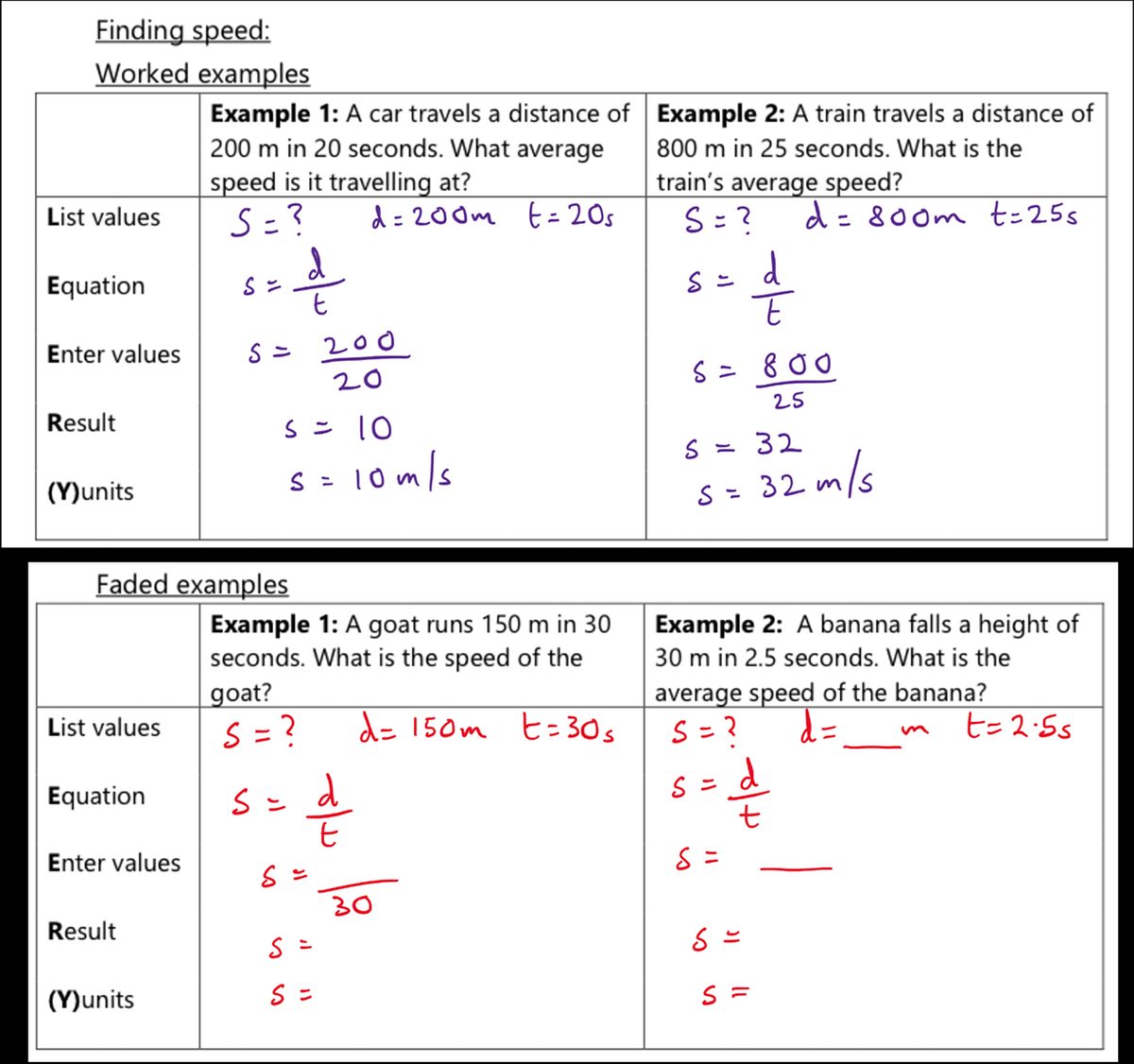
The top examples make the whole method visible:
- List the known values.
- Select the relationship between the quantities.
- Substitute the values.
- Calculate.
- State the answer with units.
The faded examples retain the structure but remove parts of the solution. This is often a sensible transition after studying a model because you are not being asked to invent an unfamiliar process from nothing.
For a clean comparison in this lesson, however, keep “worked examples” and “retrieval practice” distinct. A faded example is a hybrid: it provides some guidance while requiring some retrieval. It is excellent for ordinary revision, but it is not a pure test of which method you used.
What delayed tests reveal
The important word in this lesson is delayed. A method that helps you answer a question five minutes after study may not be the method that leaves you able to answer it a week later.
Yeo and Fazio compared repeated study of worked examples with repeated retrieval in several experiments. Their central finding was not that one strategy always wins. Instead, the better choice depended on the learning goal: retaining stable information versus learning a flexible procedure.
[PDF] Retrieval Practice Versus Worked Examples - Andy Matuschak
Read selected parts of Yeo and Fazio’s research article, “The Optimal Learning Strategy Depends on Learning Goals and Processes: Retrieval Practice Versus Worked Examples.” It provides the evidence behind the practical distinction you are making in this lesson.
In the abstract and opening introduction on p. 73, read the opening rationale. Focus on the authors’ distinction between remembering material and learning a procedure. Next, on p. 79, find the “Discussion” following Experiment 1. Read the Experiment 1 conclusion. Notice that the authors assess both factual recall and procedure use, not merely whether students enjoyed the method. Finally, on pp. 86–87, in “General Discussion” and “Conclusion,” read from the retention summary. Focus on how a longer retention interval changes the value of retrieval practice.
The study found two patterns worth remembering.
1. Stable facts benefit strongly from retrieval over time
For material where the goal was to remember the contents of a passage, repeated studying and repeated retrieval produced similar results after five minutes. After one week, however, the retrieval group recalled more: about 41 percent of the idea units compared with about 28 percent for the repeated-study group.
This fits everyday experience. Rereading notes before a test can create a strong sense of familiarity, but it does not necessarily build the ability to produce knowledge when the notes are gone.
Examples of relatively stable knowledge include:
- definitions in Economics or Geography
- terminology in Studies of Religion
- quotations, textual evidence, and contextual facts in English
- formulas, laws, and units in Mathematics or Physics
For these, retrieval should become a major part of long-term revision.
2. New flexible procedures often need models first
When the goal was to learn a novel mathematical procedure, students who repeatedly studied worked examples initially performed better on problem solving than students who only repeatedly attempted retrieval.
That result makes sense for an unfamiliar multi-step skill. Before you can efficiently retrieve a process, you need some process worth retrieving. A well-chosen worked example lets you form an initial mental model of the procedure.
Examples include:
- rearranging an unfamiliar type of equation
- resolving a vector into components
- calculating a map distance from a scale
- tracing an economic change through several linked variables
- constructing an analytical paragraph from a model
This does not mean “only study examples.” The research also suggests that, when a delay matters, procedures benefit from retrieval because you need to remember the method as well as understand its logic.
A practical Year 12 sequence is therefore usually:
- Study one or two accurate worked examples when the process is new.
- Complete a faded or guided example while the model is still visible nearby.
- Attempt a similar question with notes closed.
- Check the solution carefully and correct it.
- Return after a delay and retrieve the method again.
Run a fair personal comparison
Research gives you a strong starting point, but it is useful to test how a strategy works for your current material. One trial will not provide perfect scientific evidence, yet a controlled comparison is far more informative than deciding based on what feels easiest.
This activity takes about 20 minutes now, followed by a 10-minute delayed test in one week.
Step 1: Choose matched material
Choose two short, comparable sets of questions from the same subject and topic. Each set should involve:
- the same broad skill level
- the same number of examples or questions
- similar wording and difficulty
- material you have not already mastered
- the same study time
For instance, use two sets of four basic calculation questions from a new Mathematics or Physics topic. Avoid making one set straightforward and the other set full of unfamiliar extensions. You would then be comparing the questions, not the methods.
For a first comparison, a new or shaky procedure is often easiest because worked examples have an obvious form.
Step 2: Study Set A with worked examples
Give yourself eight minutes.
Study three or four fully correct solutions. Follow each line and identify:
- what the question gives you
- what is being found
- the rule, formula, or reasoning pattern selected
- where values are substituted or evidence is used
- how the final answer is checked or expressed
Do not turn this part into independent practice. You are testing the effect of studying models, so keep the completed solution visible.
Record the set as Worked Example condition.
Step 3: Study Set B with retrieval practice
Give yourself the same eight minutes.
First allow yourself the same brief initial exposure to the relevant rule or notes. Then close the notes and attempt comparable questions from memory. After each attempt, check a complete answer and correct your work in a different colour.
Record the set as Retrieval condition.
If you cannot begin a question at all, make a genuine attempt before checking. Write what you do remember: the formula, the first step, a relevant definition, or the type of response required. Partial retrieval still tells you exactly what needs rebuilding.
Step 4: Protect the delay
Put both sets aside. Do not revise either set before the delayed test, or the comparison will no longer be fair.
A one-week delay best matches the research you read. If you need a quicker decision for an upcoming task, use a two-day delay, but treat the result as a less reliable first indication.
Step 5: Take a closed-book delayed test
One week later, do a short test without notes:
- two new questions testing the Set A skill
- two new questions testing the Set B skill
- one minute at the start to write down any formulas, steps, or key ideas you can recall
Use new questions rather than repeating the original ones. You want to know whether you can use the knowledge, not whether you remember the page layout.
Score each question consistently. For procedures, give yourself separate credit for selecting the correct method and for reaching a correct final answer. For content-heavy subjects, score accurate key points, terminology, evidence, or links in your explanation.
A simple record is enough:
| Condition | Delayed recall of method or key ideas | Delayed application score | What went wrong, if anything? |
|---|---|---|---|
| Worked examples | |||
| Retrieval practice |
Repeat this comparison with another matched pair before making a big change to your study routine. On the second round, swap the order in which you use the methods, because the set studied first or last can sometimes gain an unfair advantage.
Selecting your initial approach
Use your results alongside the nature of the task.
| If your immediate situation is… | Start with… | Then add… |
|---|---|---|
| You must remember facts, definitions, quotations, terminology, or formulas for weeks | Retrieval practice | Spaced recall and feedback |
| You face a new multi-step procedure and do not yet know how to begin | Correct worked examples | Guided questions, then closed-book attempts |
| You can follow a solution but cannot reproduce it later | Retrieval practice | Feedback and a later reattempt |
| You repeatedly make the same procedural mistake | A carefully chosen worked example of that exact step | A fresh problem without notes |
| You can solve standard questions but struggle with unfamiliar versions | Several varied worked examples | Retrieval with varied practice questions |
The decision rule is simple:
Use worked examples to build an initial map of an unfamiliar procedure. Use retrieval practice to make knowledge available after the map is no longer in front of you.
For Year 12, the most reliable default will usually be a combination, but with the order chosen deliberately. Do not spend an entire revision session rereading completed solutions when your assessment will require recall. Equally, do not spend an entire first encounter with a difficult new method struggling through questions without first seeing what a correct solution looks like.
Key takeaways
Worked examples and retrieval practice are both effective, but they support different needs. Worked examples are particularly valuable when a complex procedure is new; retrieval is particularly valuable when you need knowledge to survive a delay. Familiarity during study is not sufficient evidence of learning, so use a closed-book delayed test to judge your approach.
Your first task is to run the matched-material comparison, record your delayed results, and use them to select a starting strategy for one subject. In the next lesson, you will build on that evidence by creating an error log that identifies why an answer went wrong, rather than simply marking it incorrect.
Can't find a good explanation? Sign up and we'll make it for you
Sign up