
Hello! Welcome back to our brief history of Bogotá.
In our last lesson, we saw the dramatic start of the independence movement, sparked by the cleverly orchestrated 'Florero de Llorente' incident. We left off with the birth of a massive new nation, Gran Colombia, and the fundamental clash between its two founding fathers: Simón Bolívar, the visionary who wanted a strong, centralized state, and Francisco de Paula Santander, the pragmatist who championed a republic built on laws.
Today, we will see the outcome of that clash. Our goal is to trace Bogotá's evolution from the capital of Gran Colombia to the capital of the modern Republic of Colombia. We'll watch as Bolívar's grand project collapses and a new, more compact nation rises from its ashes, undergoing a series of identity crises and "rebrands" before finally settling on the Colombia we know today, with Bogotá at its heart.
The Collapse of a Dream
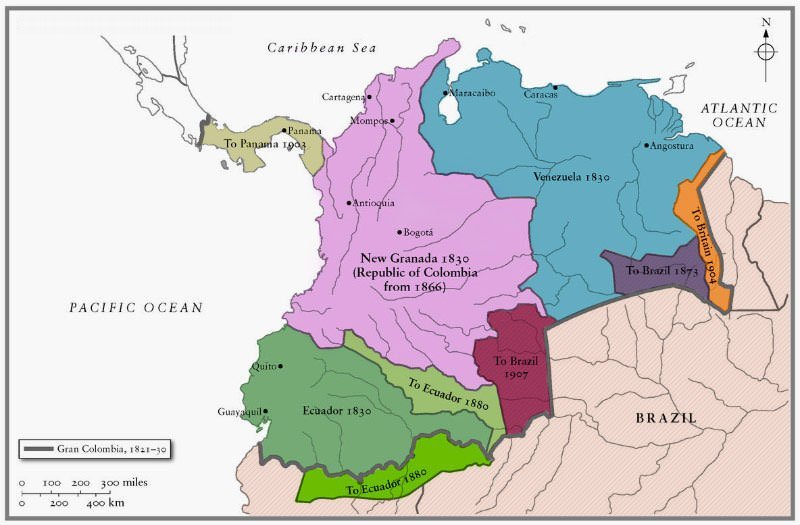
Bolívar's vision for Gran Colombia was epic: a single, powerful republic stretching from the Caribbean to the Pacific, strong enough to rival the powers of Europe and North America. Bogotá was chosen as its capital. However, from a systems design perspective, the project had critical flaws from the start.
The 'users'—the people of Venezuela, Ecuador, and New Granada (modern-day Colombia)—had distinct regional identities forged over centuries of separate colonial administration. The 'infrastructure'—the rugged Andes mountains and vast, undeveloped plains—made communication and economic integration nearly impossible. Forcing a rigid, centralized government from Bogotá onto these disparate regions created immense friction.
To understand the mechanics of this collapse, let's watch a video that breaks down the political and regional conflicts that tore Gran Colombia apart.
Why did Greater Colombia Collapse?
The video 'Why did Greater Colombia Collapse?' by the channel Knowledgia provides a detailed look at the internal conflicts that doomed the federation. It clearly explains the roles of key figures and the rise of regional movements.
Please watch from 05:39 to 08:25 and then from 08:51 to 10:35. Focus on the reasons the union failed, particularly the tension between the central government and regional leaders like José Antonio Páez in Venezuela, and how Bolívar's attempts to centralize power backfired.
As the video explains, the key factors in the breakup were:
- Regionalism: Leaders in Venezuela and Ecuador resisted taking orders from the central government in Bogotá.
- Political Division: The deep-seated conflict between Bolívar's centralists and Santander's federalists paralyzed the government.
- Bolívar's Authoritarianism: His late attempts to impose a more powerful, lifelong presidency were seen as a move toward dictatorship and alienated even his allies.
By 1830, Bolívar, exhausted and defeated, resigned. He died shortly after, watching his dream crumble. By 1831, Venezuela and Ecuador had officially seceded. Gran Colombia was no more.
Test your understanding!
Thinking like a product designer, if Gran Colombia were a digital product (e.g., a social network for South Americans), what were its core "design flaws" that led to its failure?
Show answer
Several design flaws stand out:
- Poor User Research: The system was designed top-down by Bolívar without fully accounting for the strong existing identities and "user needs" of the regions (the 'users'). They didn't want to be assimilated; they wanted autonomy.
- Flawed Architecture: A highly centralized architecture was unworkable given the poor "network infrastructure" (the physical geography of the Andes). Decisions from the central server (Bogotá) couldn't be implemented effectively or quickly in the regions.
- Bad User Experience (UX): From the perspective of a Venezuelan or Ecuadorian, the UX was poor. They felt their local industries were ignored, they were underrepresented, and their affairs were being dictated by a distant capital, leading to high "user churn" (secession).
- Leadership Conflict: The conflict between the "CEO" (Bolívar) and "COO" (Santander) over the core product vision (centralism vs. federalism) created instability and prevented any consistent strategy.
An Era of Reinvention: New Granada and the Search for a Name
With Gran Colombia dissolved, the central territory, which included present-day Colombia and Panama, had to forge a new identity.
The first step in this national "rebranding" was taken in 1831.
[2026] History of Colombia: a journey through the ages
The article 'History of Colombia: a journey through the ages' on Visit My Colombia outlines the period immediately following the breakup. Let's read the section that describes the new state that emerged.
Please read the section titled 'The Republic of New Granada (1831-1858)'. Focus on how this new, smaller republic was formed and the kinds of instability it immediately faced.
As you read, you'll see that the new Republic of New Granada, with Bogotá as its capital, was simply a smaller container for the same old conflicts. The ideological battle between the followers of Bolívar (who would form the Conservative Party) and the followers of Santander (the Liberal Party) continued, often erupting into violent civil wars.
This instability was reflected in the country's very name, which went through a series of changes as different political philosophies gained the upper hand:
- Republic of New Granada (1831-1858): A centralist state.
- Granadine Confederation (1858-1863): The name change signaled a shift toward a more federalist, decentralized model, giving more power to the regions.
- United States of Colombia (1863-1886): An even more radical federalist constitution, creating nine "sovereign states" with a weak central government.
This constant rebranding reflected a nation struggling to define its core operating system: should power be centralized in Bogotá or distributed among the states?
The Modern Republic is Forged
After decades of instability and civil war under federalist systems, the pendulum swung decisively back toward centralism. Let's read about the final, lasting transformation.
[2026] History of Colombia: a journey through the ages
Let's return to the 'History of Colombia' article to see how the modern republic was finally established.
Read the short section titled 'The Republic of Colombia: a new nation (1886)'. It explains the creation of the political structure that exists today.
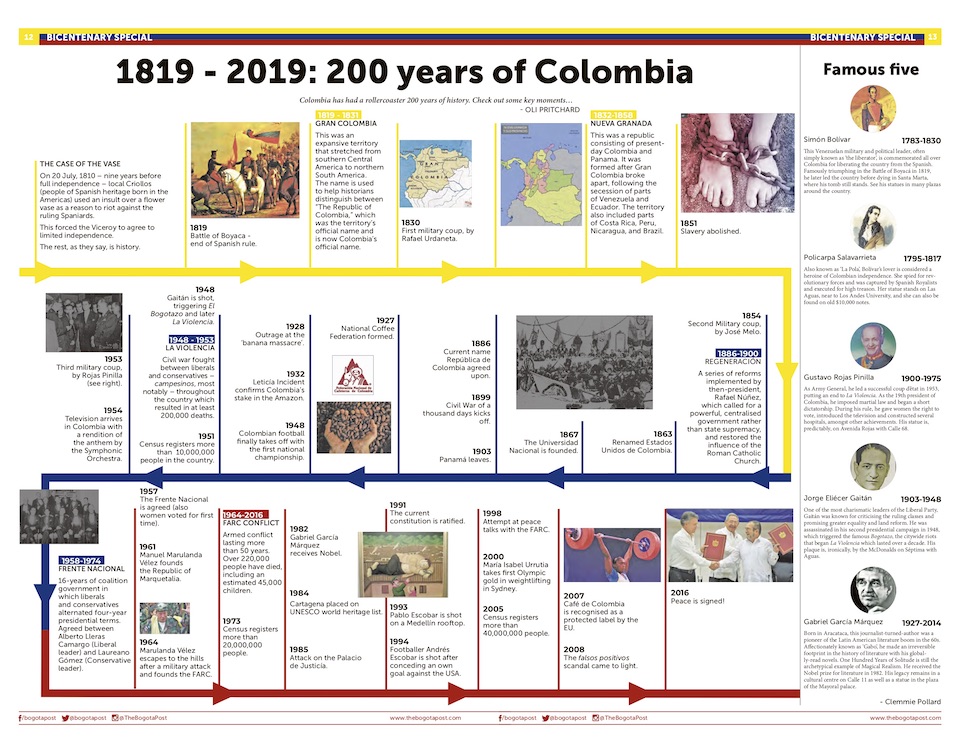
In 1886, President Rafael Núñez, a former Liberal who switched sides, spearheaded a new constitution. It abolished the United States of Colombia and created the Republic of Colombia. This constitution, which remained in force for over 100 years, did two crucial things:
- It dissolved the "sovereign states" and created departments with governors appointed by the president.
- It consolidated political, economic, and military power firmly in the central government in Bogotá.
This was the final step. Bogotá's journey was complete: from the regional center of the Muisca, to the capital of the Spanish Viceroyalty, to the ambitious but failed capital of Gran Colombia, and now, finally, to the undisputed center of the modern Republic of Colombia.
Conclusion
Today we traced the tumultuous journey from a continental empire to a modern nation-state. We saw how Bolívar's grand vision for Gran Colombia shattered against the hard realities of regionalism and political infighting, a classic case of a system failing to meet the needs of its users.
Our key takeaways are:
- System Failure: Gran Colombia collapsed due to a combination of geographical barriers, strong regional identities, and intractable political conflict between centralist and federalist models.
- An Age of Instability: The successor state, New Granada, remained politically volatile. Its various name changes—from Republic of New Granada to Granadine Confederation to the United States of Colombia—reflect a prolonged identity crisis and a struggle between centralist and federalist ideals.
- Consolidation of Power: The 1886 Constitution marked the definitive victory for the centralist model, creating the modern Republic of Colombia and cementing Bogotá's role as the nation's powerful political and administrative center.
The political conflicts of the 19th century were not just abstract. They directly shaped the physical and social fabric of Bogotá. In our next lesson, we will begin exploring how the city started to modernize, examining projects like the tramway and the National Capitol as tangible results of these turbulent times.
Can't find a good explanation? Sign up and we'll make it for you
Sign up