
Hello! Welcome back to our brief history of Bogotá.
In our last two lessons, we acted like urban and social archaeologists. We first deconstructed the physical "user interface" of colonial Bogotá—the grid plan and plaza designed for control. Then, we mapped its social "operating system"—the rigid Casta pyramid that assigned everyone a role based on their birth. We left off by highlighting the system's most critical tension: the educated and wealthy Criollos, who were blocked from real power by the Spanish-born Peninsulares.
Today, we'll see that tension ignite. Our goal is to narrate the 'Florero de Llorente' incident and explain how it ignited the independence movement, leading to the clash between Simón Bolívar's and Francisco de Paula Santander's visions. This isn't just a story about a broken vase; it's a masterclass in strategic provocation and a foundational conflict over what it means to build a nation—a clash of visions that will feel very familiar to anyone involved in strategy and design.
Setting the Stage: A Power Vacuum
The Criollo frustration had been simmering for decades. But for a revolution to start, you often need more than just internal discontent; you need an external opportunity. That opportunity came from Europe.
In 1808, Napoleon Bonaparte invaded Spain and forced the Spanish King, Ferdinand VII, to abdicate. This threw the entire Spanish Empire into a crisis of legitimacy. Who was in charge? Was it the French usurper? The deposed king? Or the local juntas (councils) that sprung up in Spain to resist Napoleon?
For ambitious Criollos in the Americas, this was the moment they had been waiting for. With the central authority of the Spanish Crown shattered, they saw a chance to assert their own authority. They began forming their own juntas, initially claiming to rule in the name of the deposed king, but with the clear underlying goal of achieving self-governance.
The Spark: A Designed Incident
By July 1810, several cities in the New Kingdom of Granada had already formed their own juntas. Bogotá, as the capital and seat of the Viceroy, was the final and most important domino to fall. The Criollo leaders in Bogotá knew they needed a public, dramatic event to galvanize the population and force the Viceroy's hand. They didn't wait for one to happen—they designed one.
This is where your background in strategic design becomes relevant. The "Florero de Llorente" was not a spontaneous riot; it was a carefully planned piece of social engineering, a trigger designed to elicit a predictable response.
Let's read the details of the broader context and the incident itself.
How a Vase Played a Key Role in Colombian ...
The article 'How a Vase Played a Key Role in Colombian Independence' provides an excellent narrative of the events. It sets the political stage and then walks through the day of the vase incident itself.
Please read from the beginning of the section 'Napoleon’s Occupation of Spain Sets off a Political Crisis' through to the end of 'The Vase Incident'. As you read, focus on how the Criollos manufactured the confrontation with the Spanish merchant, Llorente.
As the reading explains, the plan was brilliant in its simplicity:
- Choose the right time and place: They picked Friday, market day, in the main plaza (now Plaza de Bolívar), ensuring a large audience.
- Create a pretext: They asked a well-known Spanish merchant, Joaquín González Llorente, to borrow a decorative vase, supposedly for a dinner honoring a fellow Criollo patriot.
- Anticipate the reaction: They knew Llorente, a Peninsular, would likely refuse them, the Criollos. Whether he did so politely or arrogantly was irrelevant.
- Escalate and reframe: When he refused, they loudly accused him of insulting all Americans, turning a private dispute into a public symbol of Spanish arrogance.
The plan worked perfectly.
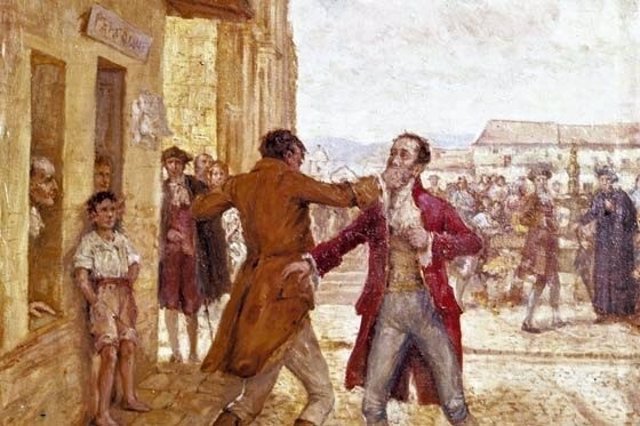
The ensuing uproar forced the Spanish Viceroy to convene an open town meeting (cabildo abierto). Under pressure from the organized Criollos and the angry mob, the council deposed the Viceroy and signed the Acta de Independencia on July 20, 1810. While it proclaimed loyalty to the king, it established an independent governing junta for New Granada. The trigger had been pulled.
Test your understanding!
From a strategic design perspective, why was a physical object—the vase—so effective as the centerpiece of this provocation?
Show answer
The vase served as a tangible, relatable symbol. Abstract grievances about political representation can be hard for a crowd to rally around. But a beautiful object, denied by an arrogant Spaniard and then dramatically smashed, is a powerful, visceral story. It transformed a complex political conflict into a simple narrative of "us vs. them," "humble Criollo vs. haughty Peninsular." It was a prop that made the drama concrete and emotionally resonant.
The Messy Aftermath: La Patria Boba
Winning autonomy was one thing; agreeing on what to do with it was another. The period immediately following 1810 is known in Colombian history as La Patria Boba—the "Foolish Fatherland."
The patriot forces, instead of consolidating their power, immediately began fighting among themselves. The core conflict was between:
- Centralists: Led from Bogotá, they wanted a strong, centralized government modeled on France.
- Federalists: Based in other provinces like Cartagena, they feared Bogotá's dominance and wanted a decentralized federation of states, like the United States.
This infighting weakened the independence movement, and when King Ferdinand VII was restored to the Spanish throne in 1814, he sent a massive army to reconquer the rebellious colonies. By 1816, the Spanish were back in control, executing many of the original patriot leaders. It seemed the revolution had failed.
The Liberator and The Lawmaker: Two Visions for a Nation
The independence movement was saved by one of history's most compelling figures: Simón Bolívar. In 1819, he led a small, ragged army on an incredible march from the Venezuelan plains, up and over the freezing Andes, to surprise and defeat the Spanish at the Battle of Boyacá. This decisive victory secured the independence of New Granada for good.
Bolívar's military genius created a new nation, Gran Colombia (uniting modern-day Colombia, Venezuela, Ecuador, and Panama), with Bogotá as its capital. But now came the harder question: how to govern it? This is where the defining ideological conflict of the era emerged, personified by two men.

-
Simón Bolívar, The Liberator: A charismatic, aristocratic visionary. Having witnessed the chaos of the Patria Boba, Bolívar was deeply skeptical of democracy. He believed the new, fragile nations needed a powerful, centralized government with a strong, lifelong president—almost a constitutional monarch. His priority was unity and glory; his method was top-down, decisive leadership. Think of him as the visionary CEO, focused on the grand mission, willing to bend the rules to achieve it.
-
Francisco de Paula Santander, The Man of Laws: A methodical, pragmatic lawyer and soldier who served as Bolívar's vice president. For Santander, the chaos of the Patria Boba taught a different lesson: the only defense against tyranny and anarchy was a nation of laws, not men. He believed power must be constrained by a constitution, that civilian rule must be supreme, and that the state's most important work was building schools and courts. Think of him as the systems-building COO, focused on creating stable, repeatable processes and a strong institutional framework.
This clash wasn't just personal; it was a fundamental debate over the design of a country. Should a nation be forged by the will of a great leader, or built upon a foundation of inviolable laws? Bolívar accused Santander of being a petty legalist who couldn't see the big picture. Santander believed Bolívar was leading them toward a new dictatorship. Their conflict grew so bitter that it ultimately led to the dissolution of Gran Colombia in 1831 and set the stage for a century of political conflict in Colombia between the parties that would evolve from their respective philosophies.
Conclusion
Today, we witnessed the birth of a nation, sparked by a brilliantly orchestrated incident and forged in war. We saw how a seemingly minor event, the quarrel over a flower vase, was the carefully designed trigger that unleashed decades of pent-up social and political frustration.
Our key takeaways are:
- A Planned Revolution: The "Florero de Llorente" incident was not an accident but a strategic provocation, designed by Criollo leaders to force a public confrontation and galvanize support for independence.
- Chaos Precedes Order: The initial declaration of autonomy led to internal conflict during the Patria Boba, which allowed a temporary Spanish reconquest.
- Two Founding Visions: True independence was secured by Simón Bolívar's military campaign, but this victory gave way to a deep ideological conflict between his centralist, authoritarian vision and Francisco de Paula Santander's vision of a republic built on laws and institutions.
This fundamental clash between the charismatic leader and the systematic institution-builder is a story that has played out in countless startups, companies, and nations. In our next lesson, we will see how their struggle, and the eventual breakup of Gran Colombia, shaped the city of Bogotá as it became the capital of the modern Republic of Colombia.
Can't find a good explanation? Sign up and we'll make it for you
Sign up