Recommended resources
The freely available resources this lesson will direct you to.
Introduction
Welcome to the third lesson in our journey to building your influencer brand! In the last lesson, you did the critical work of defining your target audience by creating a detailed persona. You now have a clear picture of who you're creating for—someone like "Frugal Frankie," with specific financial anxieties and lifestyle goals.
Today, we'll build on that foundation to craft your personal brand statement. This is a single, powerful sentence that clearly and concisely communicates who you help, what you help them achieve, and how you do it. Think of it as your brand's compass; it will guide every piece of content you create and instantly tell new followers why they should pay attention to you.
By the end of this 60-minute lesson, you will have a clear, compelling brand statement that communicates your unique value as a frugal lifestyle creator.
What is a Personal Brand Statement?
Before we start writing, let's clarify what a personal brand statement is and why it's so important. It's the core of your message, distilled into an "elevator pitch" that you can use in your social media bios, when introducing yourself, and to keep your own content focused.
To get a formal definition, let's turn to a great resource on this topic.
25 Personal Brand Examples + Statements To Follow
The following article from Kartra, a platform for online creators, explains the concept of personal branding and introduces the idea of a brand statement. It also provides a helpful template that we will be using.
Please read the two short sections titled 'What Is Personal Branding and Why It Matters' and 'How to write a personal brand statement.' Focus on the definition of a personal brand statement and the simple template provided: I help [target audience] [goal] by [method].
The Core Formula for Your Brand Statement
As you just read, a strong brand statement follows a simple, effective formula. The most common structure is:
I help X achieve Y by doing Z.
- X = Your Target Audience: The specific group of people you serve.
- Y = Their Goal/Transformation: The result or outcome they desire.
- Z = Your Method/Approach: How you uniquely help them get there.
Let's watch a short video that brings this formula to life.
The Perfect Elevator Pitch - Best Examples and Templates
In this clip, business coach Patrick Dang explains this exact formula. It's a great, quick summary that will solidify the concept in your mind.
Watch from 00:49 to 01:43. Listen for how he breaks down the 'I help X achieve Y by doing Z' formula.
Now, let's break down each part of this formula and connect it to the work you've already done.
Step 1: Who You Help (Your 'X')
This is the easiest part because you've already done the work! Your 'X' is the audience persona you created in the last lesson.
Instead of a generic term like "people," use a specific descriptor from your persona.
- "Young professionals"
- "Recent college grads"
- "Budget-conscious renters"
- "Young families on a tight budget"
Using a specific audience makes your message feel personal and direct.
Step 2: What You Help Them Achieve (Your 'Y')
This is the transformation you offer. It should address a key pain point or goal from your audience persona. Remember "Frugal Frankie's" anxieties about debt and desire to feel in control? Your 'Y' should speak directly to that.
The key here is to focus on one primary problem. Trying to solve everything at once dilutes your message.
The Perfect Elevator Pitch: One Sentence That Will Grow Your Business
This video from StoryBrand with Donald Miller explains why focusing on a single, clear problem is far more effective than listing many. This is a crucial insight for making your brand statement powerful.
Watch from 03:26 to 08:18. Pay close attention to the 'Problem, Product, Result' framework and the advice that 'commas are not your friend'—meaning, don't list multiple problems. The goal is to find the one problem that resonates most strongly.
So, what is the single biggest goal you can help your audience with?
- "Feel in control of their finances"
- "Live a fulfilling life without going into debt"
- "Create a beautiful home on a tiny budget"
- "Stop living paycheck to paycheck"
Step 3: How You Help Them (Your 'Z')
This is your unique method. As a "cheap and cheerful" creator, your 'Z' is the specific type of content you'll provide. This is what makes you different from a stuffy financial advisor or an extreme minimalist.
Your 'Z' could be:
- "...by sharing fun, low-cost DIY projects."
- "...by teaching simple meal-prep and grocery-saving hacks."
- "...by providing daily tips for finding the best deals."
- "...by curating stylish, thrifted outfits."
This part of the statement tells your audience what to expect from your content.
Your Action Step: Draft Your Personal Brand Statement
It's time to put pen to paper (or fingers to keyboard). We'll use a simple template to structure your brainstorming and craft your first draft.
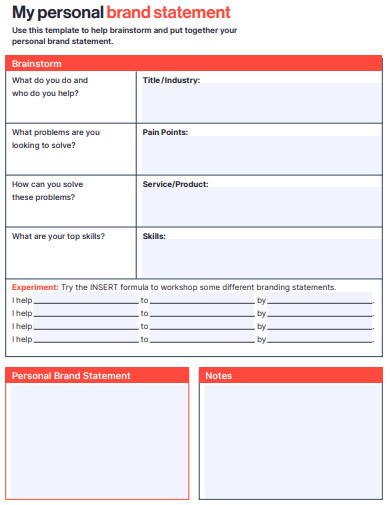
Your Task:
- Open a document or grab a notebook.
- Brainstorm: Use the prompts in the template image above to jot down ideas.
- Who do you help? (Your audience persona)
- What problem do you solve? (Their biggest pain point)
- How do you solve it? (Your specific content type/method)
- Experiment: Use the
I help ___ to ___ by ___formula to write at least three different versions of your brand statement. Mix and match your brainstormed ideas. - Select & Refine: Choose the one that feels the clearest and most authentic to you.
Example Drafts for a "Cheap and Cheerful" Niche:
- Version 1 (Food Focus): I help busy young professionals save money on groceries by sharing delicious, easy-to-make recipes that cost under $5 per serving.
- Version 2 (Home Decor Focus): I help renters on a budget create a home they love by teaching them creative DIY decor projects and thrifting secrets.
- Version 3 (General Lifestyle): I help recent grads overcome financial stress by sharing simple, cheerful tips for living a full life on a small income.
Don't strive for perfection on the first try. The goal is to get a solid draft that you can refine over time. This process is about gaining clarity.
Inspiration from Other Creators
Sometimes, seeing how others do it can spark ideas. While you work on your draft, feel free to look at how other successful creators frame their value.
25 Personal Brand Examples + Statements To Follow
The Kartra article you looked at earlier contains a long list of brand statements from successful creators in various fields. You don't need to read them all, but scanning a few can be very inspiring.
Scroll through the 'Examples of powerful personal brands' section. Pay attention to how clear and concise they are. For example, notice Lindsay Ostrom's simple but effective statement: 'Simple recipes made for real, actual, everyday life.'
Conclusion
Excellent work today! You have translated your brand's purpose into a single, focused sentence. This personal brand statement is more than just a tagline; it's a strategic tool that will keep your content consistent and make your value instantly clear to your ideal followers.
Key Takeaways:
- Your brand statement is your compass: It defines your purpose and guides your content strategy.
- Use the formula: "I help [Target Audience] achieve [Transformation] by [Your Method]" is a powerful and proven structure.
- Leverage your persona: Your brand statement should directly address the pain points and goals of the audience you defined in the last lesson.
- Clarity over complexity: Focus on a single, compelling problem to make your message strong and memorable.
Preview of the Next Lesson:
Now that you have a statement that defines your brand, the next step is to give it a name! In the next lesson, you will choose a memorable username and display name and learn how to check for its availability across all your target platforms (Instagram, TikTok, YouTube, X, and Pinterest).