
Hello! Welcome to the next lesson in our journey through rigid body dynamics.
In our last lesson, we focused on solving for forces and accelerations at a specific instant using the equations of motion ( and ). This method is powerful for understanding the instantaneous state of a system.
Today, we're going to learn a different but equally powerful technique: the Principle of Work and Energy for Rigid Bodies. This method shines when we're interested in the change in speed of a body after it has moved over a certain distance or rotated through a certain angle. It allows us to relate the initial and final states of motion without needing to calculate the acceleration in between. This is particularly useful for analyzing systems like landing gear mechanisms, rotating engine components, or control surface deployments.
Your learning outcome for this lesson is to apply the work-energy method for rigid bodies to relate forces, moments, and changes in speed.
1. The Principle of Work and Energy
The principle of work and energy is a fundamental concept that you've already seen for particles. For rigid bodies, the idea is the same, but we need to expand our definition of kinetic energy. The core equation is a scalar equation that represents a balance of energy:
Where:
- is the initial kinetic energy of the rigid body.
- is the sum of the work done by all external forces and couple moments as the body moves from state 1 to state 2.
- is the final kinetic energy of the rigid body.
This equation simply states that the initial energy of the body, plus the work done on the body, equals its final energy.
2. Kinetic Energy of a Rigid Body
A key difference between a particle and a rigid body is that a rigid body can both translate and rotate. Its total kinetic energy is the sum of the energy from both types of motion.
For a rigid body in general plane motion, the kinetic energy is given by:
- is the translational kinetic energy, based on the velocity of the center of mass .
- is the rotational kinetic energy, based on the body's angular velocity about its center of mass.
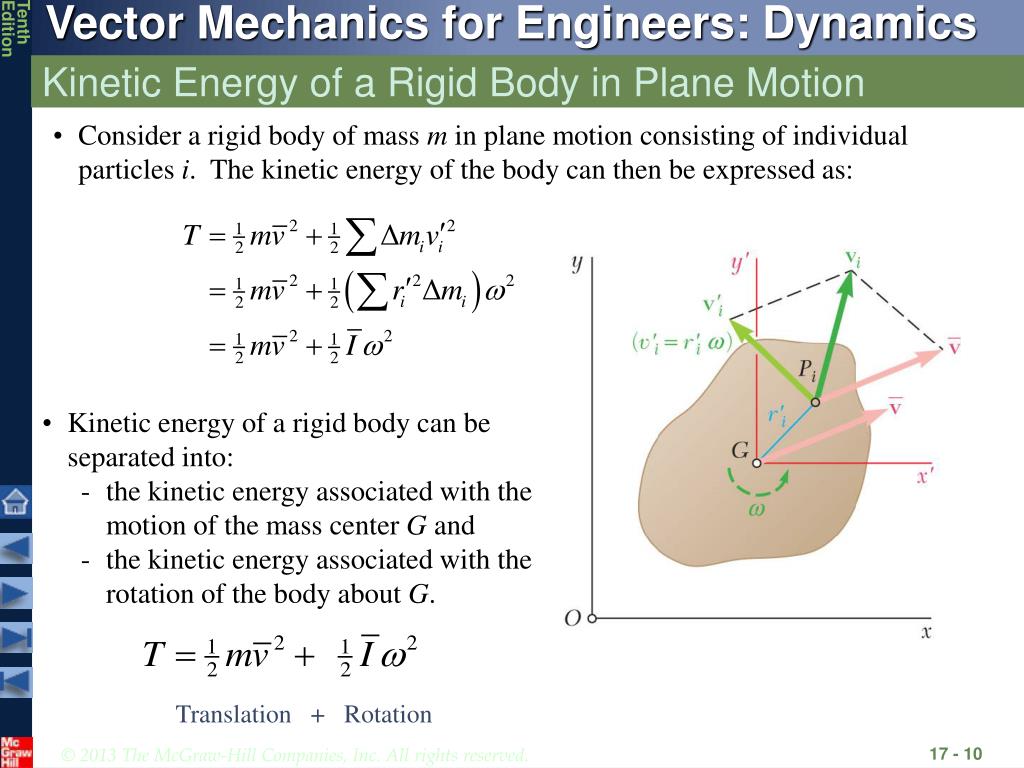
This is analogous to an electrical circuit that might have energy stored in both a capacitor (like translational energy) and an inductor (like rotational energy). Both contribute to the total energy of the system.
There are two important special cases:
- Pure Translation: If the body is only translating (), the rotational term is zero, and , just like for a particle.
- Fixed-Axis Rotation: If the body rotates about a fixed axis O, we can simplify the expression to , where is the mass moment of inertia about the pin O. This is a very useful shortcut.
3. Work Done on a Rigid Body
The work done, , is the sum of the work from all external forces and moments. Most of these are familiar from particle dynamics, but there is one crucial addition for rigid bodies.
- Work of a Force: . For a constant force, this simplifies to , where is the displacement of the point of application.
- Work of Gravity (Weight): , where is the vertical displacement of the center of mass. Work is positive if the center of mass moves down.
- Work of a Spring: , where and are the initial and final stretch/compression distances of the spring. This work is negative because the spring force opposes the displacement.
- Work of a Couple Moment (New!): A couple moment does work when the body it acts on rotates. The work done is , where is the angular displacement in radians. If the moment is variable, the work is .
Forces That Do No Work
It's equally important to identify forces that do not perform work, as they can be ignored in the work-energy equation:
- Reactions at a fixed, frictionless pin, because the point of application does not move.
- A normal force on a body moving along a surface, because the force is perpendicular to the displacement.
- The friction force for a body rolling without slipping, because the point of contact with the ground has an instantaneous velocity of zero, and therefore zero displacement.
4. Putting It All Together: A Comprehensive Video
The following video provides an excellent summary of all these concepts and then walks through several worked examples that demonstrate how to apply the principle of work and energy in different scenarios.
Rigid Bodies Work and Energy Dynamics (Learn to solve any question)
This video from Question Solutions will guide you through the complete process of using the work-energy method for rigid bodies. It covers the formulas for kinetic energy, the work done by different forces and moments, and three distinct example problems.
Watch the entire video (about 9.5 minutes). 0:00 - 4:05: Pay close attention to the formulas for kinetic energy and the work done by forces and moments. Notice the discussion of forces that do no work. 4:05 - 6:41: The first example is a rod in fixed-axis rotation. This is a great way to see the method applied to the type of motion we studied in the last lesson. 6:41 - 8:14: The second example involves a rolling disk and a spring, which is a classic general plane motion problem. 8:14 - 9:31: The final example shows how to handle a variable moment, which requires integration.
To complement the video, here is a concise text resource that lays out the key formulas for kinetic energy and work. It's a useful reference to have open as you work through problems.
Planar Kinetics of a Rigid Body: Work and Energy
These slides, 'Planar Kinetics of a Rigid Body: Work and Energy,' provide a clear, formula-based summary of the concepts discussed in the video.
Read through slides 3, 4, and 5. Focus on the equations for Kinetic Energy (slide 3), Work of a Force (slide 4), Work of a Couple (slide 5), and the final Principle of Work and Energy (slide 5).
5. Test Your Understanding
Let's apply these concepts to a typical aerospace-related problem. Consider a simplified aircraft wheel assembly.
A 50 kg wheel with a radius of gyration m is released from rest at the top of a 30-degree ramp. The wheel rolls without slipping. What is the velocity of its center, , after it has rolled 5 meters down the ramp?
A wheel of mass m and radius r rolls down a ramp inclined at angle θ.
Your Steps:
- Write down the principle of work and energy: .
- Determine the initial kinetic energy, .
- Calculate the work done, . Which force does positive work? Do the normal force or friction force do any work?
- Write the expression for the final kinetic energy, , using both translational and rotational terms. Remember that for rolling without slipping, .
- Substitute everything into the main equation and solve for .
Test your understanding!
Here's a breakdown of the solution.
-
Work-Energy Equation:
-
Initial Kinetic Energy (): The wheel starts from rest, so and .
-
Work Done ():
- Weight (Gravity): This is the only force doing work. The wheel moves 5 m down the ramp, so its vertical displacement is m. The work done by weight is positive because it moves down.
- Normal Force and Friction: As the wheel rolls without slipping, both the normal force (perpendicular to motion) and the friction force (at the point of zero velocity) do no work.
- Total Work:
- Weight (Gravity): This is the only force doing work. The wheel moves 5 m down the ramp, so its vertical displacement is m. The work done by weight is positive because it moves down.
-
Final Kinetic Energy ():
- The wheel has both translational and rotational energy.
- We need . We are given the radius of gyration .
- For rolling without slipping, . The radius isn't given, which is a common trick! Let's re-read the problem. Ah, a wheel... let's assume the radius of gyration is the key parameter, and we don't need the physical radius unless it's given. In many problems, we might assume the wheel is a uniform disk () if isn't provided. Let's assume the problem meant the physical radius is also needed for the kinematic constraint. Let's say the radius of the wheel is m (a reasonable value). So, .
- Substituting into :
- The wheel has both translational and rotational energy.
-
Solve for :
Conclusion
In this lesson, you've added a powerful scalar method to your dynamics toolkit. The principle of work and energy allows you to directly relate forces, moments, distance, and speed, bypassing the need to solve for acceleration as an intermediate step.
Key Takeaways:
- The work-energy principle for rigid bodies is .
- The kinetic energy of a rigid body includes both translational () and rotational () components.
- Work can be done by external forces (like weight and springs) and also by external couple moments ().
- Remember to identify forces that do no work, such as reactions at fixed pins and friction in rolling without slip.
- This method is most effective for problems where you need to find a change in velocity over a given distance or rotation.
Next Lesson Preview:
We will next explore the principle of impulse and momentum for rigid bodies. This is another method that relates the "before" and "after" states of motion. While work-energy deals with forces over a distance, impulse-momentum deals with forces over a period of time and is especially powerful for analyzing collisions and impacts.
Can't find a good explanation? Sign up and we'll make it for you
Sign up