
Hello again. Last lesson dealt with gross earnings: separating ordinary hours, overtime, and allowances before adding the parts. Interest questions need the same careful reading. First identify the starting amount, rate, time, and whether the interest is simple or compound.
In this lesson, you will calculate both the interest earned and the final amount for savings or loans. This is a high-value exam skill because the maths is predictable once you choose the right formula and convert the percentage correctly.
Start by decoding the financial language
These terms appear in almost every interest question:
| Term | Meaning |
|---|---|
| Principal, | The original amount invested or borrowed |
| Interest, | The extra money earned on savings or charged on a loan |
| Rate, | The interest rate per year, written as a decimal in formulas |
| Time, | Time in years |
| Final amount, | The total balance after interest has been added |
For example, if AUD 2000 becomes AUD 2180, then:
The final amount is AUD 2180, while the interest is only AUD 180. A question may ask for either one, so circle the exact wording.
A quick decision guide:
| If the question says... | Use... |
|---|---|
| “simple interest” | |
| Interest is calculated only on the original deposit | Simple interest |
| “compounded annually,” “monthly,” or “daily” | Compound-interest formula |
| Interest is earned on previous interest | Compound interest |
Watch this short explanation before working through the formulas. It gives a useful overview of both forms of interest.
Simple and Compound Interest Problems Explained | Algebra 2
Watch “Simple and Compound Interest Problems Explained” from your math tutor to hear the meaning of principal, rate, time, and compounding in worked financial situations.
Watch simple interest for the formula, the decimal-rate conversion, and the meaning of each variable. Then skip to compound interest and focus on the key idea that the balance, rather than just the original deposit, is used at later interest calculations.
Simple interest: the original amount stays the base
With simple interest, the interest is always calculated from the original principal. It does not grow from year to year.
The formula for interest is:
where must be a decimal. Therefore:
If the question asks for the final amount, add the interest back onto the principal:
You can also combine these ideas:
However, in an exam, using first is often safer because it clearly distinguishes the interest from the final balance.
Calculating interest: simple interest (article) - Khan Academy
Read Khan Academy’s “Calculating interest: simple interest” for a compact explanation of the formula and a worked example.
In the section “Simple interest,” read the formula explanation. Then follow the example immediately below it. Focus especially on why the percentage is written as a decimal and why the time is measured in years.
Worked example: savings account
A student deposits AUD 2400 in an account paying simple interest of 4.5% per annum for 3 years. Calculate the interest earned and final amount.
First, identify the values:
Calculate the interest:
The interest earned is AUD 324.00.
Now calculate the final amount:
Therefore, the final amount is AUD 2724.00.
Why simple interest grows evenly
The annual interest is the same every year because the principal remains AUD 2400.
Over three years, the account earns three lots of AUD 108:
This regular growth is the defining feature of simple interest.
Time must be in years
If the rate is expressed per annum, convert months to years before using .
For example:
If AUD 5000 is invested at simple interest of per annum for 18 months:
Do not use as the value of , because that would incorrectly treat 18 months as 18 years.
Compound interest: interest earns interest
With compound interest, each new interest calculation uses the current balance, including interest earned earlier. This is why compound interest produces a higher final amount than simple interest when the principal, rate, and time are the same.
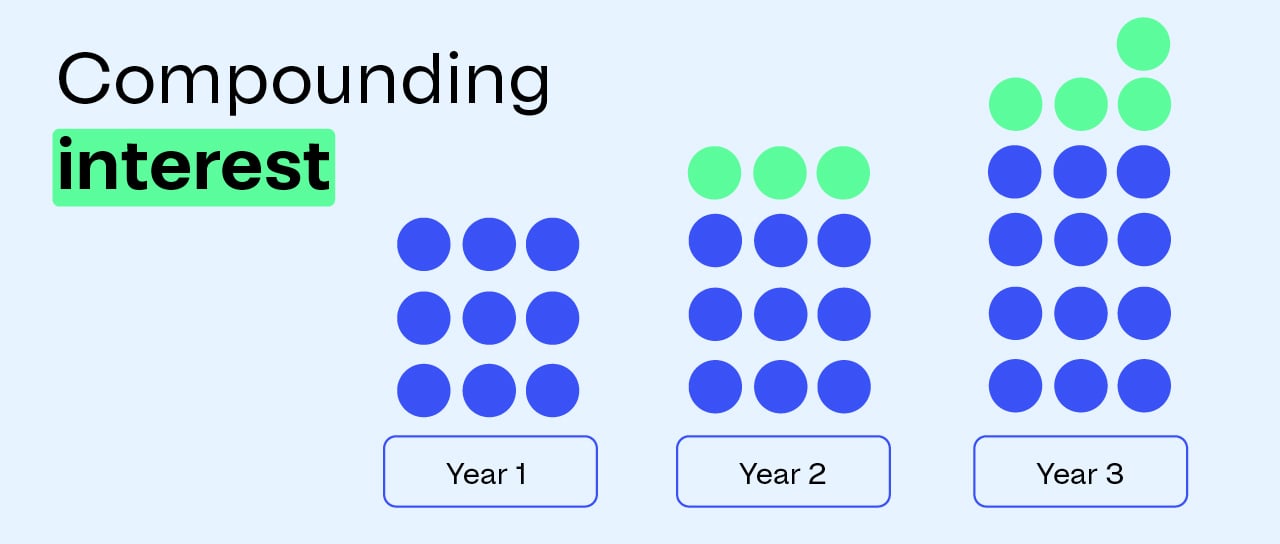
The key phrase is:
Interest is earned on interest already earned.
Compound interest - Moneysmart.gov.au
Read the “How compound interest works” section of MoneySmart’s “Compound interest” page to build the concept before applying the formula.
In the section “How compound interest works,” read the comparison of compound and simple interest. Stop before “Save more with compound interest.” Focus on the changing balance: each later calculation is based on more than the original deposit.
Compound interest compounded annually
When interest is compounded annually, use:
Then find interest earned by subtracting the original principal:
Worked example: compounded annually
Use the same starting amount as the simple-interest example:
- Principal: AUD 2400
- Rate: per annum
- Time: 3 years
- Interest compounded annually
Substitute into the formula:
So the final amount is AUD 2738.80.
Now find the interest:
The compound interest earned is AUD 338.80.
Compare the two accounts:
| Interest type | Final amount after 3 years | Interest earned |
|---|---|---|
| Simple interest | AUD 2724.00 | AUD 324.00 |
| Compound interest, annual | AUD 2738.80 | AUD 338.80 |
Compound interest earns an extra AUD 14.80 in this example. The difference becomes much more noticeable with larger deposits, higher rates, or longer time periods.
Monthly and daily compounding
If interest is compounded more than once per year, use the general compound-interest formula:
where:
- is the final amount;
- is the principal;
- is the annual interest rate as a decimal;
- is the number of times interest is compounded each year;
- is the time in years.
Common values of :
| Compounding frequency | |
|---|---|
| Annually | |
| Quarterly | |
| Monthly | |
| Daily |
The formula makes two adjustments:
- Divide the annual rate by , because each interest period is shorter than a full year.
- Multiply the number of years by , because there are more interest calculations.
Worked example: compounded monthly
AUD 2000 is invested at per annum, compounded monthly, for 2 years. Find the final amount and interest earned.
Identify the values:
Substitute carefully:
The final amount is AUD 2209.88.
Find the interest:
Therefore, the interest earned is AUD 209.88.
Keep all calculator digits until the final answer, then round money to two decimal places. Rounding the monthly rate too early can slightly change the final amount.
Exam method: choose, substitute, answer
For any interest question, use this layout.
1. Identify the type of interest
Look for key words such as:
- simple interest;
- compounded annually;
- compounded monthly;
- compounded daily.
Do not choose a formula just because the question involves a savings account. Savings accounts can use compound interest, while some other products may use simple interest.
2. Write the known values
For example:
For monthly compounding, also write:
Writing these values first helps prevent a common error: entering instead of .
3. Use the appropriate formula
For simple interest:
For compound interest:
For annual compounding, you may use:
4. State exactly what was requested
Use a full financial conclusion, such as:
- “The interest earned is AUD 324.00.”
- “The final account balance is AUD 2738.80.”
- “The total amount owing is AUD 2209.88.”
For a loan with no repayments, the same mathematics applies, but interest is payable rather than earned. Real loans can also include repayments, fees, and changing rates; in an exam question, follow the conditions provided.
Common errors to avoid
- Leaving a percentage as instead of converting it to .
- Giving the interest when the question asks for the final amount.
- Giving the final amount when the question asks for interest only.
- Using for 18 months instead of years.
- Treating monthly compounding as annual compounding.
- Rounding during intermediate calculator steps rather than at the end.
Key takeaways
- Simple interest is calculated only from the original principal:
- For simple interest, the final amount is:
- Compound interest is calculated from the growing balance, so it includes interest on earlier interest.
- For annual compounding:
- For monthly, quarterly, or daily compounding:
- To find compound interest earned, subtract the original principal:
This completes the consumer-arithmetic section of your revision. Next, you will move into measurement problems, using perimeter, area, volume, scale factors, similarity, and consistent units.
Can't find a good explanation? Sign up and we'll make it for you
Sign up