
Good to see you again. You have now finished the consumer-arithmetic part of your revision: percentage problems, earnings, and interest all depended on identifying what changes and keeping units or percentages consistent. Measurement questions use the same habit, but now the key is to identify whether you are working with a length, area, or volume.
This lesson brings together perimeter, area, volume, similarity, scale factors, and unit conversion. These commonly appear as multi-step exam questions, so the goal is not just remembering formulas: it is choosing the correct operation and presenting a clear solution.
Start with the measurement type
Before calculating anything, look at the unit required. It tells you what type of measurement the question involves.
| Measurement | What it describes | Common units | What to do |
|---|---|---|---|
| Perimeter | Distance around a 2D shape | , , | Add outside lengths |
| Area | Space covered by a flat 2D shape | , | Use a 2D area formula |
| Surface area | Total area covering a 3D object | , | Add areas of all faces |
| Volume | Space inside a 3D object | , , | Use a 3D volume formula |
For the common shapes in General Mathematics:
A perimeter answer in , or a volume answer in , should immediately look wrong. The exponent on the unit is part of the answer, not decoration.
A practical example: court boundary
A rectangular training area is long and wide.
If the question asks how much tape is needed around the edge, calculate perimeter:
If it asks how much floor space the area covers, calculate area:
The dimensions are identical, but the question changes what you calculate.
Consistent units: convert before applying a formula
You can only add or multiply measurements meaningfully when the units match. If a rectangular garden bed has a length of and width of , do not calculate . First convert one measurement.
For instance:
Then calculate its area:
The conversion relationship for metric length is:
However, when the unit is squared or cubed, the conversion factor must also be squared or cubed.
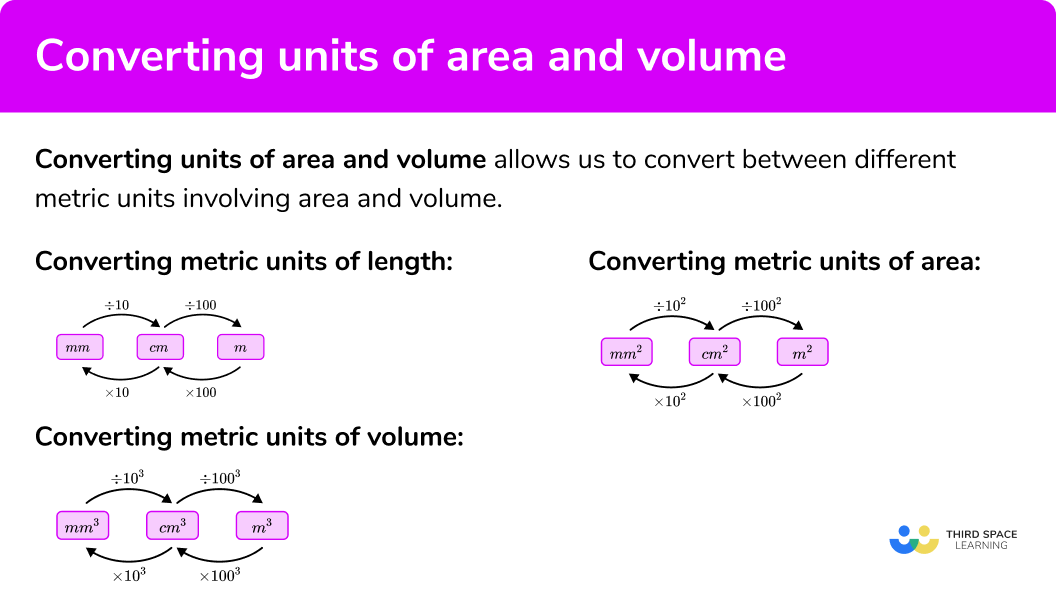
Area conversions
Since:
square both sides to convert area:
For example, convert to :
Volume conversions
For volume, cube the conversion factor:
This large number makes sense because volume has three dimensions: length, width, and height.
Watch this focused explanation from Unit Conversions with Area and Volume by Tyler DeWitt. It addresses the common mistake of using a length conversion factor without squaring or cubing it.
Unit Conversions with Area and Volume
Watch “Unit Conversions with Area and Volume” by Tyler DeWitt to see why area and volume conversions require powers on the conversion factor.
Watch area conversion, especially the explanation beginning with 1\text{ foot} = 12\text{ inches}, to see why the factor becomes 12^2 for area. Then watch volume conversion, focusing on why a cubic conversion uses the third power. Translate the method to metric units such as metres and centimetres.
A useful exam check is:
- For , use the length conversion factor.
- For , square the length conversion factor.
- For , cube the length conversion factor.
Similarity: same shape, proportionally different size
Two shapes are similar when they have the same shape but may be different sizes. Corresponding angles are equal, and all corresponding lengths have the same ratio.
For example, suppose a small rectangle measures by , while a larger rectangle measures by .
Compare corresponding sides:
Because both lengths have been multiplied by , the rectangles are similar. The linear scale factor from small to large is:
It matters which direction you are scaling.
From small to large:
From large to small:
A reliable setup is:
If a shape is enlarged, the factor is greater than . If it is reduced, the factor lies between and .
Finding a missing length
A school is making a scale model of an equipment-storage box. The actual box is high, and the model height is . Another actual dimension is . Find the corresponding length on the model.
First put the compared dimensions in the same unit:
Find the model-to-actual scale factor:
Now use that factor on the actual dimension. Convert first:
Therefore, the model dimension is:
Notice the order: convert units, find the scale factor, then calculate the unknown measurement.
How scale factors affect perimeter, area, and volume
The scale factor is applied differently depending on the number of dimensions involved.
| Measurement being compared | Number of dimensions | Scale factor used |
|---|---|---|
| Length or perimeter | ||
| Area or surface area | ||
| Volume |
This is one of the highest-value rules in this topic:
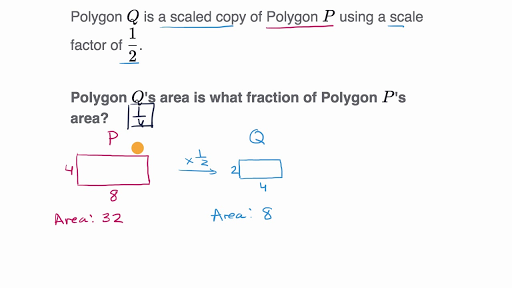
The picture shows why area does not simply halve when each length halves:
Both the length and the width are halved, so the area becomes one quarter of the original.
Worked example: similar court diagrams
A small rectangular court diagram has area:
A similar enlarged diagram has a linear scale factor of . Find its area.
Because this is an area question, square the scale factor:
Then multiply:
The enlarged diagram has area:
Using would be incorrect because that only applies to a length or perimeter.
Worked example: similar storage containers
Two similar rectangular equipment containers have a linear scale factor of , from the smaller container to the larger container. The smaller container holds:
Find the volume of the larger container.
This is a volume question, so cube the scale factor:
Therefore, the larger container has volume:
A doubling of every dimension creates eight times the volume, not two times the volume.
This short video gives a clear visual explanation of the difference between a linear scale factor, an area scale factor, and a volume scale factor.
Scale Factors Finding Length, Area, Volume in Similar Figures
Watch “Scale Factors Finding Length, Area, Volume in Similar Figures” by Mario’s Math Tutoring for a compact explanation of the scale-factor rules used in exam questions.
Watch finding scale factor to reinforce the direction of a scale factor. Continue with area and volume rules, noting the dimensional reason for squaring or cubing. If you need worked examples, watch similar solids, which applies the rules to surface area and volume ratios.
Solving multi-step measurement questions
In an exam, a question may combine several skills. Use a deliberate method rather than trying to calculate mentally.
Exam routine
-
Identify the requested measurement.
Is the answer a length, perimeter, area, surface area, or volume? -
Write the relevant formula.
For example, use for a rectangular prism. -
Make units consistent.
Convert before substituting values into the formula. -
Check whether the shapes are similar.
If so, find the linear scale factor using corresponding dimensions. -
Match the power to the measurement.
Use , , or . -
State the answer with units and sensible rounding.
Worked exam-style example
A rectangular sports-equipment box has dimensions:
A second box is similar, with each length dimension scaled by a factor of:
Find the volume of the larger box in litres.
First calculate the smaller box’s volume:
Because the dimensions are scaled by , the volume scale factor is:
Calculate the larger volume:
Now convert to litres. Since:
Therefore, the larger equipment box holds:
There are two valid ways to solve this question: calculate the original volume then apply , or first multiply every dimension by and then calculate the new volume. The first method is usually faster when a question directly gives a scale factor.
Common errors to avoid
- Adding dimensions when the question asks for area or volume.
- Mixing and without conversion.
- Using instead of for area.
- Using instead of for volume.
- Reversing the scale factor direction.
- Forgetting that surface area uses square units and volume uses cubic units.
- Giving a bare number without units.
A final estimate is useful. If every side length is increased, area and volume must increase. If your “larger” object has a smaller calculated area or volume, revisit the scale-factor direction.
Key takeaways
- Perimeter measures distance around a shape and uses linear units.
- Area measures flat coverage and uses square units.
- Volume measures capacity or space inside a solid and uses cubic units.
- Convert all measurements to consistent units before calculating.
- Similar figures have corresponding lengths in a constant ratio.
- For a linear scale factor :
- Always finish an exam response with the correct unit.
Next, you will move from measurement into algebra, beginning with solving linear equations by simplifying expressions and using inverse operations.
Can't find a good explanation? Sign up and we'll make it for you
Sign up