
Hi again. In the previous lesson, you learned to factor trinomials such as
Factoring turns a quadratic expression — ביטוי ריבועי — into multiplication. Today you will use that multiplication to solve a quadratic equation — משוואה ריבועית.
By the end of this lesson, you should be able to factor a quadratic equation, use the zero-product property — חוק המכפלה האפסית — to find all its solutions, and check each solution by substitution. This is a high-priority test skill: the key is to get the equation into a factored form with on one side.
Why a product equal to zero is special
Consider this equation:
The left side is a product: two factors — גורמים — multiplied together.
The only way multiplication can give is for at least one factor to be . For example:
But two nonzero numbers cannot multiply to make zero:
This fact is called the zero-product property:
The word or — או — matters. Usually, one factor is zero for one solution, and the other factor is zero for a different solution. They do not both need to be zero at the same time.
Solving equations with zero product property
Watch “Solving equations with zero product property” from Khan Academy. It explains why a product can equal zero only when at least one factor is zero, then demonstrates solving and checking an equation with two factors.
Watch the key idea for the zero-product property. Then watch the worked solution, paying attention to how one factored equation becomes two separate linear equations. Finish with the check to see why each answer makes the entire product equal zero.
Here is the same idea visually:
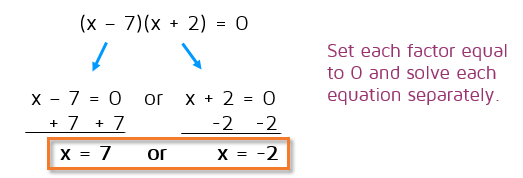
Solving an equation already in factored form
Let us solve:
Step 1: Set each factor equal to zero
or
Step 2: Solve both linear equations
For the first factor, add to both sides:
For the second factor, subtract from both sides:
Therefore, the solutions — פתרונות — are:
A useful shortcut is to notice that each factor gives the opposite signed number:
| Factor | Value that makes it zero |
|---|---|
Do not just copy the signs inside the parentheses. For instance, does not give . Since you subtract from both sides, it gives:
Verify by substitution — הצבה
To verify — לוודא / לבדוק — a solution means substitute it back into the original equation and check that both sides are equal.
Check :
So works.
Check :
So also works.
Notice that when one factor becomes zero, you do not need the other factor to be zero. Any number multiplied by zero is zero.
Vocabulary for test questions
| English | Hebrew | Meaning |
|---|---|---|
| solve | פתור | Find the value or values of the variable |
| solution | פתרון | A value that makes the equation true |
| root | שורש | Another name for a solution of a polynomial equation |
| zero | אפס | A value of that makes an expression equal |
| verify / check | בדוק / ודא | Substitute your answer to prove it works |
| substitute | הצב | Replace the variable with a number |
| zero-product property | חוק המכפלה האפסית | If a product is , at least one factor is |
| factor | גורם | A part of a multiplication expression |
Factors that contain a number in front of
Sometimes a factor is not just . You may see:
The zero-product step stays exactly the same:
or
Now solve each linear equation carefully.
For the first factor:
Add to both sides:
Divide both sides by :
For the second factor:
Add to both sides:
Divide both sides by :
So the complete answer is:
The quadratic equation can have fractions as solutions. That is completely normal.
A quick verification
Check in the original equation:
The first factor becomes:
Therefore the whole product is , so the value works.
You can similarly check : this time the second factor becomes zero.
From a quadratic equation to a factored equation
Often the test will not give you the factors immediately. It may give you an equation like:
This is where the factoring skill from the previous lesson comes in.
You need two numbers that:
- multiply to ;
- add to .
Those numbers are and :
So factor first:
Only after factoring may you use the zero-product property:
or
Solve:
Therefore:
Verify both answers in the original equation
Check :
Check :
Both values make the original equation equal to , so both are correct.
A test answer should normally list both solutions unless the two solutions happen to be the same.
A special but common case: a GCF gives one solution of zero
Recall that a greatest common factor (GCF) — גורם משותף גדול ביותר — is a factor shared by every term.
Solve:
Factor out the shared :
Now set each factor equal to zero:
or
The second equation gives:
So:
This is an important pattern. If every term in a quadratic has an , one solution is often .
Check:
Both work.
The equation must equal zero first
The zero-product property works only when the product equals .
For example, this is ready to solve:
But this is not ready:
You cannot set or there, because a product equaling does not require either factor to be zero.
Sometimes you must rearrange the equation before factoring. Solve:
First, subtract from both sides so that the right side is zero:
Now factor. Find two numbers that multiply to and add to :
Therefore:
Set each factor equal to zero:
or
So:
Check in the original equation .
For :
For :
Both solutions are valid.
The complete test routine is:
- Put all terms on one side, with on the other side.
- Factor completely.
- Set each factor equal to .
- Solve each resulting linear equation.
- Substitute both answers into the original equation to verify.
One repeated solution
Occasionally, the same factor appears twice:
This means:
Both factors produce the same equation:
Thus:
There is only one distinct solution. You may hear that is a double root — שורש כפול — because the factor is repeated, but for now the important point is simple: write the answer once.
Verification:
Common mistakes to avoid
1. Using the zero-product property before factoring
This is incorrect:
The left side is a sum, not a product. Factor it first.
2. Forgetting that a plus in a factor gives a negative solution
The solution has the opposite sign.
3. Factoring correctly but solving only one factor
From:
you need both:
and
A quadratic commonly has two solutions.
4. Not making one side equal to zero
The equation
must become:
before factoring and applying the zero-product property.
5. Skipping the check
A sign error in factoring can create a wrong answer. A quick substitution tells you whether the original equation is truly satisfied.
Key takeaways
To solve a factorable quadratic equation:
first write it as:
Then apply the zero-product property:
means:
Solve each linear equation and verify each result by substitution into the original equation.
Remember these essentials:
- You can use the zero-product property only when one side is .
- Factor before splitting into two equations.
- A factor produces .
- A factor produces .
- Check both proposed solutions.
Next, you will begin algebraic fractions — שברים אלגבריים — by learning how to identify values that are not allowed because they make a denominator equal to zero.
Can't find a good explanation? Sign up and we'll make it for you
Sign up