
Hello again. Last lesson, you learned that factoring — פירוק לגורמים — reverses distribution: you take a shared factor outside parentheses. Now we use the same reverse-thinking idea for a special three-term expression.
This lesson is about factoring a quadratic trinomial — תלת־איבר ריבועי — of the form
By the end, you will be able to turn it into two binomials — דו־איברים — such as
You will also know how the plus and minus signs tell you which numbers to use. This is important preparation for the next lesson, where these factored expressions become quadratic equations that you can solve.
The pattern: reverse expansion
A trinomial has three terms — three parts separated by or . In this lesson, its first term is always , with no number in front of it except the hidden :
Here is the key expansion pattern:
When we distribute:
Combine the two middle -terms:
Compare this with:
This shows the two facts you need:
In words:
- Find two numbers that add to the middle coefficient .
- The same two numbers must multiply to the last number .
Then write:
Essential vocabulary
| English | Hebrew | Meaning |
|---|---|---|
| quadratic | ריבועי | An expression whose highest power is |
| trinomial | תלת־איבר | An expression with three terms |
| binomial | דו־איבר | An expression with two terms, often in parentheses |
| factor | גורם | A quantity being multiplied |
| factor pair | זוג גורמים | Two numbers whose product is a given number |
| coefficient | מקדם | Number multiplying a variable; is the coefficient of |
| constant term | האיבר החופשי | A number with no variable; is the constant |
| expand / distribute | לפתוח סוגריים / חוק הפילוג | Multiply out parentheses |
| factor | לפרק לגורמים | Rewrite an expression as multiplication |
A useful test-reading note: if the question says “Factor completely” — פרק לגורמים באופן מלא — first check whether there is a GCF. For expressions of the exact form , there is usually no GCF, so you can use the method in this lesson directly.
Factoring Trinomials of the Form x2+bx+c
Watch “Factoring Trinomials of the Form x2+bx+c” from Mometrix Academy. It visually shows why two numbers must satisfy both the addition and multiplication conditions, including the most important sign cases.
Watch the core method first. Focus on why x goes in both parentheses and why the chosen numbers add to the middle coefficient but multiply to the constant. Then watch the sign examples, pausing when the signs change. Notice that the method itself stays the same; only the signs of the two numbers change.
A reliable factoring routine
Suppose you need to factor:
Step 1: Set up the parentheses
Because:
the answer must begin with:
The boxes will contain numbers and signs.
Step 2: Identify and
For
we have:
So find two numbers that:
- multiply to ;
- add to .
List positive factor pairs of :
| Factor pair | Sum |
|---|---|
The pair and works because:
and
Step 3: Put those numbers into the binomials
The order does not matter:
is exactly the same answer.
Step 4: Check by expanding
On a written test, a quick expansion check catches sign errors:
It matches the original trinomial, so the factorization is correct.
Signs are clues, not decoration
The signs of and tell you what signs and must have.
Remember the two conditions:
The product tells you whether the signs are the same or different.
| Sign of | What this means for and |
|---|---|
| Same signs: both positive or both negative | |
| Different signs: one positive and one negative |
Then the sum tells you which sign arrangement is correct.
When is positive
A positive product comes from two positive numbers or two negative numbers.
- If is positive, use two positive numbers.
- If is negative, use two negative numbers.
For example:
The numbers must multiply to and add to .
Since the product is positive, the signs match. Since the sum is negative, both numbers are negative:
Therefore:
Check the middle terms:
When is negative
A negative product needs opposite signs: one number positive, one number negative.
The number with the larger absolute value decides the sign of the sum.
Consider:
We need two numbers that multiply to and add to .
The factor pairs of are:
Because the product must be negative, try opposite signs. The pair and has a difference of . To get a positive sum, the must be positive:
So:
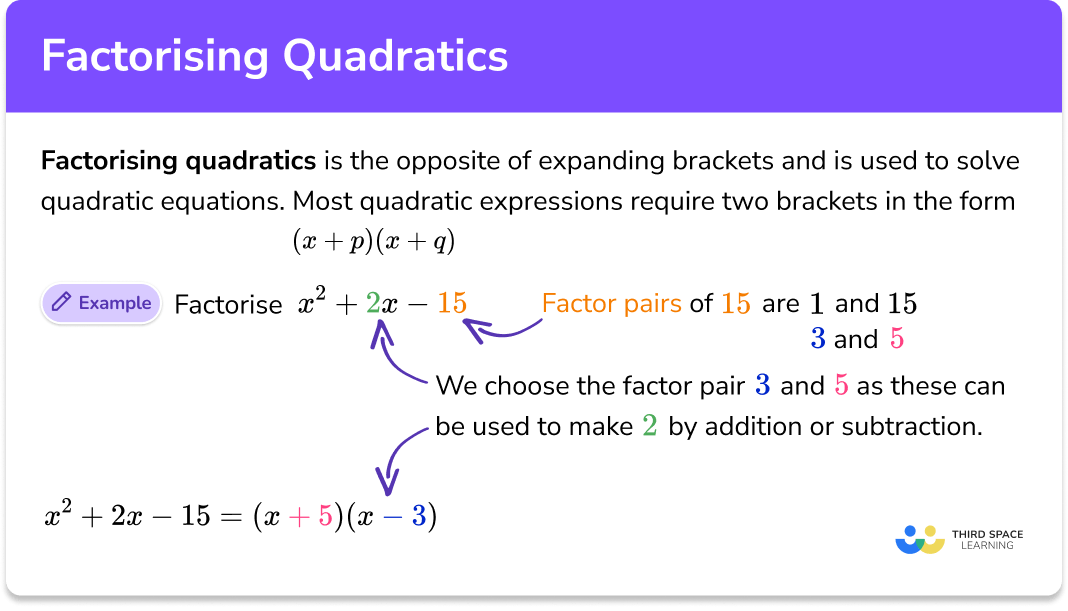
Check it:
The image’s wording “make by addition or subtraction” means exactly this signed-number check:
The four sign situations
You do not need to memorize a complicated rule. Still, this compact chart can help under test pressure.
| Trinomial pattern | Signs inside the factors | Example result |
|---|---|---|
| both | ||
| both | ||
| different; larger number is | ||
| different; larger number is |
The last two rows may look alike in writing, so rely on the add check, not only the chart.
For example, factor:
We need a product of and a sum of . The factor pair and is one apart. The larger number must be negative because the sum must be negative:
Therefore:
A common error would be:
But its middle coefficient is positive:
So it would expand to , not the original expression.
A fast scratch-paper method
For each question, make a tiny two-column note:
For example:
Write:
The factors of are and . You need opposite signs because the product is negative. The pair and has difference , and the larger number must be negative:
So:
This written routine is safer than guessing:
- Check for a GCF first.
- Write down , the middle coefficient.
- Write down , the constant term.
- List factor pairs of .
- Assign signs so the product is .
- Check that the signed numbers add to .
- Write the two binomials.
- Expand briefly to verify if you have time.
When no integer pair works
Some trinomials do not factor into integer binomials. For example:
We would need two integers with product and sum .
Possible opposite-sign pairs are based on and :
Switching the signs gives negative sums, not . No integer pair works.
For this course, call such a trinomial prime — ראשוני — or not factorable over the integers. Do not invent a pair just because the numbers look close. The two checks, product and sum, must both work.
Later mathematics has other ways to solve or rewrite these quadratics, but the next lesson will focus only on equations that do factor cleanly.
Key takeaways
To factor a trinomial of the form
find two integers and such that:
and
Then write:
Keep these sign facts in mind:
- Positive : the two numbers have the same sign.
- Negative : the two numbers have different signs.
- The middle coefficient confirms whether the final sum must be positive or negative.
- Always verify by expanding if a sign feels uncertain.
Next, you will use factored quadratics to solve equations such as
using the zero-product property — חוק המכפלה האפסית.
Can't find a good explanation? Sign up and we'll make it for you
Sign up