
Hello again. In the previous lesson, you identified a trade-off by locating a scarce resource, the alternatives competing for it, and the sacrificed option. Now we make that sacrifice measurable.
The key distinction is simple but essential for full-mark answers:
Opportunity cost is the value of the next best alternative forgone when a choice is made.
By the end of this lesson, you should be able to identify the relevant alternative, calculate its value, and distinguish it from a direct money payment. This is a foundation for later topics such as marginal decision-making, budget constraints, and consumer choice.
From trade-off to opportunity cost
A trade-off tells us that a choice requires a sacrifice. Opportunity cost tells us the value of the sacrifice that matters most.
Suppose you have one free evening and can choose only one of these options:
- Attend a paid tutoring session and earn Rs. 800
- Complete an assignment, which you value at Rs. 650
- Watch a film, valued at Rs. 500, with a ticket costing Rs. 150
First calculate the net value of each option:
| Option | Benefit | Direct cost | Net value |
|---|---|---|---|
| Tutoring | Rs. 800 | Rs. 0 | Rs. 800 |
| Assignment | Rs. 650 | Rs. 0 | Rs. 650 |
| Film | Rs. 500 | Rs. 150 | Rs. 350 |
If you choose tutoring, the next best alternative is completing the assignment, valued at Rs. 650. Therefore:
You do not add Rs. 650, Rs. 350, and any other possible alternatives. You could have undertaken only one alternative during that evening. Economics counts the best alternative forgone, not every imaginable alternative.
This short OpenStax reading gives the core definition and connects it to familiar choices involving money, time, education, and leisure.
Read “The Concept of Opportunity Cost” from OpenStax’s Principles of Economics 3e. It establishes the definition you should use in an exam: opportunity cost is the value of the next best alternative.
In the subsection “The Concept of Opportunity Cost,” read from the definition and examples. Focus particularly on why buying one good, using time in one way, or attending class necessarily means giving up another valued use of resources.
A useful exam sentence is:
The opportunity cost of choosing ______ is the value of the next best alternative, ______, that is forgone.
For the example above:
The opportunity cost of working as a tutor is Rs. 650, because completing the assignment is the next best alternative forgone.
A reliable method for calculation
When a question gives you alternatives, use this five-step method.
- Identify the action chosen or the action whose opportunity cost is being asked.
- List the feasible alternatives available at the same time or with the same scarce resource.
- Find the value of each alternative. If an alternative has a direct cost, use its net value where relevant.
- Select the next best alternative, not all alternatives together.
- State the opportunity cost clearly, with units such as rupees, hours, goods, or units of output.
Consider another example. Aarav has Saturday afternoon free. He can:
- Work for four hours at Rs. 200 per hour.
- Attend a free economics workshop that he values at Rs. 600.
- Meet friends, which he values at Rs. 500.
If Aarav chooses the workshop, the best alternative forgone is paid work:
Meeting friends is not included in the calculation because its value, Rs. 500, is lower than the Rs. 800 available from working. The opportunity cost is not Rs. 1,300.
This short Khan Academy segment demonstrates exactly this logic: identify the highest-valued alternative and ignore lower-valued options.
Optimal decision-making and opportunity costs | AP(R) Microeconomics | Khan Academy
Watch “Optimal decision-making and opportunity costs” by Khan Academy for a visual walkthrough of opportunity cost, implicit cost, and the distinction between the foregone alternative and direct spending.
Begin with the definition, which introduces opportunity cost as the value of an alternative forgone. Then watch the work example, where several possible jobs are compared. Continue through the key clarification: only the next best option counts. Finally, watch total cost to see how a direct payment can be added when the question asks for the full economic cost of an action.
Explicit cost, implicit cost, and total economic cost
Opportunity-cost questions often include two kinds of sacrifice.
An explicit cost is a direct payment of money. Examples include a cinema ticket, transport fare, textbook price, or entry fee.
An implicit cost is the value of the next best alternative forgone. A common example is income sacrificed when time is used for studying, travelling, or leisure rather than working.
In many introductory microeconomics questions, the total economic opportunity cost of an action is calculated as:
Here, the implicit cost is the value of the next best alternative.
The wording of the question matters:
| If the question asks… | Usually calculate… |
|---|---|
| “What is the opportunity cost of choosing X rather than Y?” | The value of the next best forgone option |
| “What income is forgone by choosing X?” | The lost wage or earning opportunity |
| “Calculate the total opportunity cost including explicit and implicit costs” | Direct payment plus value of next best alternative |
| “What is the economic cost of attending college?” | Fees and other direct expenses plus earnings forgone, where relevant |
For example, suppose a student goes to a concert.
- Concert ticket: Rs. 500
- Food and travel specifically for the concert: Rs. 200
- Wages forgone from a part-time shift: Rs. 900
The explicit cost is:
The implicit cost is:
Therefore, the total economic opportunity cost of attending the concert is:
Notice that Rs. 900 is the value of the next best alternative use of the student’s time. The Rs. 700 is money that could have been used for other consumption.
Reading the clubbing-versus-working example
The following table illustrates a choice between clubbing and working. It is useful because it makes both direct spending and the value of time visible.
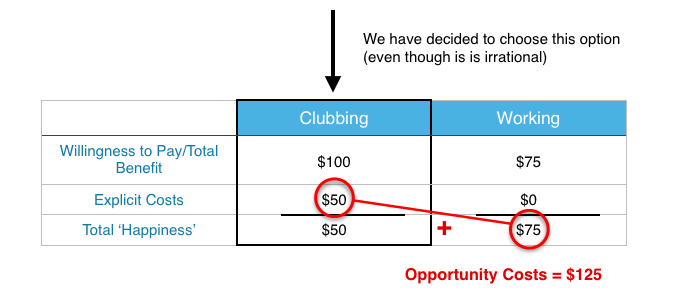
Read the table in this order:
- Clubbing gives a total benefit of $100.
- The explicit costs of clubbing are $50, for items such as entry, drinks, and transport.
- Thus, the net benefit of clubbing is:
- Working provides $75, with no stated direct cost.
- If the person chooses clubbing, they give up working and its $75 return. This is the implicit cost.
- The full economic cost of clubbing is:
Since the benefit from clubbing is $100 while its total economic opportunity cost is $125, a strictly economic comparison indicates that working is the better option.
The accompanying reading develops this example and explains why time has value in economic decision-making.
1.2 Opportunity Costs & Sunk Costs – Principles of Microeconomics
Read the clubbing-versus-working example in “1.2 Opportunity Costs & Sunk Costs” from Principles of Microeconomics. It shows how direct cash payments and forgone income can be combined when calculating total economic opportunity cost.
In Section 1.2, begin with the paragraph that introduces the clubbing example and continue through the numerical comparison. Pay close attention to measuring the value of time. Then examine Table 1.2b and follow why the $50 direct cost and $75 forgone earnings are added in the author’s total-cost calculation.
Avoiding common calculation errors
Counting every alternative
Suppose you can work for Rs. 500, study for a benefit valued at Rs. 400, or watch a match valued at Rs. 250. If you choose to work, the opportunity cost is Rs. 400, not:
The next best alternative is studying, so only Rs. 400 is relevant.
Treating the money price as the entire cost
If a student buys a reference book for Rs. 600, Rs. 600 is a direct monetary cost. It represents other consumption the student could have purchased. But if buying the book also requires giving up three hours of paid work worth Rs. 450, the full economic opportunity cost is:
Including a cost that has already been paid
A sunk cost is a past cost that cannot be recovered regardless of the decision made now. It should not be included in a current opportunity-cost calculation.
For instance, if you already paid a non-refundable Rs. 300 registration fee last week, that Rs. 300 should not determine whether you attend an optional lecture today. The fee is already gone whether you attend or stay home. Your current decision should compare the benefit of attending with what you give up now, such as study time, travel cost, or leisure.
Forgetting that opportunity cost can be non-monetary
Opportunity cost may be expressed as:
- wages forgone,
- units of another good,
- hours of leisure,
- marks or learning forgone,
- output that could have been produced,
- the value of another activity.
For example, the opportunity cost of sleeping through a lecture may be missed learning, notes, explanations, and participation—not necessarily a cash amount.
An exam-ready answer format
For a short numerical question, write enough working to show the examiner your reasoning.
Question type: A student can attend a concert by paying Rs. 300, or work and earn Rs. 700. What is the total opportunity cost of attending the concert?
Model answer:
The student’s explicit cost of attending the concert is Rs. 300. The next best alternative is working, which would provide Rs. 700; this is the implicit cost. Therefore, the total opportunity cost of attending the concert is:
Thus, the student sacrifices Rs. 1,000 worth of resources and opportunities by attending the concert.
For a question asking only for the forgone alternative, be more direct:
The opportunity cost of attending the concert is the Rs. 700 wage forgone from working, because working is the next best alternative.
The safest approach is to identify the explicit cost and implicit cost separately whenever the question provides both. Then state whether the examiner is asking for the forgone alternative alone or the full economic cost.
Key takeaways
- Opportunity cost is the value of the next best alternative forgone.
- Do not add all possible alternatives; choose only the highest-valued feasible alternative that is sacrificed.
- Explicit costs are direct payments, while implicit costs are the values of forgone alternatives, often lost wages or time.
- When asked for the total economic opportunity cost, calculate:
- Exclude sunk costs and costs that would be incurred regardless of the option chosen.
- In an exam answer, name the chosen option, identify the next best alternative, show the calculation, and give a final conclusion with units.
Next, you will use this cost-based way of thinking to decide whether an activity should be increased: compare its marginal benefit with its marginal cost.
Can't find a good explanation? Sign up and we'll make it for you
Sign up