
Hello again. In the previous lesson, you learned that the cost of a choice includes the value of the next best alternative forgone. Marginal analysis uses that same forward-looking logic, but asks a narrower question: should I do one more unit of this activity?
This is a core “thinking at the margin” principle in Unit I. By the end of this lesson, you should be able to compare marginal benefit and marginal cost and state clearly whether an activity should be increased, reduced, or continued up to its best level.
The marginal question: “one more” or “one less”
A marginal decision concerns a small change in an activity, usually one additional unit. It is not an all-or-nothing decision.
For example, these are marginal questions:
- Should I study for one more hour?
- Should I buy one more drink?
- Should a shop produce one more unit?
- Should I spend one more hour preparing for an exam?
The word marginal means additional or extra.
Two ideas guide the decision:
- Marginal benefit (MB): the additional benefit obtained from one more unit of an activity.
- Marginal cost (MC): the additional cost, including opportunity cost, of one more unit of an activity.
For a student considering one additional hour of revision:
- The marginal benefit may be better understanding, improved expected marks, or greater confidence.
- The marginal cost may be fatigue, missed leisure, reduced sleep, or time that could have been used for another subject.
Marginal benefit and marginal cost need not be paid in cash. They must simply be measured in comparable terms, such as rupees, marks, points, or an estimated value of time.
The central comparison is:
If this difference is positive, the next unit adds more than it sacrifices. If it is negative, the next unit makes the person worse off.
This short reading establishes why economists focus on “a little more or a little less,” rather than treating choices as entirely all-or-nothing.
2.1 How Individuals Make Choices Based on Their Budget Constraint
Read the section “Marginal Decision-Making and Diminishing Marginal Utility” from Principles of Microeconomics (Hawaii Pressbooks). It connects scarcity and opportunity cost to the practical method of marginal analysis.
In the subsection “Marginal Decision-Making and Diminishing Marginal Utility,” begin at the explanation of marginal analysis. Focus on why an economic decision normally concerns the next unit, rather than the total quantity of a good.
The decision rule
A rational decision-maker compares the benefit and cost of the next unit, not the total benefit and total cost already received.
| Comparison for the next unit | Decision |
|---|---|
| Increase the activity; the extra unit gives a net gain. | |
| Do not increase the activity; the extra unit causes a net loss. | |
| The efficient or optimal level has been reached; there is no further net gain from expanding. |
The key condition is:
At this point, the value gained from one more unit exactly equals the value sacrificed for it.
A useful way to remember the rule is:
Continue an activity while its marginal benefit is at least as large as its marginal cost. Stop increasing it when the next unit has marginal cost greater than marginal benefit.
Be precise in exam answers. If a question asks whether an activity should be increased, the direct test is whether the next unit has:
If equality holds, the activity is already at its optimal level; adding that unit does not create an additional net benefit.
The Pearson study guide below gives the definitions, formulas, and decision rule in one sequence.
Macroeconomics Study Guide: Marginal Costs & Benefits | Notes
Read the sections on marginal cost and the “Putting It Together” decision rule. Although labelled as a macroeconomics study guide, these are foundational marginal-analysis tools used throughout microeconomics.
First, read “Marginal Costs,” especially the definition beginning marginal cost and its pattern. Then go to “Putting It Together: Marginal Benefits vs. Marginal Costs” and read the decision rule. Notice that the rule applies to any additional unit, whether it is a unit of consumption, production, or time.
Why marginal benefits often fall and marginal costs often rise
In many ordinary decisions, the first units of an activity are most valuable, while later units are less valuable. This is called diminishing marginal benefit.
For instance, the first hour of revision before an economics test may clarify the most important concepts. By the fourth or fifth hour without a break, concentration may weaken; that extra hour may contribute less to learning.
At the same time, marginal cost often rises. As study time extends, fatigue increases and the opportunity cost of sacrificing sleep, food, relaxation, or another subject becomes larger.
These are common patterns, not automatic laws for every situation:
- Marginal benefit often decreases as quantity rises.
- Marginal cost often increases as quantity rises.
Together, these patterns explain why people usually choose a middle level rather than doing none of an activity or doing it without limit.
Calculating marginal values from totals
When a question provides total benefit and total cost, calculate the marginal values by finding the change caused by an extra unit:
Here, means total benefit, means total cost, and means quantity.
Suppose a student is deciding how many hours to spend on an extra revision session. Benefits and costs are measured in estimated “value points.”
| Revision hours | Total benefit | Total cost | Marginal benefit of that hour | Marginal cost of that hour |
|---|---|---|---|---|
| 0 | 0 | 0 | — | — |
| 1 | 20 | 2 | 20 | 2 |
| 2 | 36 | 6 | 16 | 4 |
| 3 | 48 | 14 | 12 | 8 |
| 4 | 54 | 26 | 6 | 12 |
For the third hour:
Since:
the student should increase revision from two hours to three hours.
Now consider the fourth hour:
Since:
the student should not add the fourth hour. The best quantity is therefore three hours.
Notice the logic: although the total benefit at four hours is higher than at three hours, the fourth hour adds only 6 points of benefit while adding 12 points of cost. It reduces overall net benefit.
Applying the rule to successive units
The Successive Drinks table shows marginal benefit, expressed as willingness to pay, for each additional drink. Marginal cost is constant at .
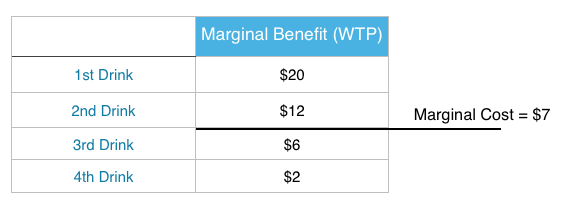
Read willingness to pay here as the maximum value the person places on each drink.
| Additional drink | Marginal benefit | Marginal cost | Decision |
|---|---|---|---|
| First | Buy or consume it | ||
| Second | Buy or consume it | ||
| Third | Do not buy or consume it | ||
| Fourth | Do not buy or consume it |
For the first drink:
It provides a positive net marginal benefit of .
For the second drink:
It should also be consumed because its marginal benefit exceeds its marginal cost.
But for the third drink:
The third drink should not be consumed. It costs more than it is worth to this particular consumer.
Therefore, the person should choose two drinks. If they already have two drinks, they should not increase consumption to a third drink.
An exam-quality conclusion would be:
The individual should consume two drinks. The marginal benefit of the second drink, , exceeds its marginal cost of . However, the marginal benefit of the third drink is only , which is less than marginal cost. Therefore, consumption should not be increased beyond two drinks.
Seeing the rule on a graph
The same reasoning can be represented with curves. The horizontal axis shows the quantity of an activity, and the vertical axis shows marginal benefit and marginal cost in common units.
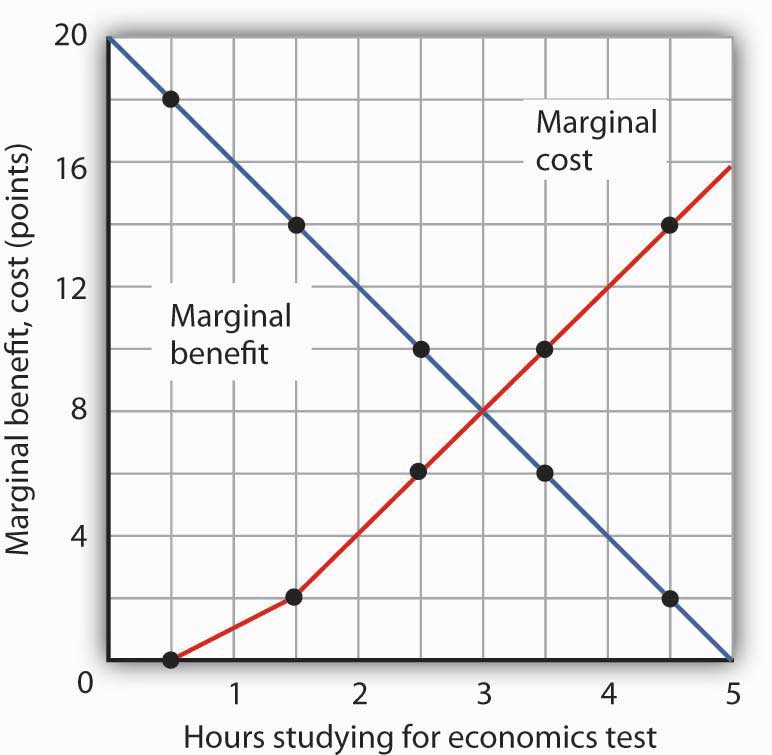
In this figure:
- Marginal benefit falls as study hours rise. Early study hours are highly valuable; later hours give less extra learning.
- Marginal cost rises as study hours rise. Longer study causes more fatigue and sacrifices more alternative uses of time.
- At three hours, the curves meet:
This is the optimal level of study in the example.
To the left of three hours, marginal benefit exceeds marginal cost. An additional hour is worthwhile, so study time should be increased.
To the right of three hours, marginal cost exceeds marginal benefit. An additional hour is not worthwhile, so study time should not be increased.
The following Khan Academy segment illustrates the same rule with marginal-benefit and marginal-cost curves. Its example uses rabbits and berries, but the reasoning is exactly the same as for study hours, purchases, or production.
Allocative efficiency and marginal benefit | Microeconomics | Khan Academy
Watch “Allocative efficiency and marginal benefit” by Khan Academy. It clearly links willingness to pay, marginal benefit, marginal cost, and the equality condition.
Watch marginal benefit curves to see marginal benefit interpreted as willingness to pay for one additional unit. Then watch the quantity decision. Focus on the comparison at each quantity: increase the activity where marginal benefit is greater than marginal cost, and stop at the point where they are equal.
Marginal analysis is forward-looking
Marginal analysis concerns the consequences of the next decision. It does not ask whether past expenditure was large or small.
Suppose you have already studied for two hours. That time cannot be recovered. The present question is only:
Is the third hour of study worth its additional benefit compared with its additional cost?
Similarly, if someone has already paid for an event, that payment may be a sunk cost. It should not decide whether they remain at the event. The relevant comparison is the future benefit of staying versus the future cost, including the value of the time that would be lost.
This continues the opportunity-cost lesson: marginal cost may include a direct payment, but it may also be the value of something else given up.
A dependable exam-answer structure
For a short question on marginal analysis, use four parts.
- State the values of marginal benefit and marginal cost for the next unit.
- Compare them using , , or .
- State the decision: increase, do not increase, or remain at the optimal level.
- Give the economic reason in one sentence.
For example:
A student obtains a marginal benefit of 15 points from one additional hour of revision. The marginal cost, in terms of fatigue and other work forgone, is 9 points.
Since , the student should increase revision by one hour. The additional benefit from the extra hour exceeds its additional opportunity cost.
Avoid these common mistakes:
- Comparing total benefit with marginal cost.
- Saying “increase” without stating the comparison.
- Treating marginal cost as only a cash payment.
- Continuing an activity merely because previous units were beneficial.
- Letting a past, unrecoverable cost determine a current choice.
Key takeaways
- Marginal benefit is the additional benefit from one more unit of an activity.
- Marginal cost is the additional cost, including opportunity cost, of one more unit.
- The decision rule is:
- Marginal benefit commonly falls with quantity, while marginal cost commonly rises.
- In an answer, always compare the marginal values for the next unit and then state a reasoned conclusion.
Next, you will examine how a change in incentives changes people’s marginal benefits or marginal costs, and therefore changes their decisions.
Can't find a good explanation? Sign up and we'll make it for you
Sign up