
Hello. In the previous lesson, you learned that a quote screen is a dated market snapshot: price, volume, market capitalization, free float, and delivery data describe trading and ownership context, not the company’s underlying performance.
Now we move to the evidence behind company analysis. An equity-research analyst needs to find the company’s own disclosures quickly, verify that they are the correct version and period, and distinguish a full annual report from a short exchange announcement. By the end of this lesson, you should be able to locate a listed Indian company’s annual reports, exchange filings, quarterly shareholding patterns, and corporate announcements using official sources.
Why company information lives in more than one place
A listed company’s public information is not contained in one perfect document or website. Different documents answer different questions:
| Source or document | Primary use | Typical timing |
|---|---|---|
| Annual report | Understand the business, management discussion, governance, audited annual financial statements, and notes | Once per financial year |
| Financial results filing | Track quarterly or annual reported performance | Usually quarterly |
| Shareholding pattern | See who owns the company’s shares by disclosed category | Usually quarterly |
| Corporate announcement | Identify material developments, board decisions, contracts, leadership changes, dividends, meetings, and other events | Event-driven |
| Exchange filing archive | Verify the time-stamped regulatory record | Ongoing |
For a company analysis, use primary sources first:
- The company’s investor-relations website is often the fastest place to find well-organized annual reports and presentations.
- NSE and BSE filing pages are the key regulatory dissemination records. They are especially useful for time-sensitive disclosures and for checking whether a document was filed.
- SEBI’s corporate-filings directory helps you find the correct NSE or BSE category when the exchanges’ navigation changes.
- News articles, broker notes, social-media posts, and finance portals can help you discover an issue, but they are not substitutes for the underlying company disclosure.
A useful mindset is: a headline tells you what to investigate; the filing tells you what the company actually disclosed.
Annual reports: the starting point for understanding a company
An annual report is a company’s broadest regular disclosure. It commonly brings together:
- management’s account of the year;
- business and industry discussion;
- directors’ and corporate-governance reports;
- auditor’s report;
- standalone and consolidated financial statements;
- detailed accounting notes; and
- information on subsidiaries, risks, and related matters.
You will learn to analyse these sections carefully in later modules. For now, the goal is more practical: reliably finding the right report.
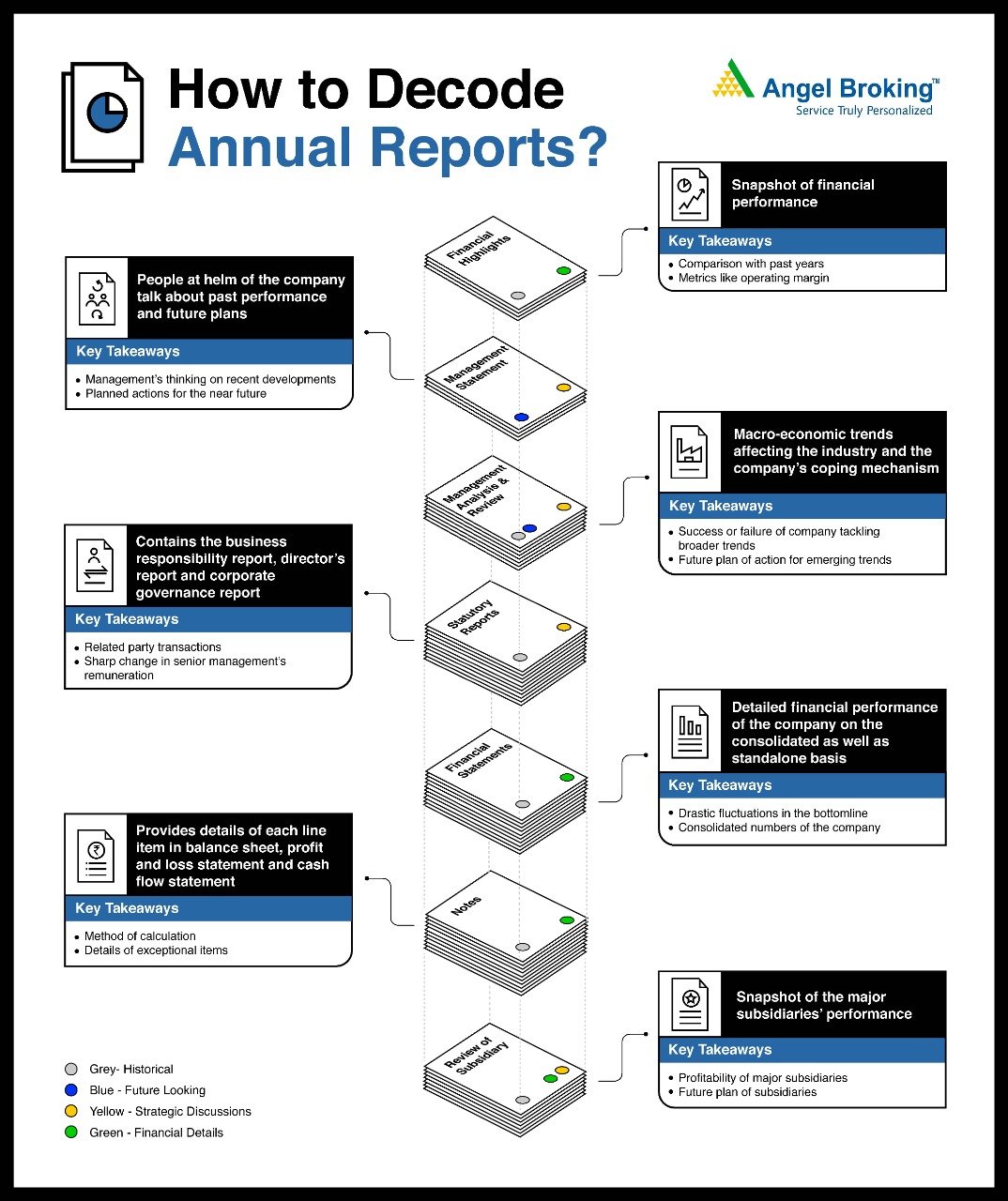
The report is usually labelled by its financial year, not by the day you download it. For example, an annual report titled FY 2024–25 generally covers the period ending 31 March 2025, even if the company uploaded it several months later.
Watch this short orientation before trying the process yourself.
3. How to read the annual report of a company
Watch “3. How to read the annual report of a company” from Zerodha Varsity for a compact overview of where annual reports are found and how their major sections fit together.
Watch finding reports to see the usual investor-relations route. Then watch report structure for the common contents, including management discussion, products, operations, subsidiaries, and governance. Finish with financial sections, focusing on why the consolidated financial statements, auditor’s report, and accounting policies deserve attention.
Three reliable routes to an annual report
Route 1: the company’s investor-relations page
Search for the exact legal company name followed by “investor relations” or “annual report.” On the company website, common menu labels include:
- Investors
- Investor Relations
- Financials
- Annual Reports
- Disclosures
- Downloads
This route is convenient because annual reports are often grouped by year and may sit beside earnings presentations, conference-call transcripts, and sustainability reports.
Before downloading, confirm:
- the company name on the report cover;
- the financial year;
- whether the PDF is an annual report, rather than an investor presentation;
- whether it is standalone, consolidated, or includes both; and
- that the document appears complete.
Route 2: BSE’s Historical Annual Reports archive
BSE provides a dedicated historical annual-reports section. This is particularly valuable when a company website is difficult to navigate, an old report has disappeared from its archive, or you want to cross-check the issuer-hosted version.
Route 3: the annual-report announcement on an exchange
Companies may submit their annual report as an exchange announcement. On BSE, such a filing can be labelled as an annual report under Regulation 34(1). This route is useful when you need the exchange-received and disseminated time, rather than simply the report itself.
Do not assume that the newest file on a website is necessarily the correct document. A newly uploaded annual report may cover the prior financial year; a company may also upload a revised document later.
A map of NSE and BSE filing categories
The exchanges organize filings by category. SEBI’s Corporate Filings page is useful because it gives the exact navigation paths for key categories on both NSE and BSE.
Read SEBI’s “Corporate Filings” directory as a navigation map for official NSE and BSE sources. It is especially useful when you know the type of document you need but not which exchange menu contains it.
In the table, focus on the rows for Shareholding Patterns, Financial Results, Corporate Governance, Related Party Transactions, and Insider Trading disclosure. Begin at the shareholding and results entries; note that each row gives both an NSE and a BSE route. You do not need to memorize every link. Instead, learn the structure: on NSE, these items sit under Corporate Announcements and View All; on BSE, they sit under Corporates and Corporate Filings.
The important distinction is between a company search page and a filing category page:
- A company search page helps you find disclosures for one company.
- A category page helps you search across many companies for one document type, such as financial results or shareholding patterns.
For analyst work, you will use both. If you are reviewing a selected company, start with its name or identifier. If you are monitoring a category, such as all quarterly results due this week, start with the category page.
Use the right identifier
Company names can be abbreviated, changed, or confusingly similar. Keep these identifiers available:
- NSE symbol, such as
TCSorINFY; - BSE scrip code, a numeric identifier;
- ISIN, the security identification code you encountered in the previous lesson;
- the company’s full legal name.
If a search produces an unexpected result, pause and check the identifier rather than assuming you have found the correct company.
BSE: one practical corporate-filings hub
BSE’s corporate-filings menu gives direct access to several items you will repeatedly use: Corporate Announcements, Financial Results, Board Meetings, Shareholding Patterns, Corporate Actions, and Historical Annual Reports.
Latest Corporate Announcements
Use BSE’s “Latest Corporate Announcements” page to familiarise yourself with its Corporate Filings menu. Although the live announcements themselves change continually, the menu is a useful map of where to retrieve recurring company records.
Find the Corporate Filings list on the page. Read the corporate-filings menu, paying particular attention to Financial Results, Shareholding Patterns, Corporate Actions, and Historical Annual Reports. Notice that these are distinct filing categories: an annual report, a quarterly result, and a dividend-related announcement should not be treated as interchangeable evidence.
When using BSE, a practical sequence is:
- Go to Corporates and open the relevant filing category.
- Search or filter for the company by name, scrip code, and where available, a date range.
- Open the attached PDF or XBRL filing rather than relying only on the short announcement text.
- Verify the document title, reporting period, and exchange timestamp.
- Save the file with a clear name.
For example, a sensible local filename is:
CompanyName_FY2024-25_AnnualReport_retrieved_2025-08-15.pdf
The retrieval date is useful because websites can replace, revise, or remove files.
Shareholding patterns: ownership at a specific date
A shareholding pattern is not a real-time list of every shareholder. It is a periodic disclosure that summarizes ownership categories as of a stated reporting date.
At this stage, focus on locating the document and reading its date correctly. A typical shareholding-pattern filing will show categories such as:
- promoter and promoter group;
- public shareholders;
- institutional holders;
- non-institutional holders; and
- sometimes other specified categories required by the disclosure format.
Later, you will interpret promoter holdings, pledging, institutional ownership, and changes over time. For now, avoid making conclusions from a single percentage.
Two dates matter
Every shareholding disclosure has at least two relevant dates:
- the quarter or period ended, which tells you when ownership was measured; and
- the filing or dissemination date, which tells you when the market received the disclosure.
Suppose a filing is published on 12 April but states “shareholding pattern for the quarter ended 31 March.” The ownership snapshot is as of 31 March, not 12 April.
This distinction matters because market participants may have traded after the quarter-end date but before the filing became public.
Where to find it
Use either exchange:
- NSE: Corporate Announcements, then View All, then Shareholding Patterns.
- BSE: Corporates, then Corporate Filings, then Shareholding Patterns.
Search for the company, choose the required period, and open the filed document or available structured data. For later comparison, download several consecutive quarters rather than only the most recent one.
Corporate announcements: the live event record
Corporate announcements are event-driven disclosures. They can be highly relevant to a company’s value, but they must be read carefully because a title may be incomplete, preliminary, or procedural.
Common announcement types include:
- board-meeting notices and outcome disclosures;
- quarterly and annual results;
- dividend proposals, record dates, stock splits, or other corporate actions;
- management appointments or resignations;
- acquisitions, sales of assets, joint ventures, and contracts;
- investor or analyst meeting information;
- annual general meeting notices and voting results;
- clarifications requested by an exchange; and
- corrections, revisions, or withdrawals of earlier filings.
The BSE live page shows how these disclosures appear in practice: an announcement title, a category, attached documents where applicable, and timing fields.
Latest Corporate Announcements
Scan BSE’s live announcement feed to see the difference between an announcement headline and its underlying attachment. The feed is dynamic, so use it to learn the format rather than to draw conclusions from any company currently displayed.
Locate an entry with a PDF attachment and examine an annual-report listing. Observe the announcement category, the attachment, and the fields for exchange-received and exchange-disseminated time. The key habit is to open the attachment and read the actual disclosure; a one-line title is only an index to the evidence.
Read the disclosure, not just the label
Consider these examples:
- A board-meeting intimation may only say that a meeting is scheduled. It does not tell you the result of the meeting.
- An announcement of a non-binding memorandum of understanding signals an intention or discussion, not necessarily a completed deal or future revenue.
- A record-date announcement tells you who may be eligible for a corporate action; it is not by itself evidence that a dividend has already been paid.
- A revised filing may supersede a previous document. Always check whether the exchange page identifies a revision or cancellation.
This is where discipline matters. A useful research note uses neutral language:
On [date], the company disclosed [event] in an exchange filing. The disclosure states [specific fact]. The potential business effect remains to be assessed.
That is much stronger than treating every announcement as automatically positive or negative.
A repeatable retrieval routine
Use this routine whenever you begin coverage of a listed company.
1. Confirm the entity
Record the legal company name, NSE symbol, BSE scrip code, ISIN where available, and the exchange you are using.
2. Download the latest annual report
First check the company’s investor-relations page. Then cross-check through BSE Historical Annual Reports or the exchange announcement archive if necessary.
Verify the financial year and whether the report contains standalone and consolidated statements.
3. Retrieve recent financial results
Locate at least the latest quarterly result and the associated outcome or presentation if available. Later, these will help you update annual-report figures with more recent information.
4. Retrieve shareholding patterns
Download the latest pattern and, ideally, the previous four quarters. Record both the quarter-end date and the filing date.
5. Scan recent corporate announcements
Use a defined period, such as the past 90 days or since the latest annual report. Prioritize:
- results;
- major contracts or capacity changes;
- acquisitions or disposals;
- management and board changes;
- capital raising or debt developments;
- dividends and other corporate actions; and
- clarifications, revisions, and regulatory matters.
6. Preserve enough context to find the document again
For every downloaded item, retain:
- document title;
- company name;
- reporting or event date;
- filing or dissemination date and time where shown;
- exchange;
- original page or document link; and
- your retrieval date.
The next lesson will turn this habit into a formal dated source log. For now, the objective is simply to make your source trail reproducible.
A short practical workflow
Use one non-financial Indian listed company as a temporary practice case. It does not have to be your eventual capstone company.
Spend about 15 minutes assembling a small evidence folder:
- Download one annual report for the latest completed financial year.
- Find the company’s most recent shareholding-pattern disclosure.
- Open three recent corporate announcements and read the attached document for at least one of them.
- Save the following details in a simple note: company name, document title, relevant period or event date, exchange, and retrieval date.
Do not interpret the company yet. At this point, success means that you can retrieve the right documents and state exactly what each one is.
Key takeaways and next step
An annual report is the broad foundation for company analysis, but it is only one part of the information set. Exchange filings update that picture through quarterly results, ownership disclosures, and event-driven announcements.
The core habits are:
- prefer issuer and exchange disclosures over secondary commentary;
- verify the company identifier, document type, and relevant period;
- distinguish the event date, reporting date, filing date, and your own retrieval date;
- open the attached PDF or structured filing rather than relying on a headline; and
- retain enough information for another person to locate the same evidence.
Next, you will build a dated source log that separates company disclosures, regulatory records, market data, and secondary commentary while recording a usable citation for each source.
Can't find a good explanation? Sign up and we'll make it for you
Sign up