
Good to see you again. Last lesson mapped the institutions that make Indian equity trading possible: brokers route orders, NSE and BSE match them, clearing corporations manage settlement, and depositories record electronic holdings. That map now lets us ask a more economic question: when an investor pays for shares, does the money go to the company or to another investor?
That distinction separates the primary market from the secondary market. Both matter to a company analyst: one explains how a company raises or reallocates ownership capital; the other produces the continuously updated price, liquidity, and trading data that investors observe.
By the end of this lesson, you should be able to explain what each market does, identify where cash goes in a transaction, and recognise an important Indian-market nuance: not every IPO raises new money for the company.
One securities market, two connected functions
A securities market connects people with savings to companies or other entities that need capital. In equity markets, investors receive ownership claims in exchange for money. But that connection takes two forms.
| Market | What is being transacted? | Who receives the investor’s money? | Main purpose |
|---|---|---|---|
| Primary market | Newly issued securities | Usually the issuing company; sometimes an existing shareholder in an offer for sale | Raise or reallocate ownership capital |
| Secondary market | Securities already issued | Another investor who sells the securities | Enable trading, liquidity, and price discovery |
The most reliable test is not whether an exchange, app, or broker is involved. It is this:
Are new shares being created, or are existing shares changing hands?
If the company creates and issues new shares, the transaction is in the primary market. If one investor sells shares that already exist to another investor, it is in the secondary market.
The two markets are not rivals. They are interdependent. A company is more likely to attract investors in a new issue if those investors know they can later sell their holdings in an active secondary market. Conversely, the secondary market can only trade securities that have already been issued.
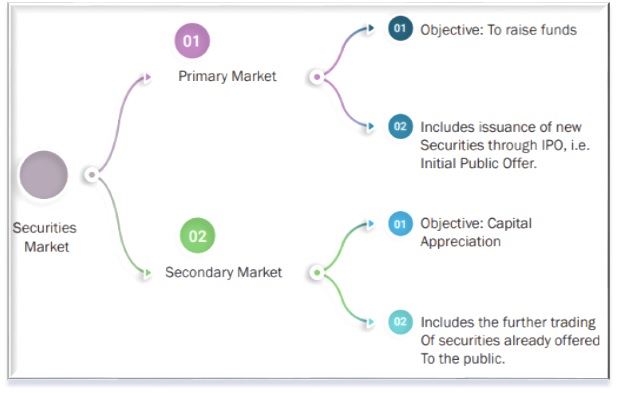
Before going further, study the official investor booklet’s overview. It establishes the central distinction and introduces the path from an issue to exchange trading.
Booklet on - SECURITIES MARKET
Read the SEBI Investor booklet’s section on “Primary Market and Secondary Market.” It gives the official Indian-market definitions, explains IPOs and follow-on issues, and highlights the distinction between a fresh issue and an offer for sale.
In “Primary Market and Secondary Market” (pp. 4–6 of the booklet), begin with the market overview. Focus on the two functions of the securities market: moving savings into investments and allowing investors to buy or sell securities. Then read the primary-market discussion, paying particular attention to the difference between a “fresh issue” and an “offer for sale.” Finish with the secondary-market introduction, stopping after its explanation of listed securities trading on stock exchanges. The later settlement material is useful, but it is not the focus of this lesson.
The primary market: creating shares and raising equity capital
The primary market is often called the new-issues market. It is where a company issues securities for the first time, or issues additional securities later.
Consider a fictional Indian manufacturer, Saffron Cables Ltd. It wants to build a new plant and needs crore. Rather than borrow the entire amount, it decides to sell ownership shares to investors. It creates new shares and offers them to investors. If investors subscribe and receive allotment, Saffron Cables receives the funds and can use them for the disclosed purpose, such as capacity expansion, debt repayment, or working capital.
This is a fresh issue. Two things happen at once:
- The company receives cash.
- The total number of shares outstanding increases.
IPO: the best-known primary-market event
An initial public offering (IPO) is a company’s first public issue of shares. Before an IPO, ownership may be concentrated among founders, promoters, employees, private-equity investors, or venture-capital investors. After listing, eligible public investors can own and trade its shares.
In India, a company seeking an IPO prepares an offer document, commonly beginning with a Draft Red Herring Prospectus (DRHP). It contains information an investor needs to assess the offer, including the business, financial history, risks, promoters, terms of the offer, and proposed use of proceeds. After the offer closes and shares are allotted, the shares are listed on NSE, BSE, or both, where secondary-market trading begins.
For an investor, applying in an IPO is not exactly the same as buying shares on the exchange:
- The investor applies for a specified quantity during the offer period.
- In a book-built issue, the offer has a price or price range.
- The investor may receive a full allocation, a partial allocation, or no allocation if demand exceeds supply.
- Under mechanisms such as ASBA, the relevant amount is typically blocked in the bank account until allotment; it is debited only for shares allocated.
An IPO gives an investor a chance to become an owner at the company’s public-market debut. It does not guarantee a listing gain, dividend, or long-term return. The business may perform below expectations, and the market price can later fall below the issue price.
Other forms of primary-market issuance
An IPO is only one type of primary-market transaction. For an analyst, the broader concept matters more than the label.
- A follow-on public offer (FPO) is a public issue by a company that is already listed.
- A rights issue offers newly issued shares to existing shareholders, generally in proportion to their current ownership.
- A preferential issue places newly issued shares with identified investors, which can include promoters, strategic investors, or institutions.
All of these can bring new capital into a company because they involve the issue of new securities.
Fresh issue versus offer for sale: a crucial distinction
A public offering may contain both a fresh issue and an offer for sale (OFS). They look similar to an applicant because both involve purchasing shares in an offer. Economically, however, they are very different.
| Feature | Fresh issue | Offer for sale |
|---|---|---|
| Shares created? | Yes | No |
| Total shares outstanding | Increases | Unchanged |
| Cash recipient | Company | Existing selling shareholder |
| Typical stated purpose | Expansion, debt repayment, capital expenditure, working capital | Promoter, private-equity, or other shareholder exit/liquidity |
| Effect on ownership percentages | Existing holders are diluted unless they participate | Ownership shifts, but there is no dilution from new shares |
Suppose Saffron Cables currently has 100 lakh shares outstanding. It issues 25 lakh new shares at each. The company receives crore and total shares become 125 lakh. An investor who previously owned 10 lakh shares now owns of the larger share count rather than . This is dilution of ownership percentage.
That dilution is not automatically bad. If the crore is invested at attractive returns, the company’s future earnings and value may grow. But an analyst should always ask whether the planned use of funds is credible and whether the issue price and added share count make economic sense.
Now imagine instead that a promoter sells 25 lakh of their existing shares to public investors. The total share count remains 100 lakh. The promoter receives the cash, not Saffron Cables. This may provide liquidity or reduce promoter concentration, but it does not itself fund a new factory, reduce company debt, or add cash to the balance sheet.
When you later read an Indian IPO prospectus or an FPO document, one of your first questions should be:
How much of the offer is a fresh issue, and how much is an offer for sale?
The secondary market: trading, liquidity, and price discovery
Once shares are issued and listed, they can be bought and sold in the secondary market. In India, this is where the normal day-to-day trading of listed shares occurs through NSE and BSE.
Suppose an investor who received Saffron Cables shares in its IPO later sells 100 shares on NSE. Another investor buys those 100 shares through their broker. The company is not a party to that transaction:
- the buyer pays for the shares;
- the seller receives the proceeds;
- the exchange matches the orders;
- the clearing and depository systems complete settlement.
Saffron Cables receives no new capital simply because its shares trade frequently or rise in price.
This does not make the secondary market unimportant to companies. It serves companies indirectly in several important ways.
Liquidity: an exit route for investors
Liquidity is the ability to sell an asset for cash reasonably quickly without having to accept an extreme price reduction. Active secondary markets give investors a practical route to enter and exit ownership.
Without a secondary market, an investor who bought shares directly from a company might have to wait years for a private buyer or for the company to repurchase the shares. The possibility of future sale makes many investors more willing to subscribe to new issues in the first place.
Liquidity is not a promise that every share can always be sold at a favourable price. A small or thinly traded company may have few buyers, especially during stress. But listed-market liquidity is generally far greater than private-company liquidity.
Price discovery: a public estimate, not a verdict
The market price of a listed share emerges from buy and sell orders. It reflects the balance of supply and demand at a given moment.
If more investors want to buy Saffron Cables than sell it at the current price, buyers may need to offer more. If sellers are more eager than buyers, the price may fall until transactions occur. This process is called price discovery.
A secondary-market price is useful because it is visible, current, and based on actual transactions. It is not, however, a final statement of intrinsic value. Prices can move because of earnings announcements, interest rates, industry news, investor sentiment, liquidity conditions, or simply changing expectations. Equity research exists partly because analysts try to judge whether the market price is reasonable relative to business fundamentals.
Continuous access for investors
For investors, the secondary market enables:
- buying into a company even if they received no IPO allocation;
- selling a holding to realise gains, cut losses, or rebalance a portfolio;
- adjusting exposure as new information emerges;
- observing market prices and trading volumes;
- investing in companies that listed years or decades ago.
For most individual investors, nearly all share purchases occur in the secondary market, not through IPO applications.
Watch this short explanation from Zerodha to consolidate the comparison. Its vehicle-showroom analogy is useful, but retain the more precise test: whether the shares are newly issued or already outstanding.
What are the Primary and Secondary markets?
Watch “What are the Primary and Secondary markets?” from Zerodha. It uses one company example to show why a business issues shares, then contrasts that first issuance with subsequent investor-to-investor trading.
Watch the primary example for the company’s expansion funding and the participants in an IPO. Then watch new securities to reinforce why primary-market activity creates financial instruments and raises capital. Continue with secondary trading, focusing on the fact that the underlying company is not the direct party to each trade and on the roles of liquidity and supply-and-demand price discovery. Finish with the comparison, especially the differing purposes and volume of activity in the two markets.
A transaction story: follow the cash, not just the shares
The following sequence makes the distinction concrete.
Stage 1: Saffron Cables issues shares
Saffron Cables conducts a fresh IPO of 25 lakh shares at per share. Investors apply, and some receive allotment.
- Market: Primary
- Shares: New shares
- Cash destination: Saffron Cables receives crore before issue expenses
- Investor outcome: Allotted investors receive shares in their demat accounts
- Company outcome: It has more cash, but there are also more shares outstanding
Stage 2: those shares begin trading
After listing, Investor A sells 100 Saffron Cables shares at to Investor B through the exchange.
- Market: Secondary
- Shares: Existing shares
- Cash destination: Investor A receives the proceeds, less applicable charges
- Investor outcome: Investor B becomes the owner of the shares
- Company outcome: No new cash is received and no new shares are created
The price has moved from to , but the company has not received the increase per share. The gain belongs to Investor A because Investor A owned the shares before the sale.
Stage 3: the company may return to the primary market
Several years later, Saffron Cables needs funds for another expansion project and launches a rights issue. Existing shareholders have the opportunity to subscribe for additional newly issued shares.
- Market: Primary again
- Shares: New shares
- Cash destination: Saffron Cables
- Analyst question: Will this new capital earn an adequate return, or is the company raising funds because operations are weak?
A listed company can therefore participate in both markets over time. The market category depends on the nature of the specific transaction, not on whether the company is already famous, large, or exchange-listed.
Why this distinction matters in equity research
For an entry-level analyst, primary- and secondary-market events create different research questions.
When a company raises capital
A fresh issue can alter several pieces of your analysis:
- Cash: How much gross and net cash will the company receive?
- Debt: Will some proceeds repay borrowings?
- Share count: How many new shares will exist after the offer?
- Earnings per share: Will future earnings be spread across a larger number of shares?
- Use of proceeds: Is the money going to productive expansion, an acquisition, working capital, or debt reduction?
- Governance: Why is capital needed now, and are promoters also selling shares?
A company may report rising profit while its per-share earnings grow slowly if it repeatedly issues many new shares. Later in the course, you will calculate earnings per share and assess dilution more formally.
When shares trade in the market
Secondary-market data supports a different set of questions:
- What is the company’s current market capitalisation?
- How has the share price performed relative to an appropriate benchmark?
- Is trading volume unusually high following a results announcement?
- Is the stock sufficiently liquid for institutional investors?
- What expectations appear to be embedded in the current price?
A high secondary-market price is not the same thing as strong business quality. Likewise, a weak share price does not prove the business is weak. Research requires connecting price movements with earnings, cash flows, industry conditions, risks, and valuation.
A source-discipline habit to start now
When you see a headline such as “Company raises crore,” do not stop at the headline. Look for the official offer document or exchange filing and classify the event:
- Is it a fresh issue, an offer for sale, or a mixture?
- Who receives the money?
- Are new shares being created?
- What is the stated use of proceeds?
- What will change in ownership and share count?
This habit prevents a common analytical mistake: treating every public share sale as new funding for the company.
Key takeaways
The primary market is where securities are newly issued. It allows companies to access equity capital, gives investors an opportunity to acquire ownership at an issuance, and can increase the company’s share count.
The secondary market is where investors trade securities that already exist. It provides liquidity, price discovery, and an ongoing route for investors to enter or exit listed companies. In a normal secondary-market sale, the company receives no cash.
The central practical distinction is:
- In a fresh issue, investor funds go to the company.
- In an offer for sale, funds go to an existing shareholder, even though the transaction occurs as part of a public offering.
- In a secondary-market trade, funds go from the buyer to the selling investor.
Next, you will distinguish individual equity shares from market indices, mutual funds, and exchange-traded funds—four instruments that can all appear on an investing screen but represent very different claims and structures.
Can't find a good explanation? Sign up and we'll make it for you
Sign up