
Hello! Welcome back to our module on "Customer Value and Segmentation Strategy."
In our last lesson, we focused on evaluating channel and messaging strategies for engaging our existing high-value customers. We learned to ask the right questions to ensure our plans for retention and monetization were strategically sound.
Now, we pivot from retaining customers to acquiring them. As a marketing leader, one of your most critical responsibilities is allocating budget across various acquisition channels—like Google Ads, Meta Ads, SEO, and more. How do you decide which channels are worth the investment? How do you justify scaling one channel over another? Answering these questions requires looking beyond immediate return and understanding the long-term profitability of the customers each channel brings in.
This brings us to today's learning outcome: to use the LTV-to-CAC ratio to evaluate the long-term profitability of customer acquisition channels. This single ratio is one of the most powerful metrics in a modern marketing leader's toolkit, connecting your team's daily acquisition efforts directly to the financial health of the business.
1. Understanding the LTV:CAC Ratio
The LTV:CAC ratio is a simple yet profound metric that answers the question: "For every dollar we spend to acquire a new customer, how much profit will that customer generate for us over their entire relationship with our brand?"
It's composed of two parts you've heard about:
- LTV (Customer Lifetime Value): The total profit you expect to earn from an average customer.
- CAC (Customer Acquisition Cost): The total cost to acquire a new customer.
The ratio is calculated as:
A ratio of 4:1, for instance, means that for every $1 you spend on acquiring a customer, you can expect to generate $4 in lifetime profit.
Defining the Components Strategically
For a leader, the nuance is in the definition of LTV and CAC.
- LTV should be Lifetime Gross Profit, not Revenue. This is a critical distinction. Revenue doesn't account for the cost of goods sold (COGS) or service delivery. Gross profit is what's left over to pay for marketing, overhead, and to generate net profit.
- CAC must be "fully loaded." It's not just your ad spend. It includes all costs associated with acquisition, such as marketing and sales team salaries, agency fees, and software subscriptions related to those channels.
To get a practical, business-focused breakdown of these two components, let's watch a few segments from a video by entrepreneur Alex Hormozi. He has a very direct style that cuts straight to the business implications.
Business Owners: You NEED to Know This Number
In this video, 'Business Owners: You NEED to Know This Number,' Hormozi explains why the LTV:CAC ratio is so critical. We'll focus on his definitions of Lifetime Gross Profit and CAC.
Please watch from the timestamp 01:02 to 05:06 for his explanation of LTV as 'Lifetime Gross Profit' and his powerful example of a company that got this wrong. Then, watch from 05:28 to 06:12 for his clear, practical definition of how to calculate CAC.
As Hormozi's example of the ad agency powerfully illustrates, confusing revenue with gross profit can lead you to believe a channel is profitable when you're actually losing money on every customer.
2. The "3:1 Rule" and Payback Period
So, what is a "good" LTV:CAC ratio? While it varies by industry and business model, a widely accepted benchmark is the 3:1 Rule.

Why 3:1? Why not 1:1? A 1:1 ratio means you're only making back what you spent to acquire the customer. This leaves no room for your other business expenses like rent, G&A (General & Administrative) staff, R&D, and other overhead.
The following resource provides clear benchmarks.
Customer Lifetime Value (LTV): The Ultimate E-commerce ...
The article 'Customer Lifetime Value (LTV): The Ultimate E-commerce...' provides excellent benchmarks for both the LTV:CAC ratio and another crucial related metric, the CAC Payback Period.
Please read the section 'LTV vs CAC: The Profitability Equation'. Focus on the 'The 3x Rule' and the benchmarks provided (e.g., 5:1 is excellent, under 2:1 is unsustainable). Then, read the subsection on 'CAC Payback Period'.
As you just read, a healthy LTV:CAC ratio is only part of the story. The CAC Payback Period adds the crucial dimension of time and cash flow. A channel might have a fantastic 8:1 LTV:CAC ratio, but if it takes 24 months to pay back the initial acquisition cost, it could put a significant strain on your company's cash reserves, especially during periods of rapid growth. As a leader, you must balance long-term profitability (LTV:CAC) with short-term cash flow needs (Payback Period).
3. Using the LTV:CAC Ratio for Channel Evaluation
The real power of this metric for a marketing leader comes from applying it not just to the business as a whole (a "blended" ratio), but to individual acquisition channels. The blended LTV:CAC for your business might be a healthy 4:1, but this can hide unprofitable channels. You might have one channel operating at 10:1 and another at a disastrous 1.5:1.
By calculating LTV and CAC for cohorts of customers acquired from specific channels, you gain a clear, data-driven basis for making budget allocation decisions.
The article you just read from rework.com contains a perfect example of this in action. Let's revisit it and analyze the table in the "Segmenting Cohorts by Acquisition Channel" section.
Example Channel-Based LTV & CAC Comparison:
| Acquisition Channel | 12-Month LTV | Cost per Acquisition (CAC) | LTV:CAC Ratio |
|---|---|---|---|
| Organic search | $278 | $15 | 18.5 : 1 |
| Email (owned list) | $312 | $5 | 62.4 : 1 |
| Facebook Ads | $145 | $45 | 3.2 : 1 |
| Instagram Influencer | $168 | $38 | 4.4 : 1 |
| Google Shopping | $187 | $32 | 5.8 : 1 |
(This table is adapted from the resource LINK and includes a calculated LTV:CAC column for clarity)
This kind of analysis is what separates tactical channel management from strategic portfolio management. When your team presents you with performance data, this is the level of insight you should be driving towards.
Interpreting the Results for Strategic Action:
- Email & Organic Search (Very High Ratio): These channels are incredibly profitable. The strategic question is not just "are they good?" but "How can we invest more to scale this advantage?" For organic search, this means more budget for SEO and content. For email, it means investing in list growth initiatives.
- Google Shopping (Healthy Ratio): This is a solid, scalable performance channel. The recommendation would be to continue investing and optimizing here, as it delivers quality customers efficiently.
- Facebook Ads (Marginal Ratio): At 3.2:1, this channel is just above the baseline. It's paying for itself, but not contributing significant profit. This is where you must ask probing questions:
- "Is the low LTV from this channel due to acquiring the wrong type of customer? Can we refine our targeting or messaging?"
- "Is our CAC too high? Can our team optimize campaigns to acquire customers more efficiently?"
- "Should we shift budget from Facebook to a more profitable channel like Google Shopping while we work to improve performance?"
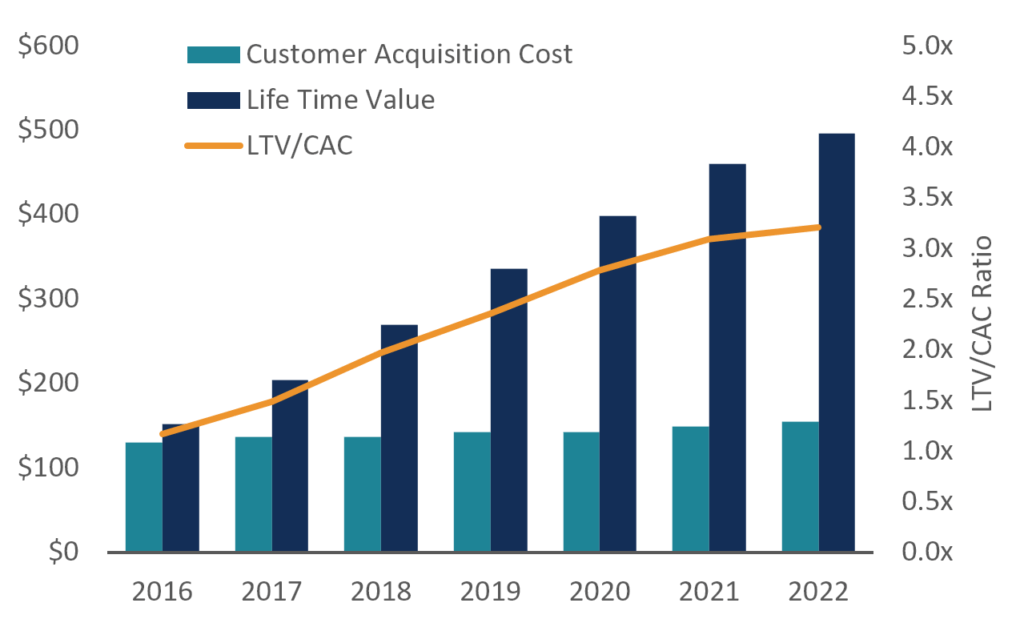
This is how you use the LTV:CAC ratio to guide your strategy—not as a simple score, but as a diagnostic tool that prompts critical business questions. Over time, as you optimize your channel mix, you should see your overall business LTV:CAC ratio improve.
Test your understanding!
You are the Head of Performance Marketing. Your team provides the following 12-month data for two paid acquisition channels:
| Channel | Total Spend (Fully Loaded) | New Customers Acquired | Average 12-Month LTV |
|---|---|---|---|
| Channel A | $200,000 | 2,000 | $350 |
| Channel B | $150,000 | 500 | $1,200 |
- Calculate the CAC and LTV:CAC ratio for each channel.
- Based on the ratios, what is your initial strategic recommendation for the budget allocation between these two channels? What follow-up questions would you ask your team?
Show answer
1. Calculations:
- Channel A:
- CAC = $200,000 / 2,000 customers = $100
- LTV:CAC Ratio = $350 / $100 = 3.5 : 1
- Channel B:
- CAC = $150,000 / 500 customers = $300
- LTV:CAC Ratio = $1,200 / $300 = 4 : 1
2. Strategic Recommendation and Questions:
Both channels are healthy (above 3:1). However, Channel B is acquiring more valuable customers and has a slightly better LTV:CAC ratio.
-
Initial Recommendation: My initial inclination would be to explore scaling the budget for Channel B, as it appears to acquire higher-value customers more profitably in the long run. Channel A is a solid workhorse, but Channel B seems to have a higher ceiling for profitability.
-
Follow-up Questions for the Team:
- On Scalability: "Channel B's economics look great. How much more can we spend on this channel before we see diminishing returns or a significant increase in CAC? Is the audience size limited?"
- On Customer Profile: "What do we know about the customers coming from Channel B? Why is their LTV so much higher? Can we use these insights to refine our targeting in Channel A to attract more valuable customers there?"
- On Payback Period: "What is the CAC payback period for each channel? While Channel B is more profitable long-term, does its high $300 CAC put a strain on our cash flow compared to Channel A?"
- On the Portfolio: "What role does each channel play in the customer journey? Is Channel A a 'prospecting' channel that feeds Channel B, or are they independent?"
Conclusion
Evaluating acquisition channels based on long-term profitability is a hallmark of strategic marketing leadership. While your team may focus on short-term metrics like ROAS or Cost per Conversion, your role is to elevate the conversation to the LTV:CAC ratio, ensuring that every dollar spent on acquisition is a sound investment in the future financial health of the business.
Key Takeaways:
- The LTV:CAC ratio is the ultimate measure of an acquisition channel's long-term profitability.
- Always use Lifetime Gross Profit for LTV and a fully loaded CAC for accurate calculations.
- A ratio of 3:1 is the minimum benchmark for a sustainable channel, but aim for 4:1 or higher.
- Segment your LTV:CAC ratio by channel to make informed budget allocation decisions—don't rely on a blended average.
- Incorporate the CAC Payback Period into your analysis to balance long-term profitability with short-term cash flow realities.
Preview of the Next Lesson:
We've now seen how LTV is crucial for evaluating both retention and acquisition strategies. However, marketing investment isn't just about direct-response channels. A significant portion of your budget might go towards long-term brand building (e.g., content, sponsorships, brand campaigns) where the ROI is less direct. In our next lesson, we will learn how to formulate a business case for long-term brand investments using an LTV framework, helping you justify these critical, but often harder-to-measure, initiatives to stakeholders.