
Hello! Welcome back to your course on Medical Instrumentation.
In our last lesson, we explored how to use machine learning to analyze raw wearable sensor data, identifying what a person is doing through activity recognition and when their behavior is unusual through anomaly detection. We concluded by noting a critical limitation: a stream of sensor data, even when classified, lacks meaning without its surrounding context. For example, a high heart rate and rapid movements could signify an intense workout or a panic attack.
Today, we directly address that challenge. The learning outcome for this lesson is to explain the role of context-aware computing in interpreting physiological and behavioral data. We will see how adding layers of contextual information allows us to move from simply measuring signals to understanding their significance. This concept is the key to transforming a data-gathering device into an intelligent system, which is directly relevant to the goals of your startup, Neuraease.
1. What is Context-Aware Computing?
At its core, context-aware computing enables systems to perceive their environment and adapt their behavior accordingly. The goal is to make technology more seamless and intelligent, allowing it to respond appropriately without constant user intervention.
To get a foundational understanding of this concept from one of its pioneers, let's watch an interview with Professor Albrecht Schmidt.
Context-Aware Computing: Research, History, and Examples | Albrecht Schmidt Interview - Part 1
This clip from an interview with Albrecht Schmidt, a leading researcher in the field, provides an excellent, high-level introduction to the core ideas and goals of context-aware computing.
Please watch two segments from this video: What is Context-Aware Computing? (00:18 - 01:56): Focus on the definition of giving computers "eyes and ears" to interact more appropriately. The Goal of Context-Aware Computing (06:30 - 08:33): Pay attention to the ultimate goal of making technology easier to use and pushing it into the background so it becomes "invisible."
While the video provides a great conceptual overview, for your course, it's also important to know the more formal, academic definition.
Context-Aware Medical Systems within Healthcare ...
This research paper, "Context-Aware Medical Systems within Healthcare," offers the formal definitions that are widely accepted in computer science and medical informatics.
Please read the Introduction section. Focus on: The definition of context by Abowd and Dey: "any information that can be used to characterise the situation of an entity." The five W’s of context: who, what, where, when, and why. The definition of a context-aware system: one that "uses context to provide relevant information and/or services to the user."
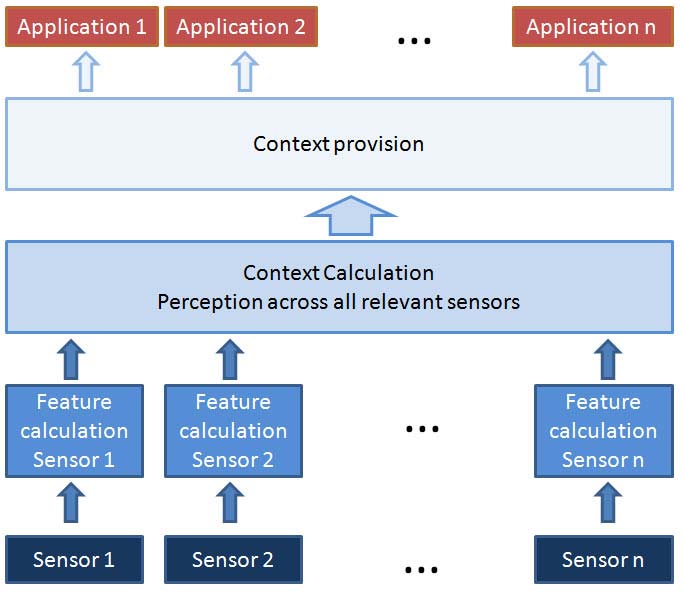
To bring this all together, we can visualize the structure of a context-aware system with an architectural diagram.
2. From Data to Meaning: The Role of Context
The single most important role of context in biomedical applications is to resolve ambiguity. The same physiological signal can mean very different things depending on the situation. The paper you just read gives the classic example: a heart rate of 160 BPM is normal during exercise but is a serious medical alert if the person is asleep. Context is the key differentiator.
For your work with Neuraease, consider these examples:
- High EDA (Electrodermal Activity): Could be excitement while watching a movie, stress during an exam, or the onset of an anxious episode. Contexts like time of day, calendar events (
Exam at 10 AM), or location (at homevs.at work) are crucial for interpretation. - Repetitive Motion (from IMU): Could be hand-flapping (stimming), typing on a keyboard, or waving to a friend. Context from audio (ambient noise level) or phone usage (is the keyboard app open?) can help distinguish these.
This fusion of physiological data with context is a field known as affective computing. Let's return to the Albrecht Schmidt video, where he discusses this exact intersection.
Context-Aware Computing: Research, History, and Examples | Albrecht Schmidt Interview - Part 1
This clip is highly relevant to your startup. It discusses the next wave of context-aware research: linking it with affective computing by using physiological sensors to understand a user's emotional state, such as stress.
Watch the section from 18:34 to 22:20. Notice the specific examples of using physiological sensors (like galvanic skin response, which is EDA) to measure stress and adapt system interactions accordingly.
3. The "Sense-Making" Process: How It's Implemented
How does a system actually "make sense" of all this data to infer context? This is where the machine learning techniques from our previous lesson come back into play. The process generally involves:
- Data Acquisition: Gathering data from multiple sources. This is a multimodal approach.
- Feature Extraction: Calculating descriptive features from raw data streams.
- Context Inference/Classification: Using a machine learning model to predict the user's state or context based on the combined features.
A recent systematic review on using electronic devices to diagnose mental health states provides a fantastic overview of the data sources and algorithms involved.
Use of physiological signals, behavioral data, and processing ...
The paper "Use of physiological signals, behavioral data, and processing..." synthesizes research on diagnosing depression, anxiety, and stress. It clearly shows how physiological data is combined with contextual, behavioral data for better results.
Please skim through the following sections to get a sense of the components of a modern context-aware system for mental health: Physiological signals (Section "Physiological signals"): Note the common signals like Cardiac measures (HR, HRV) and EDA. Behavioral variables (Section "Behavioral variables"): This is a key part. Notice that these variables—Phone usage, Sleep-wake patterns, Location tracking, Ambient light exposure—are all forms of context. Algorithms (Section "Algorithms and statistical analysis techniques"): Look at Table 5. You'll see familiar algorithms like Random Forest and Support Vector Machine being used to classify states based on a combination of these physiological and behavioral (contextual) inputs.
As the paper highlights, a model that only uses EDA is limited. A model that combines EDA with heart rate, activity level (from an accelerometer), time of day, and location (from GPS) can make a much more accurate and reliable inference about the user's stress level. This multimodal fusion of data is at the heart of modern context-aware behavioral analysis.
Test your understanding!
Imagine your Neuraease wearable detects a pattern of rapid, repetitive motion from its IMU, along with a spike in the user's heart rate. Using the types of context discussed in the articles (e.g., location, time, phone usage), list 3-4 contextual variables you could collect (e.g., from the user's phone or environment) and explain how each would help you differentiate between "positive excitement" and "agitated distress."
Show answer
Here are a few examples:
- Location (from GPS): If the user is at a theme park or concert venue, the pattern is more likely to be excitement. If they are in a typically quiet place like a library or their office after hours, it could signal distress.
- Calendar Data: If the user's calendar shows "Rock Concert" or "Birthday Party," the physiological arousal is likely positive. If it shows "Final Exam" or "Major Project Deadline," it points towards stress.
- Ambient Audio (from microphone): Loud music and cheering suggest a fun event. A quiet environment or sounds of agitated speech might indicate distress. (Note: This has significant privacy implications).
- Time of Day: The same physiological signature at 2 PM might be less concerning than if it occurs at 2 AM, when it might indicate a nightmare or a nocturnal panic attack, disrupting sleep.
Conclusion
In this lesson, we've explored how context-aware computing provides the missing link for interpreting physiological and behavioral data. By moving beyond isolated data streams and embracing a multimodal approach, we can build systems that have a more holistic and accurate understanding of a user's state.
Key Takeaways:
- Context-aware computing uses situational and environmental information (who, what, where, when, why) to adapt an application's behavior, making technology more intelligent and less intrusive.
- In behavioral analysis, context is essential for resolving the ambiguity of physiological signals. A high heart rate, for example, is interpreted based on the user's current activity and environment.
- Building these systems requires a multimodal approach, fusing data from physiological sensors (e.g., ECG, EDA), motion sensors (IMU), and contextual sources (e.g., GPS, phone usage, calendar).
- Machine learning algorithms are the engine for this "sense-making" process, classifying user states by learning from the patterns across all these combined data streams.
Preview of the Next Lesson:
We have now completed our deep dive into sensing and analyzing human physiology and behavior from the outside. In the next module, we will shift our focus to looking inside the body with established clinical tools. We will begin by exploring the principles of medical imaging, starting with X-ray and Computed Tomography (CT), fundamental technologies in modern diagnostics.
Can't find a good explanation? Sign up and we'll make it for you
Sign up