
In our previous lesson, we established a solid understanding of the injection molding process, from the cycle stages to the key components of the mold itself. Now that you know how a part is made, we must turn our attention to what it is made of. The choice of material is one of the most fundamental decisions a design engineer makes, as it dictates the part's performance, cost, durability, and manufacturability.
This lesson directly addresses this by comparing the key thermoplastics used in the automotive industry. We will focus on four workhorse materials: Polypropylene (PP), Acrylonitrile Butadiene Styrene (ABS), Polyamide 6 (PA6), and the ubiquitous PC/ABS blend. By the end, you will be able to evaluate these materials based on their core mechanical, thermal, and chemical properties, preparing you to make informed selection decisions in your design projects.
The Hierarchy of Plastics
Before diving into specific materials, it's important to understand that plastics are broadly classified based on their performance and cost. An automotive engineer typically works with two main categories: standard and engineering plastics.
Selecting Engineering Plastics for Injection Molding
This guide from TADE Solutions provides a clear classification of plastics.
Read the introduction and the sections on "Standard Plastics" and "Engineering Plastics." Focus on the general characteristics that differentiate these groups and note the typical applications mentioned for Polypropylene (PP), ABS, and Polyamide (PA).
As you read, you'll notice a clear trade-off:
- Standard (or Commodity) Plastics like PP are inexpensive and process easily, making them ideal for high-volume, cost-sensitive parts where mechanical demands are moderate.
- Engineering Plastics like PA and PC offer superior strength, dimensional stability, and temperature resistance, but at a higher cost and with more demanding processing requirements.
A large portion of an automobile is a carefully engineered mix of these categories to balance cost and performance.
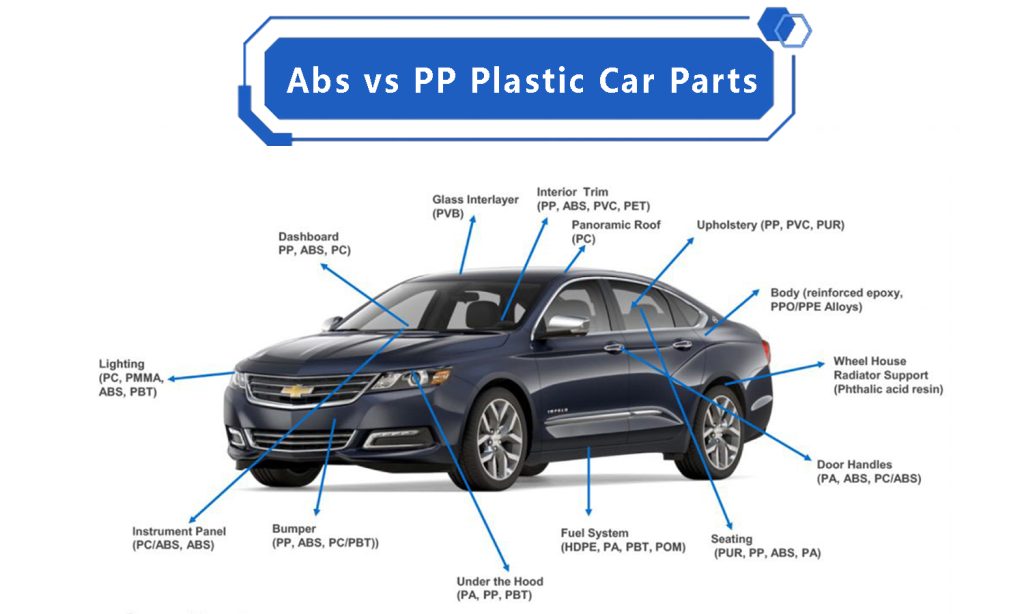
Comparing the Automotive Workhorses
Let's now analyze our four key materials in detail. For an engineer, material selection is a multi-variable problem, so we'll compare them across three critical axes: mechanical performance, thermal behavior, and chemical resistance.
1. Polypropylene (PP)
- Category: Standard Plastic
- Key Characteristics: PP is the most widely used plastic in the automotive industry, primarily due to its low cost, low density (leading to lighter parts), and excellent chemical resistance to automotive fluids. It also has great fatigue resistance, which is why it's often used for parts with "living hinges" (e.g., a cap on a fluid container). However, its base form has low stiffness and temperature resistance.
- Common Automotive Applications: Bumpers, dashboards, door trims, battery cases, and interior panels.
- Engineering Consideration: To overcome its low stiffness, PP is very often blended with fillers like talc (e.g., PP-T20 for 20% talc) or glass fibers (e.g., PP-GF30). This significantly improves its rigidity and heat resistance, making it suitable for more structural applications.
2. Acrylonitrile Butadiene Styrene (ABS)
- Category: Engineering Plastic
- Key Characteristics: ABS is known for offering a good, balanced profile of properties at a reasonable cost. It has good stiffness and impact strength, but its most valued attribute is its high-quality surface finish. It is also easily painted and can be chrome-plated, making it a top choice for cosmetic parts.
- Common Automotive Applications: Interior trim pieces, center consoles, radiator grilles, and mirror housings.
- Engineering Consideration: While tough, ABS has poor resistance to UV light and certain chemicals (like solvents), which limits its use for unpainted exterior components. Its thermal resistance is moderate.
3. Polyamide 6 (PA6)
- Category: Engineering Plastic
- Key Characteristics: Commonly known as Nylon 6, this material is valued for its high mechanical strength, stiffness, excellent wear resistance, and higher temperature capability compared to PP and ABS. It is frequently used for components that experience mechanical load or are located in the engine bay.
- Common Automotive Applications: Engine covers, radiator fans, gears, bearings, and fuel filter housings.
- Engineering Consideration: PA6's biggest drawback is its hygroscopic nature—it absorbs moisture from the air. This absorption acts as a plasticizer, reducing stiffness and strength but increasing toughness and impact resistance. This change in properties and dimensional stability must be accounted for in the design. Like PP, it is almost always glass-filled (PA6-GF30 is a common grade) for demanding applications to maximize strength and heat resistance.
4. Polycarbonate / ABS Blend (PC/ABS)
- Category: Engineering Plastic (Alloy)
- Key Characteristics: This alloy is created to combine the best attributes of Polycarbonate (PC) and ABS. It leverages the excellent processability and aesthetics of ABS while incorporating the superior impact strength and heat resistance of PC. This synergy makes it a premier material for robust interior components.
- Common Automotive Applications: Instrument panels, center consoles, pillar trims, and glove box doors.

A Deeper Dive into the Data
To move from qualitative descriptions to quantitative engineering decisions, you must be able to read and interpret material datasheets. The following resource provides tables with specific property values. Your mechanical engineering background will make you comfortable with concepts like tensile strength and modulus.
[PDF] ENGINEERING THERMOPLASTICS
This document from IIT Madras provides detailed properties and tabular data for key engineering plastics.
Skim the sections on Polyamides, Polycarbonate, and ABS to reinforce your understanding. Then, focus your attention on the tables at the end of the document: MECHANICAL PROPERTIES OF UNFILLED AND FILLED PLASTICS: Compare the Tensile Strength and Flexural Modulus of unfilled vs. 40% GF Polyamide 66, and unfilled vs. 30% GF Polypropylene. Note how significantly the glass fiber (GF) filler increases these values. HDT FOR UNFILLED AND FILLED PLASTICS: HDT, or Heat Distortion Temperature, is a critical thermal property. Compare the HDT of unfilled vs. filled PP, PC, and PA6/PA66. Observe the dramatic increase in temperature resistance provided by glass fillers. CO-EFFICIENT OF LINEAR THERMAL EXPANSION...: Note how fillers reduce the thermal expansion, leading to better dimensional stability. MOULD SHRINKAGE...: This is a crucial processing parameter. Compare the shrinkage of unfilled vs. filled materials. Lower, more predictable shrinkage is a major design advantage.
Summary Comparison Table
Here is a summary table to consolidate your understanding. These are typical values for unfilled grades unless stated otherwise; always refer to the specific supplier datasheet for design work.
| Property | Polypropylene (PP) | ABS | Polyamide 6 (PA6) | PC/ABS | Engineering Context |
|---|---|---|---|---|---|
| Mechanical | |||||
| Tensile Strength | Low (~30 MPa) | Medium (~45 MPa) | High (~80 MPa) | Medium-High (~55 MPa) | Governs resistance to pulling forces. PA6 is superior. |
| Flexural Modulus | Low (~1.5 GPa) | Medium (~2.3 GPa) | High (~2.8 GPa) | Medium (~2.4 GPa) | Material stiffness. Values increase significantly with glass filler. |
| Impact Strength | Good (ductile) | Excellent | Good (but notch sensitive) | Excellent (high) | Ability to absorb energy. PC/ABS is a top performer here. |
| Thermal | |||||
| HDT (@ 0.45 MPa) | Low (~100 °C) | Low (~95 °C) | High (~180 °C) | Medium-High (~120 °C) | Max short-term service temp. PA6 is best for under-hood use. |
| Shrinkage | High (1.5-2.0%) | Low (0.4-0.7%) | High (0.8-1.5%) | Low (0.5-0.7%) | Affects dimensional tolerance and warpage. ABS and PC/ABS are more stable. |
| Chemical | |||||
| Resistance | Excellent | Fair (poor UV/solvent) | Good (but sensitive to moisture) | Good | PP is best for contact with oils, fuels, and acids. |
| Cost | |||||
| Relative Price | $ | $$ | $$$ | $$$ | A primary driver in selection. |
Conclusion
In this lesson, we transitioned from the injection molding process to the materials themselves. You can now compare the most common automotive thermoplastics based on their fundamental properties and typical applications.
Key Takeaways:
- Plastics are categorized into standard (like PP) and engineering (like ABS, PA6) tiers, representing a trade-off between cost and performance.
- PP is the low-cost, lightweight choice for non-structural parts with good chemical resistance.
- ABS is selected for its excellent surface finish and balanced properties for cosmetic interior parts.
- PA6 is the go-to for high-strength, high-temperature applications, especially under the hood, but its properties are affected by moisture absorption.
- PC/ABS offers a powerful combination of the toughness and heat resistance of PC with the processability of ABS, making it ideal for robust interior structures like instrument panels.
- Fillers (like glass fiber and talc) are critical tools used to enhance the mechanical and thermal properties of base polymers to meet specific engineering requirements.
In our next lesson, we will investigate common injection molding defects. You will see how the material properties we've just discussed—particularly shrinkage and viscosity—are direct root causes for issues like warpage, sink marks, and short shots.
Can't find a good explanation? Sign up and we'll make it for you
Sign up