
Hello. Last lesson focused on recognition: you distinguished techniques such as juxtaposition, contrast, repetition, parallelism, and rhetorical questions by locating the exact pattern in an unfamiliar extract. That is essential groundwork, but identifying a technique is only the beginning of literary analysis.
This lesson develops the next step for SACE-style responses: explaining how a textual choice shapes an audience response, develops meaning, and contributes to an authorial purpose. By the end, you should be able to turn a label such as “metaphor” or “repetition” into a precise analytical claim rather than stopping at “this makes the reader want to read on.”
A useful study route for this lesson is about 40 minutes: spend 4 minutes on the short video, 8 minutes on the reading, then work through the models and writing method below.
From technique-spotting to analysis
Compare these two comments on the same line:
“The city was a machine that ate its workers.”
Identification only:
The writer uses a metaphor.
Analysis:
By describing the city as a “machine” that “ate” its workers, the writer presents urban life as impersonal and destructive. The verb “ate” suggests that workers are consumed rather than valued, encouraging readers to feel disturbed by their exploitation. This supports a critical purpose: exposing the human cost of an economy that treats people as replaceable.
The first comment is accurate, but it does not explain anything. The second comment follows a chain of reasoning:
- Textual choice: metaphor of a city as a “machine”; the violent verb “ate.”
- Audience response: readers are positioned to see the city as threatening and to feel unease or indignation.
- Meaning: work within the city is represented as exploitative and dehumanising.
- Authorial purpose: the writer may be criticising a system that values production over people.
The technique itself does not mechanically produce one universal response. Different readers can respond differently. Your role is to offer the most plausible interpretation, supported by the words on the page. Use cautious but confident phrasing: suggests, positions the reader to, invites the audience to, may encourage. Avoid unsupported claims that a writer “forces” every reader to feel something.
English Exam Revision: Exam Skills - How to Analyse a Writer's Language
Watch “English Exam Revision: Exam Skills - How to Analyse a Writer's Language” from Tutoring with Gavin. It introduces a compact method for moving from a named technique to implication, connotation, and reader effect.
Watch the DICE method for the four parts of close language analysis. Then watch the worked example, which unpacks “John exploded with anger.” Notice that the explanation does not end at “metaphor”: it explores what “exploded” connotes, what that implies about John, and how that creates tension for an audience.
The video’s DICE mnemonic is useful for close word-level analysis:
- D — Device: What technique or language choice is present?
- I — Inference: What does it suggest beneath the literal meaning?
- C — Connotations: What associations does a key word carry?
- E — Effect: How might this position an audience?
For this lesson, add one final question: What larger purpose does this effect serve?
Keep response, meaning, and purpose distinct
These terms are closely related, but separating them prevents vague analysis.
| Part of the chain | Useful question | Example |
|---|---|---|
| Textual choice | What has the writer deliberately selected or arranged? | the repeated word “still” |
| Audience response | What is the reader invited to notice, feel, question, or anticipate? | a sense of frustration and prolonged waiting |
| Meaning | What idea about a character, setting, conflict, or issue emerges? | the character feels trapped in an unchanging situation |
| Authorial purpose | Why make this idea and response important in this text? | to reveal the emotional cost of powerlessness |
An effect is more than a feeling-word. “It makes the reader sad” is rarely enough. Pin down both the emotion and its cause:
- Weak: “This makes the reader feel sad.”
- Stronger: “The repeated word ‘still’ prolongs the moment of waiting, inviting the reader to share the character’s growing frustration.”
- Strongest: “The repeated word ‘still’ prolongs the moment of waiting, inviting the reader to share the character’s growing frustration and revealing how inaction has become emotionally exhausting.”
Purpose is also more varied than “to persuade.” In a speech or editorial, a writer may indeed want an audience to accept an argument or take action. In a poem, novel extract, or short story, the purpose may instead be to:
- create sympathy for a character;
- expose injustice or hypocrisy;
- build tension and uncertainty;
- challenge a familiar assumption;
- explore a conflict without offering a simple answer;
- make an audience reflect on memory, identity, grief, power, or responsibility.
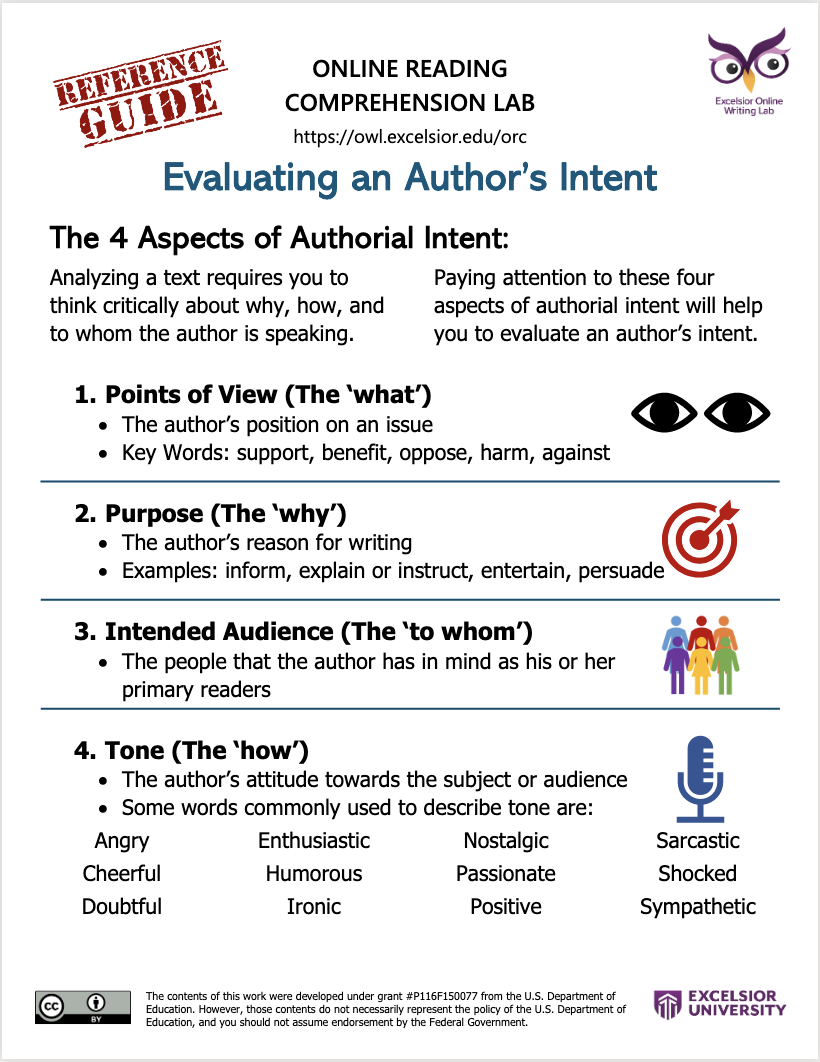
When purpose is not directly stated, infer it from patterns across the extract. Ask: Whose perspective is privileged? What behaviour is praised or criticised? What emotional response does the text repeatedly cultivate?
For example, if a narrator repeatedly describes a wealthy neighbourhood through images of brightness and comfort while nearby residents are depicted as hidden, cold, or hungry, a reasonable purpose might be to draw attention to inequality. It would be less convincing to claim that the writer’s purpose is simply “to use contrast.”
A paragraph scaffold: SQUID
The SQUID scaffold is a practical way to keep each analytical point moving forward rather than becoming a list of techniques.
Use the acronym in this way:
- S — Statement: Make an interpretive point about the writer’s choice and its significance.
- Q — Quotation: Embed a short, precise piece of evidence.
- I — Inference: Explain connotations, associations, or implied meaning within the quotation.
- D — Development: Extend your explanation to audience response, the text’s wider meaning, and authorial purpose.
Here is SQUID applied to an invented extract:
“At noon, the new apartment towers flashed above the river; at their feet, the old boarding house sagged behind a fence.”
Statement: The writer uses juxtaposition to present redevelopment as socially unequal.
Quotation: The “new apartment towers flashed” while the “old boarding house sagged.”
Inference: “Flashed” connotes brightness, wealth, and modern appeal, whereas “sagged” suggests exhaustion, neglect, and decline. The spatial phrase “at their feet” places the vulnerable building literally beneath the prosperous towers.
Development: Readers are positioned to notice the uncomfortable contrast between visible wealth and ignored poverty. The setting therefore comes to represent a city whose progress benefits some people while abandoning others, supporting a critical purpose of exposing the unequal consequences of development.
In a timed paragraph, you would combine those notes into fluent prose:
The juxtaposition between the “new apartment towers” that “flashed” and the boarding house that “sagged” presents redevelopment as socially unequal. While “flashed” connotes wealth and polished modernity, “sagged” suggests neglect and exhaustion; moreover, placing the boarding house “at their feet” makes its vulnerability seem overshadowed by the towers’ prosperity. Readers are invited to recognise the uncomfortable proximity of privilege and deprivation, so that the setting becomes a criticism of urban progress that leaves disadvantaged people behind.
Notice four features of this paragraph:
- It names the technique accurately.
- It chooses short quotations that can be analysed word by word.
- It explains why “flashed” and “sagged” matter.
- It moves outward from language to an idea about the world of the text.
The Ultimate Visual Devices List ⎮ VCE English Guide
Read the analysis method in “The Ultimate Visual Devices List” from Matrix Education. It uses VCE terminology, but its four-step process transfers directly to SACE-style close analysis: name the choice, explain what it does, consider audience positioning, and connect it to the wider argument or purpose.
In the section “How to use literary devices in your VCE English analysis,” read the four numbered steps, beginning with Step 1 and continuing through “Step 4: Link it back to the argument.” Then read the following “Example of analysing a persuasive technique,” especially the worked chain. As you read, underline the phrases that move from a feature of the wording to an audience response and then to a larger purpose.
Build the causal chain from the inside out
A reliable way to avoid generic comments is to begin with a specific detail, often one word.
Consider this invented line:
“Who will remember the names beneath the water?”
You recognised rhetorical questions in the previous lesson. Now develop its effect.
1. Identify the textual choice
This is a rhetorical question. In context, it may not seek an actual answer; it conveys the speaker’s fear that unnamed people will be forgotten.
2. Examine a key word or image
The verb “remember” implies that the people mattered and deserve continued recognition. The phrase “beneath the water” may suggest death, disappearance, burial, or a history concealed from public view.
3. State the audience response
Rather than merely saying “the reader feels sad,” be specific: the question involves readers because they must mentally confront its implied answer. It may create grief, discomfort, and a sense of responsibility.
4. Draw out meaning and purpose
The line suggests that forgetting is not neutral: it can become another form of loss. In a poem about a disaster, war, migration, or environmental destruction, the writer may use the question to memorialise victims and challenge an audience’s willingness to look away.
A compact analytical sentence might read:
The rhetorical question, “Who will remember,” confronts readers with the possibility that those “beneath the water” will be erased from public memory; this evokes grief and moral unease, supporting the poem’s apparent purpose of demanding remembrance for lives that have been overlooked.
The exact purpose must fit the whole extract. If later lines celebrate survival, “memorialising loss” may be only part of the interpretation. Always check that your claim accounts for the surrounding evidence.
Diagnose and improve weak analysis
The following common sentence has the right starting point but does not complete the chain:
The writer uses repetition of “every day” to emphasise that the characters walk past the building every day.
This mostly repeats the quotation in different words. It tells us what repetition does in general, but not what it means here.
Improve it by asking three questions:
-
What pattern does the repetition make noticeable?
Here, daily routine. -
What does that pattern imply about the characters or issue?
Their failure to act has become normalised. -
Why might a writer make readers notice that?
To criticise passive complicity in social neglect.
A developed version becomes:
Repetition of “every day” emphasises that the characters’ avoidance is habitual rather than accidental. Readers are positioned to recognise how easily injustice can become part of ordinary life when it is repeatedly ignored, contributing to the writer’s criticism of collective indifference.
Avoid these shortcuts in an exam:
| Shortcut | Why it weakens analysis | Better move |
|---|---|---|
| “This makes the reader want to read on.” | It could apply to almost any technique. | Name what readers anticipate or question, and why. |
| “This creates imagery.” | It identifies a broad result but not the particular image. | Explain the associations created by a key word or comparison. |
| “The author uses a metaphor to show…” | It can become a label followed by plot summary. | Explain how the metaphor changes the way readers see the subject. |
| “The reader feels sad.” | It is too broad and may not be supported. | Specify the trigger: grief, guilt, anxiety, sympathy, outrage, or uncertainty. |
| “The purpose is to persuade.” | It often ignores what the audience is persuaded to believe or do. | State the specific idea, judgement, or action the writer advances. |
A fast annotation-to-sentence routine
In an unseen-text response, do not try to analyse every device. Select the choices that most strongly develop the text’s central concern.
For each promising quotation, make a compact note in four lines:
- Choice: technique and exact words.
- Connotations: two or three associations of the most important word.
- Response and meaning: what readers are invited to feel, notice, or understand.
- Purpose: the broader idea the writer appears to explore, reveal, or challenge.
Then turn the note into a sentence using this adaptable pattern:
By using [technique] in “[short quotation]”, the writer associates [key word] with [connotations]. This positions readers to [specific response], suggesting that [meaning] and contributing to the writer’s purpose of [precise purpose].
You do not need to use this exact wording every time. Its value is that it prevents your paragraph from stopping after technique identification.
Key takeaways
Strong literary analysis follows a defensible chain: a precise textual choice shapes how an audience responds, develops an idea or meaning, and helps fulfil the writer’s broader purpose. To make that chain convincing, zoom in on a key word and its connotations before zooming out to the wider text.
Use SQUID to structure your thinking: make a statement, select a quotation, infer its implications, then develop the point into audience response, meaning, and purpose. Keep purpose specific and provisional: a writer may seek to challenge, expose, complicate, memorialise, or invite reflection, not merely “persuade.”
In the next module, you will apply this method to diction and connotation, learning how individual word choices establish tone in an unfamiliar text.
Can't find a good explanation? Sign up and we'll make it for you
Sign up