
Hello again. In the previous lesson, you practised identifying figurative techniques by their defining features: direct or explicit comparison, human qualities given to non-human things, and symbols that gain meaning through context. This lesson shifts from what an image compares to how a writer arranges language, ideas, and questions.
For SACE unseen-text work, these terms can overlap, but they are not interchangeable. By the end of this lesson, you should be able to distinguish juxtaposition, contrast, repetition, parallelism, and rhetorical questions in short unfamiliar extracts, using exact textual evidence rather than guessing from a single striking word.
Begin with the kind of pattern you can see
These five techniques fall into three useful categories:
| What the writer is doing | Techniques to consider | Main clue |
|---|---|---|
| Setting ideas or images in relation | Juxtaposition, contrast | What has been placed together, and how do the elements differ? |
| Creating recurrence or formal balance | Repetition, parallelism | What words or grammatical structures recur? |
| Framing an idea as a question | Rhetorical question | Is an answer genuinely wanted? |
A single sentence can contain more than one technique. Your task is not to find one “correct” label and ignore everything else; it is to name the feature that your evidence genuinely demonstrates.
For instance:
“Who will speak for the forgotten? Who will name them?”
These are likely rhetorical questions, because the speaker does not appear to expect an answer. They also use parallelism, since both questions have a similar grammatical shape. The repeated opening word, “Who,” contributes to repetition.
In an exam, the strongest analysis selects the label that helps you explain the specific pattern you have noticed.
Juxtaposition and contrast: placement versus difference
Juxtaposition means placing two things close together so that readers compare them. The key idea is deliberate proximity: two images, characters, settings, time periods, or ideas are set side by side.
Contrast is the meaningful difference between those elements. It might be a difference in wealth, age, mood, light, morality, power, noise, or values.
They often work together, but their definitions are distinct:
- Juxtaposition answers: How has the writer arranged the elements?
- Contrast answers: What difference does that arrangement reveal?
Consider:
“Beyond the gates, the hotel glowed gold; beside it, families slept beneath tarpaulins.”
The hotel and the families are positioned in close proximity, so this is juxtaposition. Their opposing conditions—luxury and homelessness, security and vulnerability—create contrast.
By contrast, a writer can create contrast without tight juxtaposition:
The opening paragraph describes a thriving coastal town. Several pages later, the narrator returns to find the same town abandoned after a storm.
This creates a contrast between past prosperity and present devastation, but the two versions are separated in the text. It is less accurate to call it juxtaposition unless the writer brings them directly together.
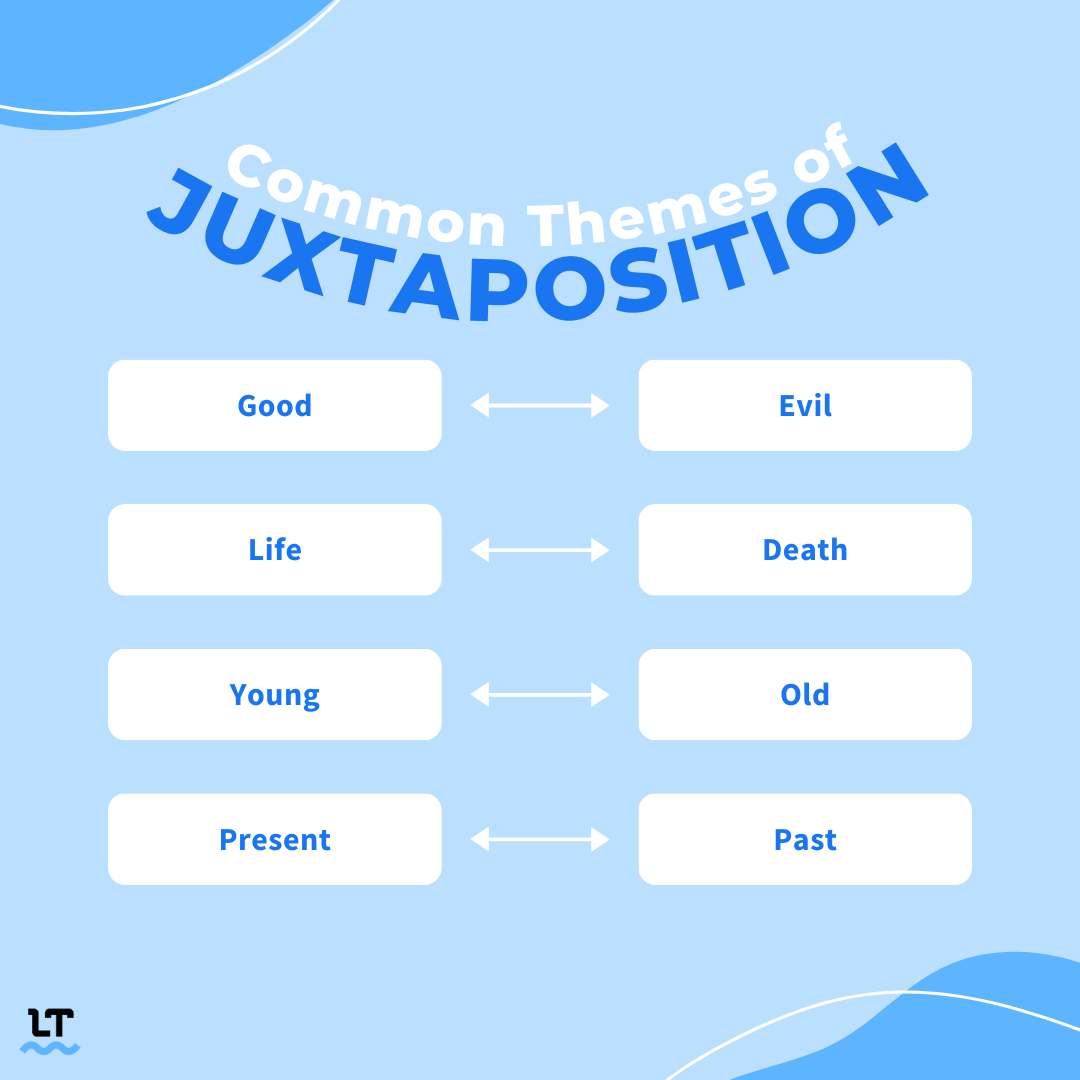
The image shows familiar oppositions, but do not limit yourself to obvious antonyms. Juxtaposition can place two things together that are not strict opposites:
“Her father’s war medal rested beside the unopened university acceptance letter.”
The medal and letter are not antonyms. Yet their placement invites a comparison between past sacrifice and future possibility, or between inherited duty and personal choice.
"What is Juxtaposition?": A Literary Guide for English Students and Teachers
Watch “What is Juxtaposition?” from the OSU School of Writing, Literature and Film. It clarifies the crucial point that juxtaposition means placing elements near one another; the elements need not be literal opposites.
Watch the definition for the distinction between adjacency and simple opposition. Then watch visual examples, focusing on how placement makes differences in size, colour, tone, or importance stand out. Finish with the Dickens example, where a repeated structure places opposing ideas directly beside each other.
When annotating, avoid writing only “juxtaposition of opposites.” Name both elements and the particular axis of difference:
- “the glowing hotel” and “families beneath tarpaulins”
- juxtaposition of wealth and deprivation
- contrast between protected privilege and exposed vulnerability
That precision gives you material for the next lesson, where you will turn identification into analysis of effect and purpose.
Repetition and parallelism: repeated language versus repeated shape
Repetition occurs when a writer deliberately repeats a word, phrase, sound, image, or sentence pattern. In this lesson, focus first on repeated words and phrases, because they are the easiest to identify accurately in an unseen extract.
“Still he waited. Still the door remained closed.”
The repeated word “Still” holds the reader in the moment. It emphasises duration and suggests that waiting has become frustrating or hopeless.
Repetition does not have to occur in consecutive sentences:
“The town remembered the fire. Years later, its silence still remembered.”
The word “remembered” links two moments in time. If a repeated word is prominent, placed at important moments, or closely associated with an idea, it is likely worth analysing.
Parallelism, also called parallel structure, occurs when phrases, clauses, or sentences follow the same grammatical pattern. The repeated feature is the sentence’s shape, not necessarily its exact wording.
“She wanted to leave, to forget, to begin again.”
The three infinitive phrases—“to leave,” “to forget,” and “to begin”—are parallel. Their balanced structure makes the desires feel linked and equally pressing.
“He had lost his job, his home, and his faith.”
This list uses parallel noun phrases. Its neat grammar can make the accumulation feel controlled, even as the content becomes increasingly serious.
"What Is Parallelism?": Oregon State Guide to Grammar
Watch “What Is Parallelism?” from the OSU School of Writing, Literature and Film. It gives a concise grammatical test for recognising parallel structure, which is particularly helpful when the repeated words are not identical.
Watch the core principle to see why elements of equal importance often share grammatical form. Then watch the example, noticing how matching verb forms makes a sentence feel balanced and easier to follow.
The distinction becomes clearer when you compare three cases:
| Extract | Best identification | Why |
|---|---|---|
| “Run, run, run.” | Repetition | The exact word is repeated for urgency. |
| “To leave, to forget, to begin again.” | Parallelism | Three different verbs follow the same infinitive structure. |
| “We demand justice; we demand mercy; we demand change.” | Repetition and parallelism | The phrase “we demand” repeats, and each clause follows the same grammatical form. |
Do not force yourself to choose only one label when the text clearly supports two. Instead, make your claim exact: the repeated phrase “we demand” creates a parallel series of declarative clauses.
Sentence structure - Analysing language - National 4 English Revision - BBC Bitesize
Read this concise BBC Bitesize guide as a revision check on several techniques in this lesson. It is useful because it places repetition, rhetorical questions, and contrast within the broader idea of sentence structure.
In the “Sentence structure” page, begin at the subsection “Repetition” and read through the entries on “Sentence types” and “Contrast.” Start with the repetition definition. Then find the “Contrast” entry and read the explanation of side by side placement. Finish with the final paragraph beginning “Punctuation is often key,” paying particular attention to its reminder that a question may be rhetorical, but is not automatically so.
A useful recognition habit is to mark both the repeated material and the unit being repeated:
- Word repetition: “still … still”
- Phrase repetition: “we demand … we demand”
- Parallel verbs: “to leave, to forget, to begin”
- Parallel clauses: “She came early; he arrived late; they stayed silent.”
This prevents a vague annotation such as “repetition is used,” which does not show what you have actually noticed.
Rhetorical questions: questions that make a point
A rhetorical question is phrased as a question but does not genuinely request information. The answer is usually obvious, implied, or deliberately unanswerable. The writer uses the question to make readers consider an idea, share an emotion, or accept a viewpoint.
“How could anyone call this justice?”
The speaker does not expect someone to provide a careful definition of justice. The implied answer is that the situation is not just. The question expresses outrage and pressures the audience to make the same judgement.
Compare it with a genuine question:
“Where did you put the keys?”
This seeks information. A character may expect someone to answer, so it is not rhetorical simply because it ends with a question mark.
Context matters. Consider:
“Will anyone remember us?”
In a conversation, this could be a genuine question. In the final lines of a poem about war or displacement, however, it may be rhetorical: it conveys fear of being forgotten and directs the reader toward a moral responsibility to remember.
Rhetorical questions commonly do one or more of the following:
- challenge an audience’s assumptions;
- express grief, anger, disbelief, or frustration;
- make an implied claim without stating it directly;
- involve the audience by making them mentally supply an answer;
- reveal a speaker’s uncertainty or emotional pressure.
The technique is not automatically persuasive or dramatic. A rhetorical question can be quiet and reflective:
“What remains when the house is empty?”
Here, the question may invite contemplation of loss rather than demanding agreement.
A model unseen extract: separating the patterns
Read this invented extract as you would in an exam:
At noon, the new apartment towers flashed above the river; at their feet, the old boarding house sagged behind a fence. We passed it every day. Every day, we looked away. Who would stop us? The council promised to repair, to protect, to remember.
Several techniques operate at once, but each has distinct evidence.
| Technique | Exact evidence | Why it fits |
|---|---|---|
| Juxtaposition | “new apartment towers” placed above “old boarding house” | The images are brought into immediate proximity. |
| Contrast | “flashed” versus “sagged”; “new” versus “old” | The language opposes prosperity and deterioration. |
| Repetition | “every day” appears twice | The repeated phrase emphasises routine and normalised avoidance. |
| Rhetorical question | “Who would stop us?” | In this context, no answer is expected; the question implies collective inaction. |
| Parallelism | “to repair, to protect, to remember” | The three infinitive phrases are grammatically balanced. |
Notice that you do not need to announce every possible technique in a final paragraph. First, identify accurately. Later, choose the two or three choices that best support your interpretation of the text’s central concern.
A fast exam routine
When you encounter a short unfamiliar extract, use this sequence during annotation:
- Circle question marks. Decide whether each question seeks information or makes an implied point.
- Underline exact repeated words or phrases. Check whether recurrence seems deliberate and meaningful.
- Bracket similarly shaped phrases or clauses. Look for matching verbs, repeated openings, or balanced lists.
- Place paired images or ideas together in your notes. If they are positioned closely, consider juxtaposition.
- Name the difference between those elements. If they differ in a meaningful way, identify the contrast precisely.
A few common errors are worth avoiding:
- Not every question is rhetorical. Context must show that an answer is not genuinely expected.
- Not every repeated word is a meaningful technique. Repeated articles, pronouns, or necessary names may be ordinary grammar. Focus on noticeable, emphasised recurrence.
- Parallelism is not simply a list. A list becomes parallel when its items have matching grammatical forms.
- Contrast does not always require juxtaposition. Ideas can differ across a whole text, even when they are not side by side.
- Juxtaposition is not restricted to perfect opposites. Its defining feature is deliberate placement that encourages comparison.
Key takeaways
Juxtaposition is the close placement of elements; contrast is the significant difference between them. Repetition repeats exact language, while parallelism repeats grammatical structure or sentence shape. A rhetorical question looks like a question but makes an implied point rather than seeking an answer.
For accurate SACE annotation, attach every label to exact words: identify what is placed together, repeated, structured in parallel, or asked rhetorically. In the next lesson, you will move from recognition to explanation, building a clear causal chain from a textual choice to its audience response, meaning, and wider authorial purpose.
Can't find a good explanation? Sign up and we'll make it for you
Sign up