
Hello, and welcome. This course will build two things together: an understanding of how the periodic table is organized, and a practical memory system for recalling it. We begin with the single fact that gives every element its identity.
By the end of this lesson, you should be able to state exactly what a chemical element is: a kind of atom defined by its number of protons.
The one feature that identifies an element
Everything around us is made of atoms, but atoms come in different kinds. Each kind is called a chemical element. Hydrogen, carbon, oxygen, iron, and gold are all elements.
The feature that tells us which element an atom is is the number of protons in its nucleus, the small central region of the atom.
A proton is positively charged, but for now the important point is simpler:
The number of protons determines the element.
For example:
- An atom with 1 proton is hydrogen.
- An atom with 2 protons is helium.
- An atom with 6 protons is carbon.
- An atom with 26 protons is iron.
This works in both directions. If you know an atom is carbon, you know it has 6 protons. If you count 6 protons in an atom, you know the atom is carbon.
The number of protons is so important that chemists give it a special name: the atomic number, written .
So the statements below mean exactly the same thing:
- Carbon has atomic number 6.
- Every carbon atom has 6 protons.
- Any atom with 6 protons is carbon.
A useful way to phrase the definition is:
An element is a substance whose atoms all have the same atomic number, or equivalently, the same number of protons.
Elements and atomic number (video) | Khan Academy
Read Khan Academy’s “Elements and atomic number” explanation for the central rule that connects an element to its proton count.
In the opening explanation, find the passage beginning “A particular element is identified by the number of protons in its atoms.” Read the central explanation through the helium and iron examples. Focus on the fact that the atomic number is a count of protons, not merely a label to memorize.
Why protons, not other particles?
Atoms contain other particles besides protons, including electrons and neutrons. Those particles matter greatly for an atom’s charge, mass, and behavior. But they do not give the atom its elemental identity.
Imagine examining two atoms:
- Atom A has 6 protons.
- Atom B also has 6 protons.
They are both carbon atoms. They may differ in some other details, but as long as both have 6 protons, neither stops being carbon.
By contrast, if an atom had 7 protons, it would be nitrogen, not carbon. Changing the proton count changes the element itself.
This is why the proton count is a dependable “identity number.” It is not based on appearance, color, whether a sample is solid or gas, or what it is combined with. It is a count inside the nucleus.
For the first part of memorizing the periodic table, you can treat every element as a pairing:
| Atomic number | Proton count | Element |
|---|---|---|
| 1 | 1 | Hydrogen |
| 2 | 2 | Helium |
| 3 | 3 | Lithium |
| 4 | 4 | Beryllium |
| 5 | 5 | Boron |
| 6 | 6 | Carbon |
The first two columns are always identical: atomic number and number of protons are two names for the same numerical fact.
Seeing the identity number on an element tile
A periodic table is made of individual element tiles. Each tile contains several facts, but the atomic number is the key starting point because it identifies the element.
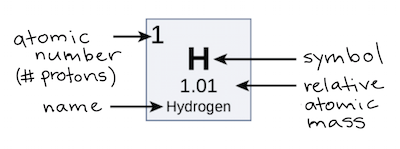
On the hydrogen tile, the number 1 at the top is the atomic number. Therefore hydrogen has one proton.
Notice the number 1.01 lower on the tile. That is the relative atomic mass, a different measurement. It is not the proton count and does not define hydrogen’s identity. For now, use the top whole number when you need to identify the element by protons. You will learn to interpret every part of a tile in a later lesson.
Here is the habit to build whenever you see an unfamiliar tile:
- Find the atomic number, usually the small whole number near the top.
- Read it as “this atom has this many protons.”
- Connect that proton count to the element’s name.
For instance, an atomic number of 26 means 26 protons, so the tile is iron. An atomic number of 8 means 8 protons, so the tile is oxygen.
A compact memory anchor
You do not need to memorize all 118 elements at once. Begin by making the central rule automatic:
Atomic number equals proton number; proton number equals element identity.
A short spoken recall routine can make this stick. Cover a periodic table, then say these associations aloud:
- “One proton: hydrogen.”
- “Two protons: helium.”
- “Six protons: carbon.”
- “Twenty-six protons: iron.”
Then reverse the direction:
- “Hydrogen: one proton.”
- “Helium: two protons.”
- “Carbon: six protons.”
- “Iron: twenty-six protons.”
The reversal matters. Memorizing the table will eventually require you to move easily from a name to a number, a number to a name, and later from a symbol to both.
Key takeaways
A chemical element is defined by its atoms’ number of protons.
- The atomic number is the number of protons in an atom.
- Every atom of a particular element has the same proton count.
- Different elements have different proton counts.
- Examples: hydrogen has 1 proton, helium has 2, carbon has 6, and iron has 26.
- On an element tile, the atomic number is the whole number that identifies the element.
Next, you will use this rule to determine both the number of protons and, for a neutral atom, the number of electrons from an atomic number.
Can't find a good explanation? Sign up and we'll make it for you
Sign up