
Hello again. In the previous lesson, you learned the identity rule for elements: the atomic number equals the number of protons, and that proton count determines which element an atom is.
Now we add one more fact that makes periodic-table tiles much more useful. For a neutral atom, the atomic number tells you two particle counts:
By the end of this lesson, you will be able to see an atomic number and state the atom’s number of protons and electrons immediately.
Why a neutral atom has equal protons and electrons
Atoms contain positively charged protons in their central nucleus and negatively charged electrons outside the nucleus.
- Each proton has one unit of positive charge.
- Each electron has one unit of negative charge.
- A neutral atom has no overall electrical charge.
For the positive and negative charges to balance, there must be exactly the same number of protons and electrons.
For example, suppose an atom has 8 protons. The protons contribute eight positive charges. To be neutral, it needs 8 electrons, whose eight negative charges cancel the positives.
This gives us the core rule for this lesson:
In a neutral atom, number of protons = number of electrons.
And because atomic number equals proton number:
For a neutral atom, atomic number = protons = electrons.
A compact version to memorize is:
Here, means protons and means electrons.
4.5: Elements- Defined by Their Number of Protons - Chemistry LibreTexts
Read this Chemistry LibreTexts explanation to connect the atomic-number rule from the last lesson with the new neutral-atom rule. Its small table of the first six elements is especially useful for seeing the matching proton and electron counts.
Begin in the “Atomic Number” section. Read the proton examples through the explanation that each element has its own fixed proton number. Then continue to the “Neutral Atoms” section and read the neutral atom explanation. In Table 1, notice that the proton, electron, and atomic-number columns match for each neutral atom shown.
A reliable three-step method
Whenever a question says an atom is neutral, use this method:
- Find the atomic number .
- State that the atom has protons.
- Because it is neutral, state that it also has electrons.
Example 1: Oxygen
Oxygen has atomic number 8.
Therefore:
Because the oxygen atom is neutral:
So a neutral oxygen atom has 8 protons and 8 electrons.
Example 2: Magnesium
Magnesium has atomic number 12.
Therefore, a neutral magnesium atom has:
- 12 protons
- 12 electrons
Example 3: Gold
Gold has atomic number 79.
Therefore, a neutral gold atom has:
- 79 protons
- 79 electrons
The numbers may become large, but the reasoning does not change. You never need to count particles one by one: read the atomic number and apply the neutral-atom rule.
Reading a model of a neutral helium atom
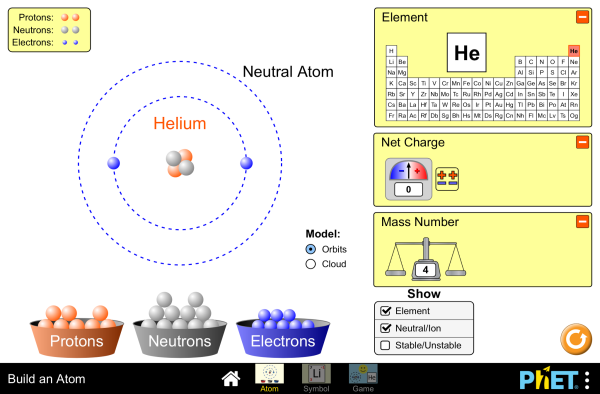
The image shows helium, written as He. Its atom contains:
- 2 protons
- 2 electrons
- 2 neutrons
The 2 protons tell us that the element is helium, because helium’s atomic number is 2. The two electrons balance the two protons, so the display correctly labels it a neutral atom with a net charge of 0.
Notice that the two neutrons do not enter the charge calculation. Neutrons have no electric charge. They do matter for an atom’s mass, but they do not change the simple relationship used in this lesson:
Also be careful not to mistake the mass number shown in the image, 4, for helium’s atomic number. The number 4 comes from its 2 protons plus 2 neutrons. Helium’s atomic number is still 2 because it has 2 protons.
How to find the Protons Neutrons and Electrons of an element on the Periodic table
Watch “How to find the Protons Neutrons and Electrons of an element on the Periodic table” from MooMooMath and Science for a quick visual demonstration of locating the atomic number and using it for neutral atoms.
Watch the core rule to see how an element tile displays its atomic number and why that number gives the proton and electron counts for a neutral atom. Then watch the silver example and the potassium example. For this lesson, focus only on the repeated pattern: atomic number, then protons, then equal electrons because the atom is neutral.
Avoiding two common mix-ups
1. Do not use atomic mass as the proton count
On a standard periodic-table tile, you may see a decimal such as 12.01 for carbon or 24.31 for magnesium. That number is the relative atomic mass, not the atomic number.
For particle counts in a neutral atom, use the atomic number: the small whole number that identifies the element.
| Element | Atomic number | Relative atomic mass, approximately | Protons in a neutral atom | Electrons in a neutral atom |
|---|---|---|---|---|
| Carbon | 6 | 12.01 | 6 | 6 |
| Oxygen | 8 | 16.00 | 8 | 8 |
| Magnesium | 12 | 24.31 | 12 | 12 |
The decimal mass values do not tell you the number of protons or electrons.
2. The word “neutral” matters
The equal-count rule applies specifically when the atom is described as neutral. In this course, when a prompt says “neutral atom,” treat it as a clear instruction:
Later, you will meet ions, atoms that have gained or lost electrons and therefore are not neutral. Their proton count still identifies the element, but their electron count can differ. For now, do not add or subtract anything: if the atom is neutral, both counts equal the atomic number.
Build instant recall
Say this sentence whenever you encounter a neutral atom:
“Atomic number tells me the protons; neutral tells me the electrons match.”
Use a quick two-direction recall routine for a few familiar elements:
| Given | Immediate conclusion |
|---|---|
| Neutral carbon, | 6 protons and 6 electrons |
| Neutral nitrogen, | 7 protons and 7 electrons |
| Neutral fluorine, | 9 protons and 9 electrons |
| Neutral aluminium, | 13 protons and 13 electrons |
| Neutral iron, | 26 protons and 26 electrons |
For a two-minute memory practice, cover the right-hand columns of the table. Read each atomic number, say the proton and electron counts aloud, then uncover the answer. Repeat later today and again tomorrow. The goal is not merely to recognize the rule, but to apply it automatically whenever you see an element tile.
Key takeaways
For any atom:
For a neutral atom:
So if a neutral atom has atomic number 17, it has 17 protons and 17 electrons. The atomic mass and neutron count are separate facts and should not be used for this calculation.
Next, you will learn to interpret the main parts of an element tile: its name, symbol, atomic number, and atomic mass.
Can't find a good explanation? Sign up and we'll make it for you
Sign up