
We'll begin today by establishing the foundational philosophical puzzle that gives rise to this entire debate: the Problem of Universals.
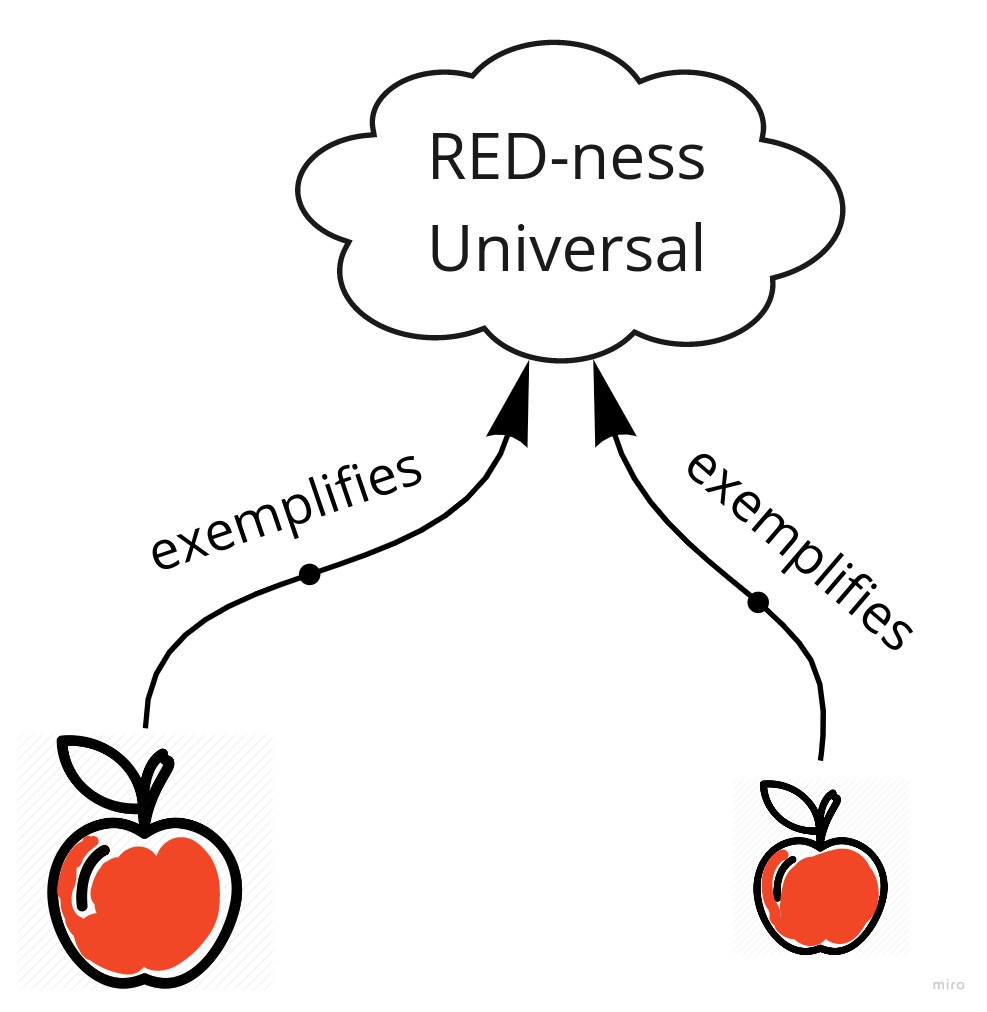
This lesson will address what it means for multiple, distinct objects to be instances of the same kind. When we say two different apples are both 'red', what exactly is this 'redness' that they supposedly share? Is it a real entity existing in the world? A mental construct? Or just a name we use for convenience? By the end of this lesson, you will be able to explain this problem using concrete examples and understand why it’s not just an abstract puzzle, but one with deep implications for fields like artificial intelligence.
The Core Puzzle: One Property, Many Things
Let's start with a clear, intuitive introduction to the central question. The following short video lays out the puzzle of how a single property, like 'redness', can seemingly exist in multiple different places at the same time.
Universals vs Particulars (Metaphysical Distinction)
This video from Carneades.org, titled "Universals vs Particulars," provides a concise and clear introduction to the distinction that lies at the heart of our topic.
Please watch the first three minutes, which cover the core of the issue. Focus on these key points: The initial puzzle presented with the two red apples: the problem. The definition of a universal: the definition. The contrasting definition of a particular: the definition.
As the video explains, we have a basic distinction:
- Particulars: These are the individual, concrete objects we encounter in the world, like a specific apple, a particular chair, or your laptop. They exist at a specific location in space and time.
- Universals: These are the repeatable properties, qualities, or kinds that can be "instantiated" or "exemplified" by many different particulars. 'Redness', 'squareness', and 'being a dog' are classic examples.
The problem, then, is to explain the nature of these universals and their relationship to particulars. How can one and the same thing—the universal 'redness'—be wholly present in two different, spatially separate particulars?
A More Precise Formulation: The "One over Many"
Philosophers have given this puzzle a traditional name: the Problem of the One over Many. The "One" is the universal property (e.g., 'redness'), and the "Many" are the particular things that share it. To delve deeper into this, we will turn to a more rigorous, academic text. While dense, its precision will be valuable.
[PDF] What is the Problem of Universals? - University of Oxford
This paper by Gonzalo Rodriguez-Pereyra provides a clear, modern analysis of the problem. We'll read the section that formalizes the "One over Many" and introduces a crucial distinction.
In the PDF, please find the section titled "2. The One over Many". Read this section carefully, from the beginning of the section to the end. Pay close attention to the formulation of the problem as "how can there be identity in the difference?" and the distinction between 'sparse' and 'abundant' properties.
This reading introduces two critical points:
-
The problem is ontological. This isn't a question about psychology or language—how we happen to think or talk about 'redness'. It's a question about ontology, the study of being: what kinds of things exist? Do universals exist as independent entities in the same way particulars do?
-
The focus is on sparse properties. David Lewis's distinction is key here. The problem isn't about "abundant" or "gerrymandered" properties, like 'being red or being a laptop' or 'being 5 feet away from a prime number of books'. The problem concerns sparse (or natural) properties—the ones that seem to "carve nature at its joints" and define genuine resemblances between things. In the context of data analysis or machine learning, this is analogous to distinguishing meaningful, predictive features from arbitrary, noisy correlations. We are interested in the features that define real structure in the world.
Why This Ancient Problem Matters for AI
This might seem like a purely philosophical debate, but it has direct and profound consequences for how we think about intelligence, both human and artificial. Different stances on the Problem of Universals lead to fundamentally different architectures for building intelligent systems.
The following text connects this philosophical history to the development of AI and computational models of the mind.
20th WCP: Computational Complexity and the Origin of Universals
This paper by Leonid Perlovsky frames the philosophical debate as a practical tension in the design of intelligent systems: the trade-off between pre-existing knowledge and learning from experience.
Please read the first section, "I. Introduction: Mathematics and Philosophy". Focus on how the paper links realism and nominalism to different scientific and computational philosophies.
As Perlovsky highlights, the debate between realism (the view that universals are real, a priori entities, associated with Plato) and nominalism (the view that universals are just names for collections of similar things, associated with William of Occam) is not just historical trivia. It maps directly onto core challenges in AI:
- A realist approach might favor systems with significant built-in,
a prioriknowledge structures—think of symbolic AI with its hand-crafted rules and ontologies. The "concepts" are given to the system. - A nominalist approach aligns more with systems that are expected to discover patterns from raw data with minimal prior assumptions—think of early connectionist models or unsupervised clustering algorithms. The "concepts" are supposed to emerge from experience.
The failure of overly simplistic approaches in both camps, and the combinatorial complexity that arises when trying to bridge the gap, shows that the Problem of Universals is very much a live issue at the forefront of AI research.
A Final Refinement: The "Many over One"
We can sharpen our understanding of the problem one last time. While the "One over Many" is the classic formulation, the Rodriguez-Pereyra paper argues that a more fundamental puzzle lies beneath it. If we think about what makes it true that "this apple is red," we are led to a different perspective.
The core of the argument is this: Consider a single particular, say, a billiard ball. Many things can be true of it simultaneously: "the ball is red," "the ball is spherical," "the ball has a mass of 170g." If the ball itself were the only thing needed to make these statements true, what would distinguish the truth of "the ball is red" from the truth of "the ball is spherical"? The same single entity (the ball) cannot, by itself, account for this variety of distinct facts about it. There must be some multiplicity within or associated with the single particular.
This flips the problem on its head. Instead of asking how many things can share one property, we ask:
How can one thing have many properties?
This is the Problem of the Many over One.
[PDF] What is the Problem of Universals? - University of Oxford
Let's return to the Rodriguez-Pereyra paper to see this final, crucial reframing.
Please read the section titled "6. The Many over One". The key part of the argument is the thought experiment about a single object a: The core question is how one thing can ground many truths. This section argues that to solve the problem, we are forced to accept that there is something more to the world than just particulars.
This reframing from the "One over Many" to the "Many over One" is powerful because it shows that we cannot simply dismiss the problem. We are forced to acknowledge the existence of properties in some form. The question is no longer if properties exist, but what they are.
Conclusion
In this lesson, we have unpacked the Problem of Universals, a cornerstone of metaphysics that is essential for any deep inquiry into the nature of concepts.
Key Takeaways:
- The Problem of Universals asks what it is for multiple different things (particulars) to share a common property or be of the same kind (a universal).
- The problem is ontological: it concerns what fundamentally exists. It's traditionally framed as the One over Many—how one property can be instantiated in many particulars.
- The problem is most relevant for sparse or natural properties, those that seem to reflect the real structure of the world, a concept analogous to identifying meaningful features in a dataset.
- A more precise formulation is the Many over One: how a single particular can have many distinct properties. This view forces us to recognize that properties, in some sense, must be real.
- This is not just an abstract puzzle; it maps onto fundamental design choices in AI concerning the balance between built-in knowledge (
a prioristructures) and learning from experience.
Having established a solid understanding of the problem, we are now in a position to examine the competing solutions. In our next lesson, we will distinguish the three major philosophical responses—Realism, Nominalism, and Conceptualism—and see how each attempts to answer the questions we've raised today.