
In our first lesson, we established the fundamental philosophical puzzle known as the Problem of Universals. We saw that whether framed as the "One over Many" or the "Many over One," we are forced to grapple with the nature of properties like 'redness' or 'dogness'. The question is not if properties have some reality, but what kind of reality they have.
Today, we will explore the three principal answers to this question. This lesson directly addresses your goal of understanding the metaphysical underpinnings of different theories of concepts by distinguishing between Realism, Nominalism, and Conceptualism. These positions represent a spectrum of thought on whether universals are mind-independent realities, mere names, or mental constructs. Grasping this framework is crucial for later evaluating the "essentialist" versus "fuzzy" views of concepts that you're keen to explore.
A Quick Tour of the Philosophical Landscape
To begin, let's get a high-level overview of the main competing views. The following video offers a concise introduction to the debate, contrasting the two extremes—Plato's radical realism and Ockham's nominalism—with the middle-ground position of Aristotle and Aquinas.
Moderate Realism (Aquinas 101)
This video from The Thomistic Institute, titled "Moderate Realism," quickly lays out the core ideas.
Watch the first three minutes, from the start until the end of the initial explanation. Pay close attention to how it defines three distinct locations for universals: In a separate, ideal realm (Plato's realism). Only as names or conventions (Ockham's nominalism). First in the things themselves, and then abstracted by the mind (Aristotle's moderate realism).
This gives us our basic map: universals exist in reality, only as names, or as concepts in the mind. Now, let's explore each of these positions with more rigor.
The Three Major Schools of Thought
We will use the paper "A Reappraisal of Realism and Nominalism" as our main guide. It provides a structured analysis of each position's historical roots and philosophical commitments.
A Reappraisal of Realism and Nominalism - The Academic
This paper by Dr. Samir Ali will be our core text for dissecting the three main philosophical solutions.
Please read the following sections to understand the key distinctions: Start with the Introduction. Read from the opening paragraph to get a clear definition of realism, nominalism, and conceptualism. Next, move to the section on Historical Foundations. Read the subsections on Plato and Aristotle to see the two major variants of realism. Then read the subsection on Nominalism to understand its origins with William of Ockham. Now focus on The Ontological Commitments. Read the two subsections, Realism and Nominalism, which explain precisely what each view claims exists. Finally, jump to the section Conceptualism: A Middle Ground. Read from the beginning of this section to the end of the subsection on "Cognitive Science of nowadays". This explains the third major view and connects it to topics highly relevant to your interests.
Let's consolidate what you've just read.
1. Realism: Universals are Real and Mind-Independent
The realist camp argues that universals exist objectively, independent of our thoughts or language. This position is appealing because it provides a straightforward foundation for objective knowledge; scientific laws like or mathematical truths like seem to describe real, universal relationships, not just our ideas about them.
The reading highlights two primary forms of realism:
- Platonic Realism (or "Exaggerated Realism"): Universals exist in a transcendent, non-physical "realm of Forms." The particular red things we see in the world are just imperfect "shadows" or copies of the one perfect Form of Redness.
- Aristotelian Realism (or "Moderate Realism"): Universals are immanent, meaning they exist within the particular things themselves. 'Redness' doesn't float in a separate realm; it exists in every red object as a constituent part of that object. The mind then discovers it through abstraction from experience.
2. Nominalism: Only Particulars Exist
Nominalism stands in stark opposition to realism. Its guiding principle is ontological parsimony, famously expressed by William of Ockham's "razor": do not multiply entities beyond necessity. For a nominalist, positing a whole other category of existence for universals is unnecessary.
- Core Idea: Only individual, particular things exist. Universals are not real entities; they are merely names (
nominain Latin) that we use as convenient labels for groups of similar particulars. - The Challenge: While ontologically simple, nominalism struggles to explain what grounds our use of these names. If there is no real, shared 'redness', what makes our grouping of red objects anything other than arbitrary? Why does the world seem to possess objective similarities at all? Later thinkers, such as Wittgenstein, would develop sophisticated versions of this view, arguing that the meaning of a word like 'game' is found not in a shared essence but in a "family resemblance" of overlapping features—a topic we'll explore in depth later.
3. Conceptualism: A Middle Ground
Conceptualism tries to split the difference. It agrees with nominalism that universals do not exist as mind-independent entities in the external world. However, it agrees with realism that universals are more than just names—they have a real existence, but as concepts within the mind.
- Core Idea: The mind actively structures reality by forming concepts. As the reading notes, this view finds a powerful formulation in Immanuel Kant, who argued that categories like 'causality' or 'unity' are not discovered in the world but are imposed by the mind to make sense of sensory experience.
- Modern Resonance: This perspective connects directly to your interests in cognitive science and AI. The work of George Lakoff, mentioned in the reading, suggests human categorization is based on mental "prototypes" (e.g., a robin is a more 'bird-y' bird than a penguin), not on detecting fixed, external essences. This is analogous to how a centroid in a k-means clustering algorithm represents a concept—it's a calculated central point, not a pre-existing entity.
Visualizing the Positions
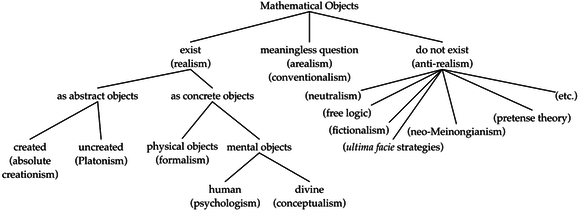
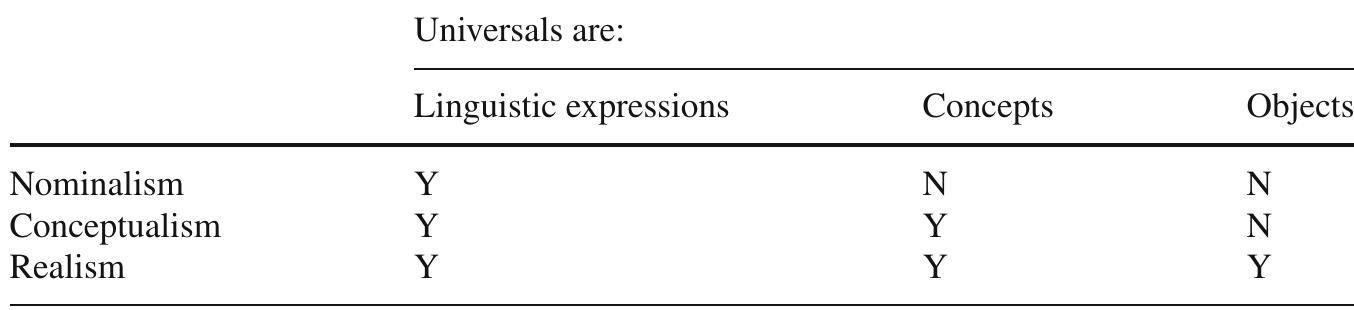
To help solidify these distinctions, here are two diagrams. The first provides a broad classification of philosophical views, and the second offers a very direct comparison of our three schools of thought.
For further clarification, the study guide "History of Philosophy 23" is an excellent resource. Its summary table and glossary crisply define the key positions.
[PDF] History of Philosophy 23 Problem of Universals By Dr. Arthur ...
This guide offers very clear, summarized definitions.
Refer to the table in the section "The Four Primary Philosophical Positions" for a quick comparison. You can also review the Glossary at the end for precise definitions of 'Exaggerated Realism', 'Conceptualism', and 'Nominalism'.
Conclusion
Today, we have mapped out the three major solutions to the Problem of Universals, moving from the problem to the proposed answers.
Key Takeaways:
- Realism holds that universals are real, mind-independent entities that exist either transcendently (Plato) or immanently in particulars (Aristotle).
- Nominalism argues that only particulars exist; universals are merely convenient names or linguistic conventions, a view prized for its ontological simplicity.
- Conceptualism offers a middle path, proposing that universals exist as concepts in the mind, which actively structures our experience of the world.
These metaphysical stances are not just abstract philosophical games. They have profound implications for how we believe knowledge is acquired and how concepts are formed. The realist-conceptualist spectrum, in particular, sets the stage for the debate between essentialist and prototype theories of concepts.
In our next lesson, we will begin to bridge this metaphysical foundation to your specific interests by examining the Classical Theory of Concepts. This theory, originating with Aristotle, is a direct application of his moderate realism to the process of definition and is a cornerstone of the "essentialist" view you wanted to investigate.