
Hello! Welcome to the fourth lesson in our module on testing strategies for microservices.
In our last lesson, we discussed the Test Pyramid. We established that while end-to-end (E2E) tests are valuable, they are also slow, expensive, and often brittle, especially in a distributed system. We concluded that we need a more efficient way to gain confidence that services can communicate correctly without relying heavily on full E2E test suites.
Today, we will explore the solution to that problem. Your goal for this lesson is to describe the purpose and benefits of consumer-driven contract testing (CDCT). This is a critical concept in modern microservices development and a topic frequently explored in senior-level interviews to gauge your understanding of building robust, independently deployable systems. We'll focus on the "what" and "why" before we dive into the implementation in the next lessons.
1. The Challenge of Inter-Service Dependencies
Imagine two teams: the Order service team and the Payment service team. The Order service (the consumer) needs to call the Payment service (the provider). If the Payment team changes its API, how can they be sure they haven't broken the Order service?
Traditionally, this is discovered late in the development cycle in a shared testing environment, where slow and flaky E2E tests run. This creates bottlenecks and slows everyone down.
How does eBay utilize Contract Testing for their Microservices?
To understand the problem more deeply, let's look at a real-world example from eBay. This video from the Software Developer Diaries channel explains the challenges they faced with traditional E2E tests and why they adopted contract testing.
Watch the first section of the video (0:00 - 1:21). Pay close attention to the four major problems with end-to-end tests that are highlighted: they are slow, flaky, hard to debug, and provide poor coverage insight.
This is the core problem contract testing aims to solve: how can we verify inter-service integrations quickly, reliably, and early in the development process?
2. What is a "Contract"?
The solution lies in creating a "contract" between a consumer and a provider. This isn't a legal document, but a technical one that captures the expectations a consumer has of its provider's API.
How does eBay utilize Contract Testing for their Microservices?
The same video provides a clear and simple definition of what a contract is in this context.
Watch the short segment from 3:35 to 4:09. This will give you a concrete example of a contract for a simple interaction between a Booking service and a Payment service.
A contract specifies the exact request a consumer will send and the exact response (including status codes, headers, and body structure) it expects to receive for a given interaction. It's a snapshot of the consumer's requirements.
To discuss this concept professionally, it's important to use the correct terminology.
My thoughts and notes about Consumer Driven Contract Testing
This article from the DEV Community provides a great glossary of the key terms used in contract testing.
Read the section titled 'Contract Testing'. Focus specifically on the 'Vocabulary' subsection to understand the definitions of: Consumer: The service that initiates the request. Provider: The service that responds to the request. Contract: The file capturing the expected interaction. Contract Broker: A central repository for sharing and versioning contracts.
3. The Consumer-Driven Contract Testing Workflow
The "consumer-driven" aspect is key. The consumer defines the contract, which ensures that the provider is tested against real-world usage patterns. The process generally follows these steps:
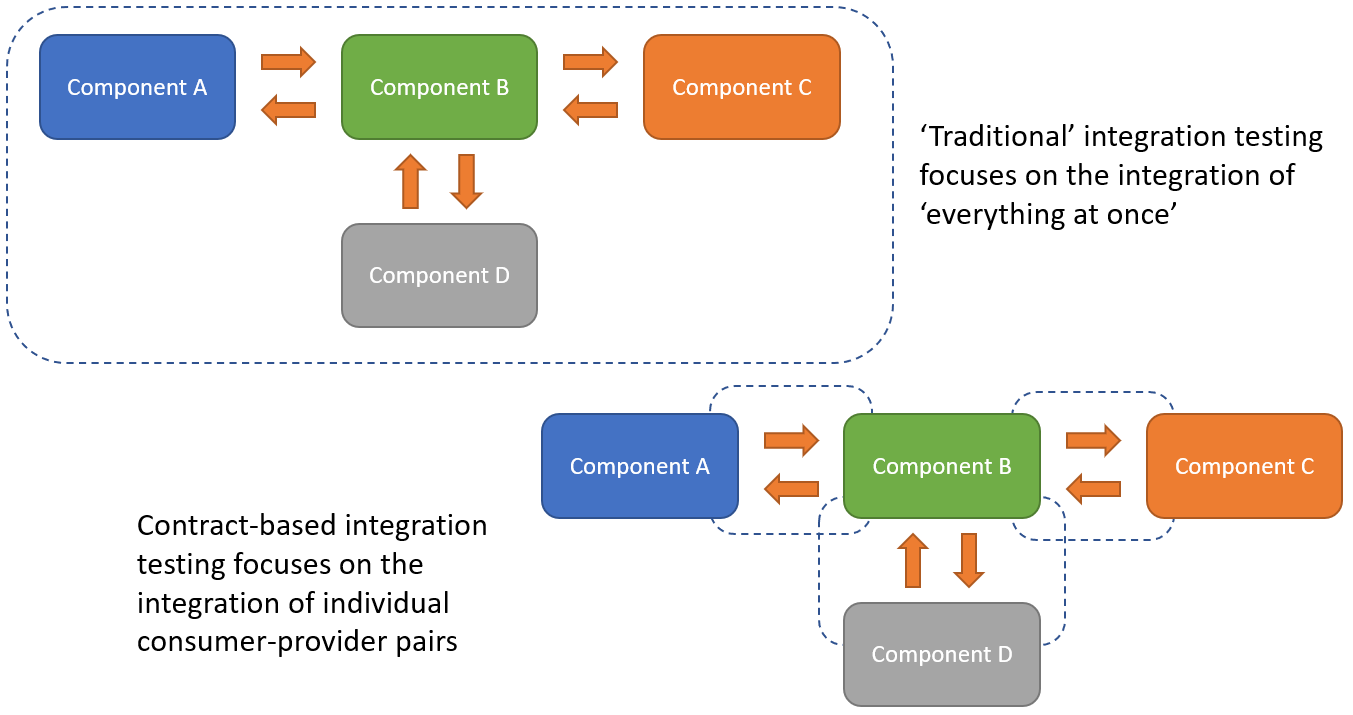
The workflow illustrated by the bottom half of the image is what gives us this powerful, isolated feedback.
How does eBay utilize Contract Testing for their Microservices?
Let's return to the eBay video, which has an excellent animation that walks through the entire CDCT workflow. This is the most important part of the lesson to understand.
Watch the section from 4:09 to 6:24. Focus on the two-step process: Consumer-side: The consumer tests against a mock provider, which captures the interactions and generates the contract. Provider-side: The contract is shared (via a broker), and the provider replays the interactions against itself to verify it meets the consumer's expectations.
To solidify your understanding, let's review this process with a textual description.
My thoughts and notes about Consumer Driven Contract Testing
The same DEV Community article provides a concise summary of the CDCT lifecycle.
Read the subsection 'Consumer Driven Contract Testing Lifecycle (CDCT)'. This recaps the flow: generate, publish, verify, and check status before deployment.
The crucial outcome of this process is that if a provider makes a change that breaks a consumer's expectations, the provider's CI/CD pipeline fails. The breaking change is caught automatically, long before it reaches a production environment.
Test your understanding!
A PaymentService team wants to rename a field in their API response from transactionId to paymentUuid. An OrderService is a consumer of this API. Describe how Consumer-Driven Contract Testing would prevent the PaymentService team from deploying this breaking change.
Show answer
- The
OrderService(consumer) has already published a contract to the broker. This contract specifies that it expects a field namedtransactionIdin the response from thePaymentService. - The
PaymentServiceteam renames the field topaymentUuidin their code. - When they push their changes, their CI/CD pipeline triggers. The contract test verification step pulls the latest contract from the
OrderServicefrom the broker. - The test framework replays the request from the contract against the modified
PaymentService. The service now returns a response withpaymentUuid, but the contract expectstransactionId. - The verification fails. The
PaymentServiceteam's build breaks, and they are immediately notified that their change is incompatible with theOrderService's expectations. - The breaking change is prevented from being deployed, and the team can now either revert the change or coordinate an update with the
OrderServiceteam.
4. Key Benefits: Your Interview Answer
When an interviewer asks, "How would you test your microservices?", describing CDCT and its benefits demonstrates a mature understanding of building scalable, distributed systems.
Monolith & Microservices tough questions & answers for ...
This article, written in an interview Q&A format, perfectly summarizes the role and benefits of contract testing in a microservices strategy.
Read the subsections on 'Contract Tests' and 'Ensuring Confidence in System-Wide Behavior'. Focus on the stated Goal of CDCT and how it serves as the backbone for system confidence.
Here are the primary benefits of CDCT, which you should be able to articulate clearly:
- Enables Independent Deployment & Team Autonomy: This is arguably the biggest benefit. Teams can deploy their services with high confidence that they are not breaking downstream consumers or upstream providers. This eliminates cross-team dependencies and release bottlenecks.
- Fast, Reliable Feedback: Contract tests are fast. They run in isolation as part of a service's own build pipeline. Failures are caught in minutes, not hours or days later in a complex E2E environment.
- Reduces Reliance on Brittle E2E Tests: By verifying integrations at the contract level, you can drastically shrink the number of expensive, flaky E2E tests. Your Test Pyramid becomes healthier, with a focus on fast unit, component, and contract tests.
- Provides Living Documentation: A contract isn't just a static document; it's executable. It shows exactly how a provider's API is actually being used by its consumers, which is far more reliable than a manually maintained OpenAPI/Swagger specification that might be out of date.
A common follow-up question is, "Why not just use shared OpenAPI/Swagger specifications?"
How does eBay utilize Contract Testing for their Microservices?
The eBay video addresses this question directly, explaining why OpenAPI specs alone are not sufficient.
Watch the section from 1:43 to 3:35. Note the key takeaway: an OpenAPI spec describes what an API can do in general, but it doesn't reflect how a specific consumer actually depends on it.
Conclusion
You now understand the critical role of consumer-driven contract testing in a modern microservices architecture. It directly addresses the shortcomings of traditional E2E testing by providing a mechanism for fast, reliable, and isolated verification of inter-service communication.
Key Takeaways:
- Purpose: CDCT verifies that a provider service meets the expectations of its consumer services, preventing breaking changes.
- Workflow: The consumer defines a contract by testing against a mock provider. This contract is then used in the provider's pipeline to verify its API against real-world usage.
- Core Benefits: It enables independent deployment, provides fast feedback, reduces the need for E2E tests, and serves as living documentation.
- CDCT vs. Schemas: A contract is more powerful than a schema (like OpenAPI) because it tests how an API is actually used, not just what it is capable of.
Next Up
We have thoroughly covered the "what" and "why" of contract testing. In our next lesson, we will move on to the practical "how". You will write your first consumer-driven contract for a REST API using Spring Cloud Contract, putting these powerful concepts into practice.
Can't find a good explanation? Sign up and we'll make it for you
Sign up