
Hello Alex,
Welcome back to your UX refresher for EdTech strategy.
In our last lesson, we focused on the crucial first moments of the user journey: the onboarding sequence. We established a framework for critiquing how effectively an EdTech product communicates its value and scaffolds the user's path to their first "win."
But successful onboarding is just the beginning. The next, and perhaps greater, challenge is fostering the long-term engagement that turns new users into committed learners. Why do some products feel compelling and others feel like a chore? This lesson will give you a powerful psychological framework to answer that question.
This lesson will take approximately 55 minutes to complete.
Learning Outcome: By the end of this lesson, you will be able to diagram a UX strategy that applies Self-Determination Theory (autonomy, competence, and relatedness) to foster long-term learner engagement in an EdTech product.
Part 1: The "Why" Behind Motivation: Self-Determination Theory (15 minutes)
To design for engagement, we need to understand what truly motivates people. Self-Determination Theory (SDT), developed by psychologists Edward Deci and Richard Ryan, offers a compelling answer. It proposes that the type of motivation matters more than the amount. The most powerful motivation is autonomous motivation—when we act from a sense of full willingness and choice.
To get a clear, foundational understanding of this, let's hear from the source himself.
Video Activity:
Please watch the following short video featuring Professor Edward Deci.

Focus on these two key segments:
- Autonomous vs. Controlled Motivation (01:08 - 03:27): Grasp the core distinction between doing something because you want to versus doing it because you have to.
- The Three Basic Psychological Needs (03:00 - 05:12): Pay close attention as he introduces the three universal needs that, when satisfied, fuel autonomous motivation.
As Deci explains, this powerful form of motivation is nurtured by satisfying three innate psychological needs: Autonomy, Competence, and Relatedness.
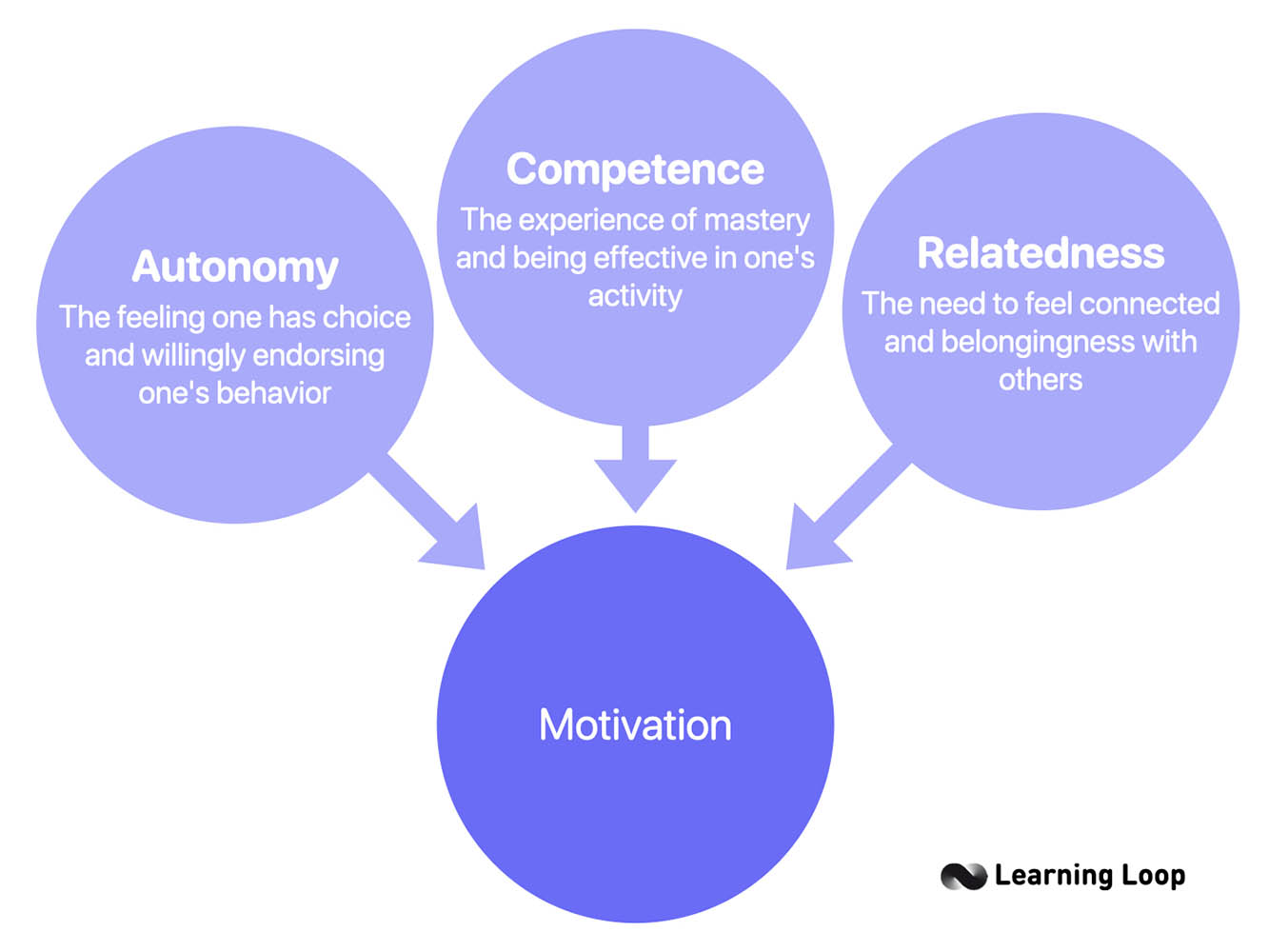 This diagram illustrates the three core psychological needs—Autonomy, Competence, and Relatedness—that drive motivation according to Self-Determination Theory.
To solidify this in a UX context, please read the introductory section of the following article.
Reading Activity:
Read the section "What is User Motivation? (Self-Determination Theory)" in the article below. This should take about 3-4 minutes.
Understanding User Motivation in UX Design: A Deep Dive ...
This reading will reinforce the definitions and connect them directly to the world of UX design, setting the stage for us to apply these concepts.
Part 2: The Three Pillars in a UX Context (15 minutes)
Now, let's translate these three psychological needs into concrete design principles. How can we, as designers, create experiences that make users feel autonomous, competent, and related?
Interestingly, game designers have been masters of this for decades. The principles that make games engaging are directly applicable to EdTech.
Video Activity:
Watch the following video, which breaks down SDT through the lens of game design. This creative perspective will provide you with a very intuitive grasp of how to apply these pillars.

Focus on these chapters as he explains each pillar with excellent examples:
- Competence (01:58 - 04:12): The need to feel effective and experience mastery. Think of progress bars, clear feedback, and leveling up.
- Autonomy (04:12 - 07:49): The need to feel in control and have choices. Think of customizable settings, branching paths, and open-world exploration.
- Relatedness (07:35 - 11:04): The need to feel connected to others. Think of leaderboards, team collaboration, and relatable stories.
As you can see, these aren't abstract ideas; they are actionable design goals. To bring this directly back to EdTech, let's look at how a platform like Khan Academy does it.
Reading Activity:
Return to the LinkedIn article and read the section "Industry-Specific Applications: E-learning Platforms." It's a short but highly relevant paragraph.
Understanding User Motivation in UX Design: A Deep Dive ...
Notice how Khan Academy's adaptive learning paths (Autonomy), mastery goals and points (Competence), and friend progress comparisons (Relatedness) are direct applications of the principles we've just discussed.
Part 3: From Theory to Practice: A Real-World EdTech Case Study (15 minutes)
Applying these principles strategically means making deliberate UX choices and measuring their impact. Let's look at a fantastic, real-world example from the EdTech company Squla. They faced a classic EdTech design challenge: how to provide learner choice without sacrificing the benefits of a structured curriculum.
They designed a feature called "structured autonomy" and ran a large-scale A/B test to see if it worked.
Reading Activity:
Please read the following article detailing their experiment. As a designer with a strategic mindset, you will find their process of forming a hypothesis, designing a solution, and measuring the outcome highly valuable. This should take about 8-10 minutes.
Structured Autonomy in Primary EdTech: A large-scale A/B ...
As you read, focus on:
- The Design Question: The tension between giving learners control (Autonomy) and maintaining a purposeful learning path.
- The UX Solution: The simple, elegant "drag & drop" interface that allows children to reorder upcoming lessons. Note the inclusion of an opt-out ("I don't want to choose"), which respects autonomy even further.
- The Business Impact: The experiment showed that this small moment of choice increased completion rates (a key engagement metric) without harming accuracy (the pedagogical goal).
This case study is a perfect illustration of how a UX strategy grounded in psychological theory can lead to measurable improvements in both learner engagement and business outcomes.
Part 4: Your Turn: Diagramming an SDT-based UX Strategy (10 minutes)
Now it's time to put it all together. Your task is to apply what you've learned by creating a simple diagram of a UX strategy for an EdTech product. This exercise will directly prepare you for the learning outcome.
Your Task:
- Choose an EdTech product you are familiar with (e.g., Duolingo, Coursera, Figma's learning resources, or even the fictional "SmartyLearn" from our last lesson).
- Create a diagram (a simple three-column table or a mind map would be perfect) with the headings: Autonomy, Competence, and Relatedness.
- Under each heading, list 2-3 specific features, UI patterns, or user flows from your chosen product that satisfy that psychological need.
To help you visualize the goal, think of this Venn diagram. Your diagram will be a way of articulating the specific features that would live within each of these circles for your chosen product.
 This Venn diagram shows the three core psychological needs and how their fulfillment is essential for committed engagement.
Example using Duolingo:
| Autonomy | Competence | Relatedness |
|---|---|---|
| Choosing your daily XP goal | "Lesson complete" screen with XP earned | Leaderboards (weekly competition) |
| Selecting which skill to practice next | "Streaks" that track consecutive days of learning | "Friend Quests" for collaborative goals |
| Disabling "listening" exercises | Skills "leveling up" from bronze to legendary | Sharing achievements on social media |
Take about 10 minutes to sketch out your own diagram. This will crystallize your understanding of how to use SDT as a strategic design tool.
Conclusion
In this lesson, we moved from getting a user started to keeping them engaged for the long run. You've learned about Self-Determination Theory and its three core psychological needs—Autonomy, Competence, and Relatedness—which are the bedrock of sustained, intrinsic motivation.
Key Takeaways:
- SDT is a strategic framework: It helps us design for why users engage, not just what they do.
- The Three Pillars are Design Goals:
- Autonomy: Empower users with meaningful choices and control.
- Competence: Help users feel effective and see their progress.
- Relatedness: Foster a sense of connection and community.
- Small Changes, Big Impact: As the Squla case study showed, even small, well-designed features that support these needs can lead to significant, measurable increases in engagement.
Preview of the Next Lesson
We've now established a psychological strategy for driving engagement. But how do we connect this strategy to high-level business objectives and measure our success in a way that executives can understand? In our next lesson, you will create a visual hierarchy that links a high-level product OKR for an EdTech product to specific UX-focused KPIs and the user interactions that influence them. This will bridge the gap between user psychology and business impact.
Can't find a good explanation? Sign up and we'll make it for you
Sign up