
Hello, and welcome back.
In the previous lesson, you built a way to diagnose errors in a mock test instead of treating every wrong answer as the same kind of failure. This lesson applies that idea to verbal aptitude. A grammar question can be lost because you do not know a rule, but also because you read too quickly, attach a modifier to the wrong word, or choose a familiar word that does not fit the context.
For GATE, the goal is not to memorize every exception in English grammar. It is to inspect a sentence systematically, identify the relationship among its parts, and select the option that is both grammatically correct and contextually precise. We will focus on sentence structure, agreement, modifiers, and word usage.
Start with the sentence skeleton
Before checking individual words, locate the sentence’s basic structure:
- Find the main subject.
- Find its finite verb, the verb carrying tense or agreement.
- Check whether the combination expresses a complete thought.
- Identify extra phrases and clauses that may be distracting you.
An independent clause has a subject and a complete verb and can stand as a sentence:
The compiler generated intermediate code.
A dependent clause cannot stand alone, even if it contains a subject and verb:
Because the compiler generated intermediate code.
The word because makes the second example dependent; it leaves the reader waiting for the result.
Fragments, run-ons, and comma splices
A sentence fragment is incomplete. It may lack a subject, a complete verb, or an independent clause.
-
Fragment: While analyzing the worst-case complexity.
-
Complete: The student was analyzing the worst-case complexity.
-
Fragment: The program executing on the server.
-
Complete: The program was executing on the server.
A run-on sentence occurs when two independent clauses are placed together without correct separation.
- Run-on: The graph was disconnected the algorithm returned false.
- Correct: The graph was disconnected, so the algorithm returned false.
- Correct: The graph was disconnected; the algorithm returned false.
- Correct: The graph was disconnected. The algorithm returned false.
A closely related error is the comma splice: a comma alone cannot normally join two independent clauses.
- Incorrect: The database was corrupted, the backup restored the records.
- Correct: The database was corrupted, but the backup restored the records.
The comma is acceptable when it is paired with a coordinating conjunction such as and, but, or, so, or yet. Alternatively, use a semicolon when the clauses are closely related.
Proofreading for Errors - Purdue OWL
Read the relevant grammar sections from Purdue OWL. They provide a practical way to test whether a sentence is complete, whether clauses are connected correctly, and whether subjects, verbs, and pronouns agree.
On the webpage, read the sections titled “Sentence Fragments,” “Run-on Sentences,” “Comma Splices,” “Subject/Verb Agreement,” “Mixed Construction,” “Parallelism,” and “Pronoun Reference/Agreement.” Begin with sentence completeness; then read run-on checks. In the later sections, focus on the method “find the subject, then find its verb” in agreement checking, and the explanation that list items must have matching form in parallelism.
Mixed construction and parallelism
A mixed construction begins in one grammatical pattern but does not finish in a compatible pattern.
- Incorrect: Since the server was down is why the request failed.
- Correct: Since the server was down, the request failed.
- Correct: The request failed because the server was down.
In a GATE question, do not rely only on whether a sentence “sounds right.” Instead, ask: What is the grammatical job of each part?
Parallelism means that items of equal importance should have the same grammatical form.
- Incorrect: The course requires solving problems, revision, and to take tests.
- Correct: The course requires solving problems, revising concepts, and taking tests.
- Also correct: The course requires students to solve problems, revise concepts, and take tests.
Look especially around and, or, either...or, and lists after a colon. If the first item is an infinitive, a gerund, a noun phrase, or a full clause, the remaining items should normally match that form.
Agreement: make the verb match the real subject
Subject–verb agreement is simple in a short sentence:
- The algorithm works.
- The algorithms work.
It becomes difficult when extra nouns are placed between the subject and the verb:
The list of valid strings is long.
The main subject is list, not strings. The phrase of valid strings supplies information about the list, but it does not control the verb.
A high-value GATE habit is to mentally remove interrupting phrases:
The performance of the processors was measured.
Remove of the processors:
The performance was measured.
The agreement is now obvious.
Additive phrases do not create a plural subject
Phrases such as the following add information but normally do not change the number of the main subject:
- along with
- as well as
- together with
- in addition to
- including
- accompanied by
Therefore:
- The manager, along with the employees, was present.
- The manager and the employees were present.
The first sentence has one grammatical subject: manager. The second uses and, which joins two subjects and usually requires a plural verb.
Let's learn from Dhoni - Subject Verb Agreement Rule 2 | GATE General Aptitude
Watch “Let's learn from Dhoni - Subject Verb Agreement Rule 2” from Exergic Aptitude. It uses a GATE-style question to show why a nearby plural noun is not always the grammatical subject.
Watch the setup for the core agreement principle and the structure of the question. Then watch the main example, focusing on why “as well as” does not make the singular subject “Dhoni” plural. While watching, practise mentally removing the inserted phrase before selecting the verb.
Patterns worth recognizing
| Pattern | Correct form | Reason |
|---|---|---|
| Each of the modules... | Each of the modules is useful. | The head word is each, which is singular. |
| Everyone... | Everyone is ready. | Everyone, somebody, neither, and either are normally singular. |
| A number of candidates... | A number of candidates are absent. | The meaning is “several candidates.” |
| The number of candidates... | The number of candidates is rising. | The subject is number. |
| Either the professor or the students... | Either the professor or the students are presenting. | With either...or and neither...nor, agreement usually follows the nearer subject. |
| Bread and butter... | Bread and butter is a common breakfast. | Two words can represent one combined dish or unit. |
The final pattern depends on meaning. If the items are separate, use a plural verb:
Bread and butter are available in the cafeteria.
Pronoun agreement and clear reference
Pronouns must clearly refer to a suitable noun, called the antecedent.
- Clear: Anjali submitted her assignment.
- Clear: The candidates submitted their assignments.
- Ambiguous: Ravi told Sandeep that he had made an error.
Who made the error: Ravi or Sandeep? The sentence is grammatically formed, but its meaning is unclear. Revise it by repeating the intended noun:
- Ravi told Sandeep that Sandeep had made an error.
This is especially important in GATE questions that ask whether a statement is ambiguous, rather than merely grammatically incorrect.
Verbal Aptitude (English Grammar) Part 1 | Many GATE PYQs | English Grammar Concepts for GATE
Watch selected GATE previous-year grammar questions in “Verbal Aptitude (English Grammar) Part 1” from GO Classes for GATE CS. These examples show that verbal questions often depend on intended sequence, specificity, and reference—not only on memorized rules.
Watch two error analyses. Notice how the instructor distinguishes sequential past events and explains why an unspecified specialist takes an indefinite article. Then watch pronoun ambiguity, and focus on why a sentence may be structurally complete but still unclear because “he” has two possible antecedents.
Modifiers: place descriptions next to what they describe
A modifier is a word, phrase, or clause that adds detail. It may describe an action, a noun, an amount, a time, or a condition.
Compare:
- The researcher observed the error in the output file.
- The researcher observed the error using the output file.
The first means the error was located in the output file. The second suggests that the researcher used the output file as a tool to observe the error. Modifier position changes meaning.
A misplaced modifier is close to the wrong word.
- Misplaced: The team discussed the bug using a projector.
- Clearer: Using a projector, the team discussed the bug.
The revision makes the team, not the bug, the user of the projector.
Dangling modifiers
A dangling modifier has no logical word to modify.
- Dangling: After compiling the program, the error message appeared.
- Correct: After compiling the program, the developer saw an error message.
- Also correct: After the program was compiled, an error message appeared.
The first version accidentally suggests that the error message compiled the program. When a sentence starts with an -ing phrase, ask:
Who is performing this action?
That person or thing should usually be the subject of the main clause.
Small modifiers can change the entire meaning
Words such as only, almost, nearly, just, and even need careful placement.
-
Only Maya solved the problem.
Nobody except Maya solved it. -
Maya only solved the problem.
Maya solved it but did nothing else. -
Maya solved only the problem.
She solved the problem, but not other tasks.
In everyday conversation, people may tolerate such ambiguity. In an aptitude question, however, the intended meaning determines the correct option.
Read Purdue OWL’s “Sentence Clarity” material for a compact framework for detecting misplaced modifiers, dangling modifiers, and nonparallel lists.
Read the sections “Misplaced Modifiers,” “Dangling Modifiers,” and “Parallel Structure.” Start with what modifiers do, then follow the rugby-match example and its revisions in dangling repairs. Finish with parallel structure. For each example, identify the word or phrase being modified before looking at the correction.
Contextual word usage: grammar must also express the intended meaning
A word can be grammatically possible but contextually wrong. In these questions, check three things:
- Meaning: Does the word express the intended idea?
- Grammar: Is its part of speech and form correct?
- Usage: Does English normally use that word with this structure?
For example:
- Incorrect: The committee discussed about the proposal.
- Correct: The committee discussed the proposal.
In standard English, discuss takes an object directly; about is unnecessary.
Similarly:
-
Advice is a noun: She gave useful advice.
-
Advise is a verb: She advised the student.
-
Affect is usually a verb: The delay affected the result.
-
Effect is usually a noun: The delay had an effect on the result.
-
Fewer is generally used with countable items: fewer errors.
-
Less is generally used with uncountable quantities: less time.
These distinctions are not isolated vocabulary facts. They depend on the role the word must play in the sentence.
Articles: , , , or no article
Articles communicate whether a noun is being introduced generally or identified specifically.
-
Use a/an for one nonspecific singular countable noun.
She consulted a specialist. -
Use the for a specific noun known from context, previously mentioned, or uniquely identified.
The specialist recommended further tests. -
Use no article for plural or uncountable nouns when speaking generally.
Algorithms require careful analysis.
Information is valuable.
The choice between a and an depends on the sound, not just the first letter:
- a university because university begins with a consonant sound, /y/.
- an hour because hour begins with a vowel sound.
- a European researcher, not an European researcher.
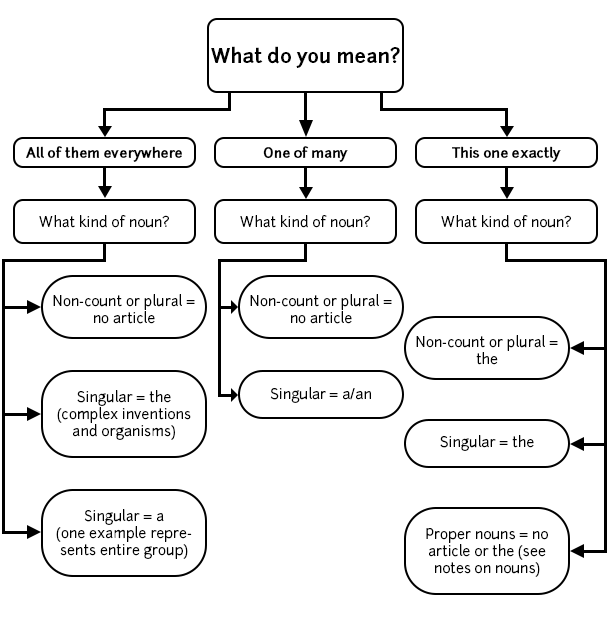
Use the Article-choice flowchart as a meaning check, not as a substitute for reading the sentence. First ask what the writer intends:
- Is this one unspecified item? Use a or an if the noun is singular and countable.
- Is this a particular item already identifiable? Use the.
- Is this a general class, plural noun, or noncount noun? Often use no article.
Compare:
-
A compiler translates source code into another representation.
This introduces one representative compiler. -
The compiler produced an error.
A particular compiler has already been identified. -
Compilers translate source code.
This makes a general statement about compilers as a class.
Tense also depends on context
Verb tense is not chosen by a single word such as yesterday or before. It represents the relationship between events.
Before the invigilator arrived, the candidates had taken their seats.
Both events are in the past, but taking seats occurred earlier. The past perfect form had taken makes that order explicit.
By contrast:
While the process was running, the system lost power.
The continuous form describes an action in progress; the simple past identifies the event that occurred during it. In a GATE error-detection problem, decide whether the actions are simultaneous, sequential, completed, habitual, or hypothetical before selecting a verb form.
A reliable GATE correction routine
When a question presents four underlined parts or several replacement options, use a fixed order. This reduces the temptation to choose an option merely because it sounds familiar.
-
Read for meaning first.
Identify the intended actor, action, time relationship, quantity, and reference. -
Locate the clause skeleton.
Find the main subject and its finite verb. Check that every clause is complete. -
Check agreement.
Ignore interrupting phrases. Match the main verb with its true subject and ensure pronouns have clear antecedents. -
Check connections and lists.
Look for fragments, run-ons, comma splices, mixed constructions, and nonparallel forms. -
Check modifiers.
Ask what each descriptive phrase modifies and whether that relationship is logical. -
Check context-sensitive words.
Inspect articles, prepositions, tense, word form, and commonly confused words. -
Read the corrected sentence once as a whole.
The selected option must preserve both grammar and meaning.
When you review verbal questions in your error log, preserve the distinction from the previous lesson:
- If you did not know that along with does not create a plural subject, record a conceptual grammar gap.
- If you knew the rule but missed the word not in “Which option is not grammatically correct?”, record an interpretation error.
- If you narrowed the answer to two options but selected the wrong one while rushing, record a time-management or execution issue.
- If an unfamiliar word caused the problem, record the word, its meaning, part of speech, and one correct sentence—not merely “revise vocabulary.”
Key takeaways
A GATE verbal question becomes manageable when you inspect structure before individual words.
- A complete sentence needs an independent clause; avoid fragments, run-ons, and comma splices.
- Match the verb with the main subject, not a nearby noun inside an added phrase.
- Keep pronoun reference clear and lists parallel.
- Place modifiers next to the words they logically describe; make sure introductory phrases have a real doer.
- Select words, articles, and verb forms according to the sentence’s intended meaning and grammatical role.
- Use a fixed checking routine so that grammar questions become structured reasoning tasks rather than guesses.
In the next lesson, you will shift from sentence-level accuracy to passage-level reasoning: identifying a passage’s main claim, assumptions, implications, and authorial intent.
Can't find a good explanation? Sign up and we'll make it for you
Sign up