
Hello, and welcome. This course is designed to make your speaking more reliable when the stakes feel high: interviews, meetings, presentations, and professional conversations. We will not treat nervousness as proof that you “cannot communicate.” Instead, we will build observable skills: recovering your thoughts, framing a clear answer, and delivering it with steadiness.
Today begins with a baseline. Before improving a skill, you need a fair picture of what happens now. You will record one short answer to a realistic interview prompt, then evaluate it for four areas: anxiety signals, clarity, structure, and delivery. The purpose is diagnosis, not self-criticism. A baseline recording gives us evidence to compare with your later practice.
A baseline is data, not a verdict
When pressure arrives, several things can happen at once: you rush, lose a word, soften your voice, repeat yourself, or try to plan the entire answer before saying the first sentence. These are patterns, not fixed traits.
Your first recording may feel uncomfortable. That is normal, especially because you will hear and see yourself more objectively than you do while speaking. Do not evaluate appearance, accent, or whether every grammar choice is perfect. In an interview, people need to understand your thinking, your experience, and your judgment. Those are the things we will assess.
The useful question is not:
“Did I sound impressive?”
It is:
“Could a busy interviewer understand my main point, follow my reasoning, and trust that I could communicate with a team?”
The short video below introduces a practical review method: record yourself, then watch once normally and once with the sound off. The second viewing separates body language from the words, which makes your observations more accurate.
How To Practice Public Speaking By Yourself | Public Speaking Tips | Public Speaking Techniques
Watch “How To Practice Public Speaking By Yourself” from JOYA DASS for a simple recording-and-review routine. Use it to approach your first recording as deliberate observation rather than as a performance to judge.
Watch the recording habit for the idea of a brief daily spoken reflection. Then watch the two reviews. Focus on the instruction to view the recording once with sound and once muted, and on noticing specific habits such as filler sounds, gaze, and physical tension.
A clear spoken answer has more than correct words. It has three connected delivery components:
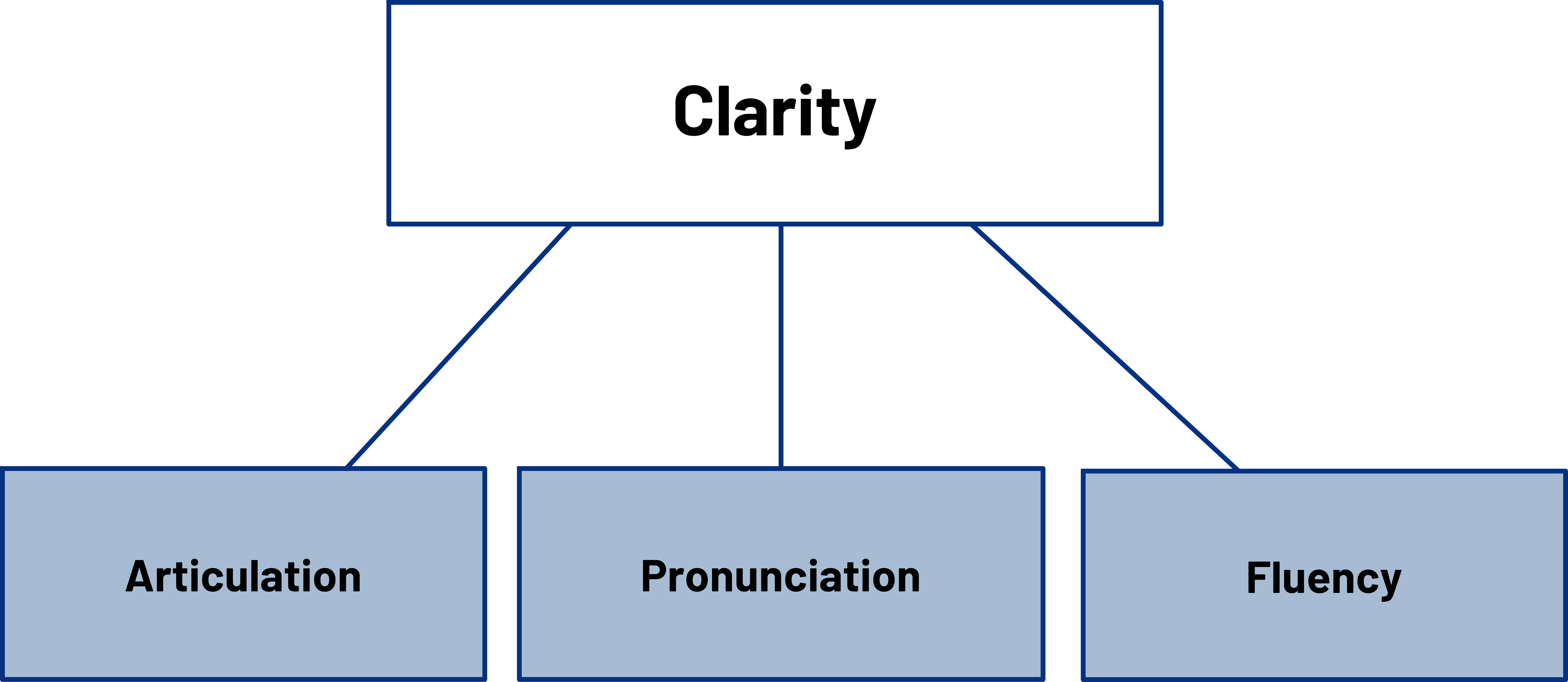
For this course, use these terms narrowly:
- Articulation: whether your words sound distinct rather than blurred together.
- Pronunciation: whether your chosen words are understandable. This is not about copying a British, American, or any other accent.
- Fluency: whether speech moves forward at a manageable pace, including useful pauses rather than repeated fillers or long stalls.
However, a listener can understand every word and still not understand the answer. That is why we also assess structure: whether the answer has a clear point and a logical order.
The four-part baseline rubric
A rubric prevents vague comments such as “I was bad” or “I need confidence.” Use a simple three-level score:
- 1 — Needs attention: the issue repeatedly makes the answer hard to follow.
- 2 — Inconsistent: the skill appears at times, but pressure disrupts it.
- 3 — Effective: the skill supports understanding for most of the response.
Do not add scores to create a label such as “good” or “bad speaker.” The purpose of the numbers is to help you identify one specific priority later.
| Area | Score 1 — Needs attention | Score 2 — Inconsistent | Score 3 — Effective |
|---|---|---|---|
| Anxiety signals | Tension, rushing, blanking, repeated apologies, or avoidance takes over the response. | Nervousness is visible or audible, but you continue and regain some control. | Some nerves may be present, but you stay engaged and continue speaking. |
| Clarity | Key words or sentences are difficult to understand; the listener must work hard to follow. | Most ideas are understandable, but rushed phrasing, vague language, fillers, or long sentences reduce clarity. | Speech is mostly easy to understand; key terms and sentences are distinct and direct. |
| Structure | No clear answer appears; ideas jump, repeat, or end without a conclusion. | A useful point or example appears, but the order is uneven or the main answer arrives late. | The answer has an identifiable main point, supporting details, and a clear finish. |
| Delivery | Pace, volume, posture, eye contact, or gestures repeatedly distract from the message. | Some delivery choices support the message, but there are noticeable distractions such as very fast pace, low volume, or looking away. | Pace and volume are generally steady; posture and gaze support the message rather than compete with it. |
Important distinction: anxiety is not the same as poor delivery. You may feel nervous and still give a clear answer. Likewise, someone may look relaxed but give an unstructured, unclear answer. Rate what can be observed in the recording.
For anxiety signals, look for evidence rather than guessing your internal state:
- audible breaths or a suddenly weak voice;
- speaking much faster after the question;
- fillers such as “um,” “actually,” or “basically” that interrupt ideas;
- a long freeze with no attempt to restart;
- apologizing for not knowing enough before attempting an answer;
- laughing, shrinking posture, looking down, or fidgeting when you reach an uncertain point.
A pause alone is not automatically a problem. A short pause can show that you are thinking. We will later turn pauses into a deliberate tool.
The resource below recommends recording first, taking a short break, and then using defined criteria instead of evaluating from memory. Its pitch-focused rubric uses categories such as storytelling, verbal communication, and non-verbal communication; our four categories adapt that idea for interview answers.
Read the “Pitch Evaluation Rubric” from the YLAI Network. It demonstrates a practical self-review process and shows how descriptive scoring criteria make feedback more useful.
On page 1, begin with the self-evaluation method. Note the recommendation to take a 15-minute break before reviewing. Then continue to the “How to use the rubric” instructions and read the rubric on page 2. Focus on how “Storytelling” evaluates organization, while “Verbal Communication” and “Non-Verbal Communication” evaluate delivery. Ignore “Presentation Design,” since you will not use slides for this baseline.
Your baseline recording: one realistic answer
Set aside about 10 minutes to record, then 10–12 minutes to review. Use your phone or laptop camera if possible; video lets you evaluate delivery as well as words.
The prompt
Record a 60–90 second answer to this interview question:
“Tell me about a time you identified an SEO or growth opportunity and what you did with it.”
This is a suitable baseline prompt because you already have relevant experience: opportunity analysis, keyword research, technical/on-page/off-page SEO, landing-page copy, and AEO/GEO work. The challenge is not researching a new topic. It is retrieving and communicating knowledge while a camera creates a little pressure.
Recording rules
- Stand or sit as you would in a real video interview.
- Read the prompt once.
- Begin recording within 10 seconds. Do not write a script or prepare full sentences.
- Speak for up to 90 seconds. If you lose your thought, stay in the recording. Do not restart.
- Stop when you naturally finish, even if the answer feels incomplete.
- Save the video with a neutral name such as Baseline 1.
The goal is to capture your current automatic response. Over-preparing would hide the exact pressure pattern we need to work on.
Review in three passes
Do not watch immediately. Take a 15-minute break—walk, drink water, or do another small task. This reduces the tendency to judge your answer based on what you intended to say rather than what a listener actually heard.
Then review it in three passes:
Pass 1: Listen for meaning
Watch with sound on, without pausing. Imagine you are the hiring manager.
Write only three notes:
- What was my main point?
- What evidence or example do I remember?
- At what moment did I become confused, less convinced, or less engaged?
If you cannot state your own main point in one sentence, that is a structure signal—not a reason to criticize yourself.
Pass 2: Score the four categories
Watch again with sound on. Pause only after the answer ends. Give each category a 1, 2, or 3, and add one evidence-based note.
Use this template in your notes app:
| Category | Score | Evidence from the recording |
|---|---|---|
| Anxiety signals | /3 | “I looked down and sped up after mentioning the result.” |
| Clarity | /3 | “The first 30 seconds were understandable, but two sentences became too long.” |
| Structure | /3 | “I described actions before explaining the opportunity or outcome.” |
| Delivery | /3 | “My volume was clear, but I used ‘um’ repeatedly while choosing metrics.” |
Be specific. “I am not confident” is not a useful observation. “My voice dropped at the end of three sentences” is useful because it can be practiced.
Pass 3: Watch silently
Now mute the recording. Observe only what a listener sees:
- Do you look toward the camera at least occasionally, or only at yourself/on-screen notes?
- Does your posture become smaller at difficult moments?
- Are hand movements helping an idea or repeating without purpose?
- Can you see the moment you lose your thought before you hear it?
This is not about appearing polished. It is about discovering whether your body gives a message that conflicts with your words.
The Toastmasters evaluation form is useful as a reference for this distinction: it separates clarity and vocal variety from eye contact, gestures, and comfort level. You do not need to score every category today; our four-part rubric keeps the first assessment manageable.
How to interpret what you find
Most first recordings reveal a mix of strengths and problems. Do not try to correct everything at once.
For example, imagine this result:
| Area | Score | Observation |
|---|---|---|
| Anxiety signals | 2 | The speaker begins steadily but speeds up when describing a challenge. |
| Clarity | 2 | The individual words are understandable, but several sentences contain too many ideas. |
| Structure | 1 | The listener hears tasks and tools but never gets a clear business outcome. |
| Delivery | 2 | Volume is adequate, but gaze drops to notes and fillers increase. |
The conclusion is not “I need more confidence.” It is:
“My first priority is to make the answer easier to follow by stating the main point and outcome earlier.”
That priority would improve structure, clarity, and likely anxiety as well. When speakers know where their answer is going, they often feel less pressure to search for the perfect next sentence.
Another common pattern is this:
- Your structure may be good because you know the work well.
- But anxiety may cause rushed speech and low volume.
- In that case, the first priority is delivery control, not creating a more complicated answer framework.
A third pattern is that your recording may sound clearer than it felt. This matters. Internal panic can make an answer feel like failure even when the listener can follow it. The recording gives you a more trustworthy external view.
For now, choose only one high-impact observation in this format:
“When I am under pressure, I tend to ___, which makes it harder for the listener to ___.”
Examples:
- “When I am under pressure, I begin explaining too many details, which makes it harder for the listener to identify the result.”
- “When I am under pressure, I speak quietly at the end of sentences, which makes it harder for the listener to hear my key point.”
- “When I am under pressure, I freeze after forgetting one word, which makes it harder for the listener to see that I still know the subject.”
This sentence becomes your starting point for the next lessons.
A short professional standard for clarity
In interviews, clarity is usually more persuasive than sophisticated vocabulary. A hiring manager does not need a long list of SEO terms; they need to understand what you noticed, what you decided, and what changed.
The following short segment from Structure and Clarity in Your Speech explains why speakers lose clarity: too much content, repetition, weak prioritization, and wandering away from the main point. It also makes an important point for future practice: direct, short phrasing is often clearer than trying to sound advanced.
Structure and Clarity in your speech
Watch selected moments from Rumen Debate Prep’s “Structure and Clarity in your speech.” Although the examples come from debating, the diagnosis of rambling, information overload, and unclear prioritization applies directly to interview answers.
First watch common clarity problems to identify patterns such as repetition, excessive content, and drifting off-topic. Then watch direct phrasing for the case for simple sentences and separated ideas. Finally, watch the shortening drill as a preview of a later practice method: saying the same idea in progressively less time.
For this week, keep your baseline recording. Do not delete it, rerecord it repeatedly, or edit it. It is the “before” sample against which later improvement will be visible.
Key takeaways
A reliable baseline evaluation has four features:
- You record an unscripted answer that is relevant to your real professional goal.
- You wait briefly before reviewing so you assess what the listener received, not only what you meant to say.
- You score anxiety signals, clarity, structure, and delivery separately.
- You use concrete evidence and select one priority, rather than trying to fix everything.
Your current communication ability is not defined by one recording. But the recording can reveal the specific speaking-pressure cycle that interrupts your ability to show what you know.
Next, you will identify your personal triggers and early warning signs using a real recent situation. That will help you notice pressure earlier—before it turns into blanking, rushing, or losing your structure.
Can't find a good explanation? Sign up and we'll make it for you
Sign up