
Welcome back. In the previous lesson, you practised reducing a question to three keyword prompts before you answer. That method helps you start with a route in mind. But even with a good start, pressure can make you lose the next point halfway through an answer.
Today’s skill is your safety net: recovering smoothly with one concise phrase, then returning to your message. The goal is not to ensure that you never blank out. It is to make a brief blank look—and feel—manageable rather than turning it into panic, fillers, or a complete restart.
By the end of this lesson, you will have a small set of professional recovery phrases and a personal default phrase you can use in interviews, meetings, and presentations.
A blank moment is not the problem; the spiral is
Suppose an interviewer asks, “How would you prioritise SEO growth opportunities?” You begin well:
“I would start with search demand and business relevance. Then I would identify gaps in our current visibility…”
Then your mind suddenly stops.
At that moment, the first internal thought is often:
“I forgot. They will think I do not know this. I need to say something quickly.”
That reaction creates the real difficulty. You may fill the silence with “umm,” repeat yourself without direction, apologise repeatedly, or begin a completely different answer. The listener then has to work harder to follow you.
A better interpretation is simpler:
“I have temporarily lost the next point. I can pause, reconnect, and continue.”
A short pause may feel very long internally, but it is usually only two or three seconds for the listener. The recovery phrase gives that pause a clear purpose: it signals that you are organising the answer, not collapsing.
Why Your Mind Goes Blank When Public Speaking (And How to Fix It Fast)
Watch “Why Your Mind Goes Blank When Public Speaking (And How to Fix It Fast)” from BostonSpeaks. It normalises the stress response and demonstrates why a prepared fallback phrase is more useful than trying to force thoughts to return.
Watch pause and breathe for the role of a deliberate breath during a blank moment. Then watch the backup plan, focusing on the idea of a personal, ready-to-use recovery phrase. Do not try to memorise the presenter’s exact wording; notice the sequence of pausing, using one line, and returning to a point.
The important change is this: you do not need to hide every moment of thinking. You need to handle it briefly and move on.
The recovery sequence: pause, phrase, point
When you lose your train of thought during an answer, use this three-part routine:
- Pause and breathe once. Keep your face neutral, lower your shoulders, and take one quiet breath. Do not apologise while you are still searching.
- Say one recovery phrase. The phrase creates a bridge while you regain the route of your answer.
- Return to one clear point. Recap what you just said, move to your next keyword prompt, or state the main conclusion.
The phrase alone is not the recovery. It only buys a few calm seconds. The real recovery is the point that follows it.
For example:
“I would start by reviewing demand and current performance. Then I would look for competitor gaps…
Let me put that more simply: I would prioritise opportunities by business impact, not traffic potential alone.”
The speaker did not find the exact next sentence they planned. That does not matter. They returned to a clear and relevant idea.
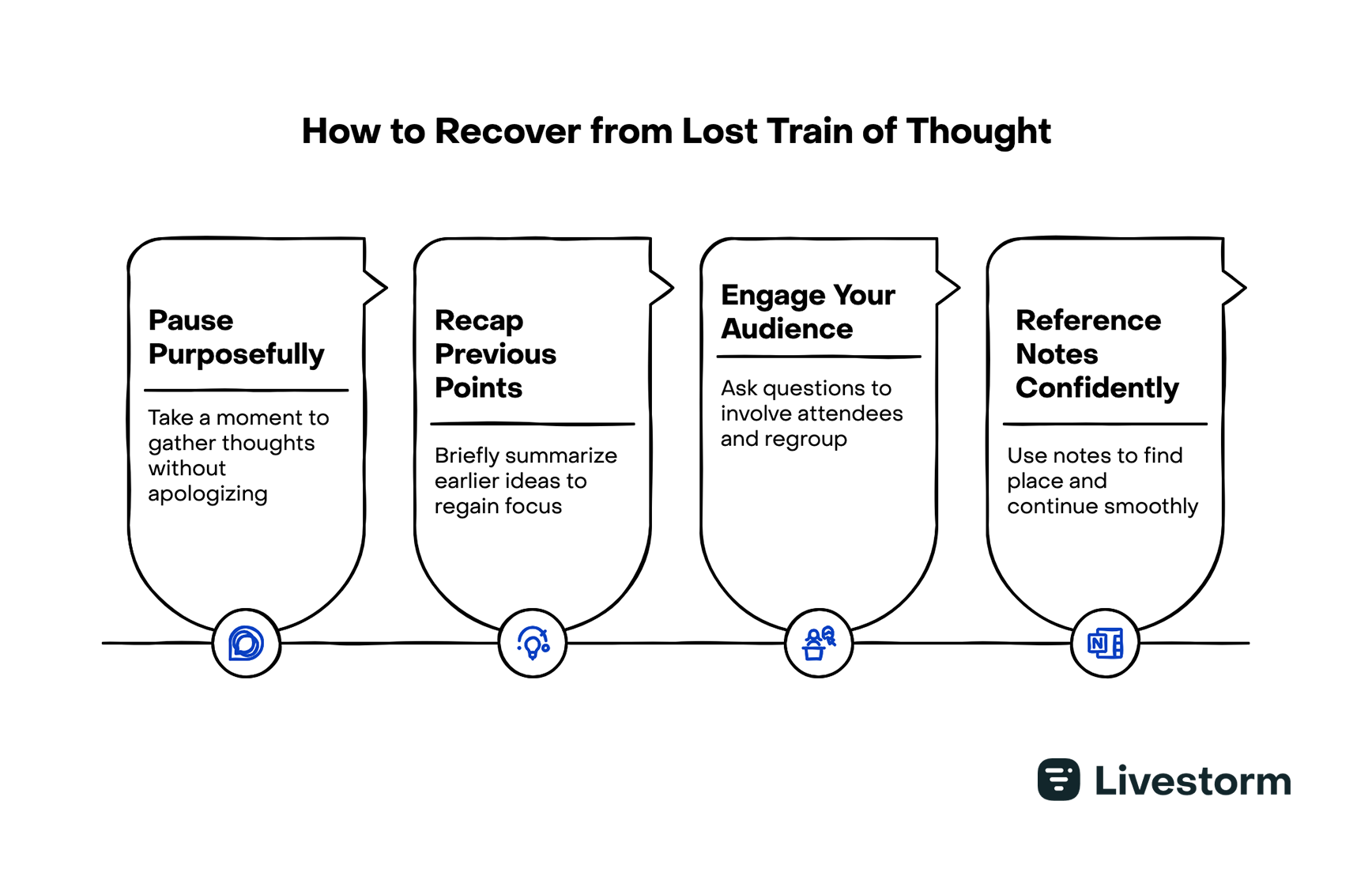
In a presentation, you may have slides, notes, or an audience question available. In an interview, your cleanest option is usually to recap and redirect. You want the interviewer to see calm judgment, not a struggle to retrieve a perfect sentence.
Read the “What To Do If You’re Nervous While Speaking” section from Toastmasters International. It gives a practical, realistic response to losing your place: pause, use a recovery line, and briefly repeat the last thought.
In the section “What To Do If You’re Nervous While Speaking,” begin with the pause guidance. Then read the recovery-line guidance and the summary bullets immediately below it. Focus on the principle of repeating the previous idea rather than reproducing your exact previous sentence.
Choose a phrase that fits the situation
A recovery phrase should be short, natural, and connected to your answer. It should not sound like a long apology or a dramatic announcement.
Use one of these four types.
| Recovery type | Useful phrase | What to say next |
|---|---|---|
| Recap | “So, the key point is…” | Repeat the main idea you just made. |
| Simplify | “Let me put that more simply…” | State the answer in clearer, shorter language. |
| Redirect | “What matters most here is…” | Return to the central decision, result, or recommendation. |
| Open reset | “I lost my thread for a moment. Let me come back to the main point.” | Restate the main point, then continue. |
For professional settings, start with the first three. They keep attention on the business topic rather than on your momentary lapse.
1. Recap phrases
Use a recap phrase when you remember what you just said but cannot retrieve what was supposed to come next.
“So, the key point is that I would not prioritise pages only by search volume.”
“Coming back to the diagnosis, the traffic decline needs to be segmented before we decide on an action.”
“To summarise that part, the objective was to find the highest-impact opportunity first.”
Recapping helps you in two ways: it reminds your own mind where you were, and it helps the listener retain your earlier point.
2. Simplify phrases
Use a simplify phrase when your answer has become too detailed, tangled, or overly technical.
“Let me put that more simply: I would first understand the user need, then test whether we can meet it profitably.”
“The short version is: we found a content gap, validated the opportunity, and prioritised the pages most likely to drive conversions.”
This is especially useful when explaining SEO, AEO, or analytics to a non-specialist interviewer. You do not have to retrieve every detail. Return to the business logic.
3. Redirect phrases
Use a redirect phrase when you remember the answer’s conclusion but have lost a middle detail.
“What matters most here is the prioritisation principle: expected business value relative to effort.”
“The important result was that the team had a shared decision framework rather than competing assumptions.”
“The practical recommendation would be to begin with a small, measurable test.”
This is a strong tactic in manager-level interviews. A precise metric, date, or tool can be useful, but it is usually less important than the decision, reasoning, and result.
4. Honest reset phrases
Sometimes the blank is real: you have lost both your last point and your next one. In that case, an honest, brief reset is better than continuing with fillers.
“I lost my thread for a moment. Let me come back to the main point.”
“Let me restart that answer more clearly.”
“I got slightly sidetracked. The main point is…”
Say it once, calmly. Then continue. Do not add repeated apologies such as “Sorry, sorry, I am very nervous” or explain why you blanked.
Honesty works when it is brief and followed by content. It becomes distracting only when it takes over the answer.
Connect recovery phrases to your three-keyword map
Your previous lesson gave you a simple route: three prompts, not a memorised script. That route is also your recovery system.
Imagine this interview question:
“How would you create a 90-day SEO growth plan for a new website?”
Your mental map is:
baseline — opportunities — roadmap
You begin:
“First, I would establish a baseline using technical health, current visibility, and conversion data…”
Then you lose the thought. Do not search for the perfect next sentence. Return to the map:
“So, the key point is to establish a reliable baseline before making recommendations. Next, I would identify and prioritise the highest-value opportunities.”
You have recovered by using the first prompt, then moving to the next prompt.
Here is another example:
Question: “Tell me about a time you influenced a stakeholder.”
Your map:
disagreement — evidence — alignment
You start explaining the disagreement, become stuck in the details, and lose your thread.
A useful recovery could be:
“Let me put that more simply: we had different views on the content priority, so I brought the discussion back to evidence and expected business impact.”
That sentence reconnects the answer to both the second and third prompts: evidence and alignment.
The rule: recover the route, not the exact sentence
Under pressure, do not attempt to remember the exact words you intended to say. That is often what keeps you stuck.
Instead, ask yourself silently:
- What was my last keyword?
- What is my next keyword?
- What is the main point of this answer?
Then use one phrase and say the first clear sentence that comes.
Your grammar does not need to be perfect. A short, direct sentence is more convincing than a long, grammatically ambitious sentence that never arrives.
Phrases to avoid
Some phrases create time but reduce clarity or confidence because they do not tell the listener where you are going.
Try to reduce these habits:
- “Umm… actually… so…”
- “Sorry, I am not good at explaining.”
- “I forgot everything.”
- “What was I saying?”
- “This is a difficult question,” followed by a long silence.
- Restarting the entire answer from the beginning.
You can replace them with a purposeful alternative:
| Instead of… | Use… |
|---|---|
| “Umm…” | A silent breath, then “The key point is…” |
| “Sorry, I forgot.” | “Let me come back to the main point.” |
| Restarting from the beginning | “To summarise that part…” |
| Explaining every detail | “The short version is…” |
| Speaking faster to escape the silence | “What matters most here is…” |
A recovery phrase is not a magic sentence. It works because it prevents the panic response from controlling the next ten seconds.
Speaking lab: build your personal fallback phrase
Spend about 20 minutes on this practice. Record the final round. Your target is not fluent perfection; it is recovering within a few seconds without abandoning the answer.
Round 1: Say the phrase naturally — 5 minutes
Stand or sit as you would in an interview. Say each phrase aloud three times, slowly and with a calm tone:
- “So, the key point is…”
- “Let me put that more simply…”
- “What matters most here is…”
- “Let me come back to the main point.”
Notice which one sounds most like you. Choose one primary phrase and one backup phrase.
For many interview answers, a strong default pair is:
Primary: “The key point is…”
Backup: “Let me put that more simply…”
Keep your primary phrase exactly the same for several days. Familiarity matters more than variety.
Round 2: Planned blank drill — 7 minutes
Choose one question at a time and answer for about 30 seconds. Deliberately stop after your first point, stay silent for two seconds, use your chosen recovery phrase, then continue.
Use these prompts:
- “How do you identify SEO growth opportunities?”
- “Tell me about a time you used data to influence a decision.”
- “How would you explain the value of AEO to a business stakeholder?”
- “How would you respond to an unexpected drop in organic traffic?”
A possible response to Prompt 1 might sound like this:
“I begin with meaningful search demand and business relevance.
Pause.
The key point is that opportunity needs to be connected to value, not just traffic. Then I look for competitor and content gaps before prioritising work by impact, effort, and measurability.”
The deliberate stop trains your brain to experience a pause as controllable rather than dangerous.
Round 3: Recover from a real interruption — 8 minutes
Record yourself answering this question for 60 seconds:
“How would you prioritise SEO, AEO, and content initiatives when resources are limited?”
Use a three-keyword map before you begin. For example, you might choose:
objective — evidence — impact
At roughly 20 seconds, interrupt yourself on purpose. Look away briefly or tap the table. Then recover with your default phrase and continue.
After watching the recording, check only these four points:
| Review point | What “good enough” looks like |
|---|---|
| Pause | You stopped for one or two breaths rather than filling silence. |
| Phrase | You used one concise phrase, not several apologies. |
| Return | Your next sentence made a relevant point. |
| Delivery | Your pace became steadier after the recovery, rather than faster. |
If you used the phrase but still felt blank, make the next step easier. Say a broad headline first:
“The key point is that I would start with business priorities.”
That headline can give your memory time to retrieve a supporting example or detail.
Use it in real conversations this week
For the next three weekdays, practise one low-pressure recovery each day. You can use it during a work call, a casual conversation, or a solo recording.
Do this deliberately:
- Speak for 20 to 30 seconds about your day, a work task, or a marketing topic.
- Stop in the middle.
- Pause for two seconds.
- Use your primary recovery phrase.
- Continue with one simple point.
The purpose is to teach your body that silence does not equal failure. It is simply part of organised speech.
Key takeaways
Losing a thought is normal, particularly when the stakes feel high. The practical skill is not avoiding every blank; it is returning to your message without panic.
- Pause and take one breath.
- Use one concise recovery phrase.
- Return to your last point, your next keyword prompt, or the main conclusion.
- Prefer professional phrases such as “The key point is…” and “Let me put that more simply…”
- Use an honest reset only when you genuinely need it, then move directly back to content.
- Recover the idea, not the exact sentence you planned to say.
You now have a complete basic toolkit for the moment pressure begins: reset your body, pause before answering, create three keyword prompts, and recover if your mind goes blank. The next module focuses on turning those ideas into concise, clear spoken sentences in real time.
Can't find a good explanation? Sign up and we'll make it for you
Sign up