
Welcome back! In our first lesson, we established a foundational concept: your son's brain is not a miniature adult brain, but a dynamic construction site. We saw that it grows not by adding neurons, but by creating a super-abundance of connections (synapses), making a toddler's brain far more densely wired than an adult's. We also touched on the immense energy cost of this process.
This lesson dives into the core mechanism driving this incredible transformation. We will explore the two-act play of brain wiring: synaptogenesis, the explosive creation of synapses, and synaptic pruning, the selective elimination of them. Most importantly, we'll uncover the elegant principle that guides this process: "use it or lose it." Understanding this is key to appreciating how your daily interactions with your 8-month-old are literally sculpting the person he will become.
Visualizing the Process: Building and Sculpting
Before we examine the mechanisms, let's visualize the two key phases of this process. In the previous lesson, we saw a simplified diagram. The following images provide a more detailed look at the structural changes at both the network and individual neuron level.

This image clearly shows the synaptogenesis phase—an explosive blooming of connections. But as we learned, this is only the first part of the story. The brain then refines this dense network.
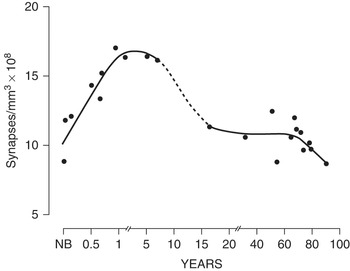
This graph perfectly illustrates the rise and fall: synaptogenesis followed by synaptic pruning. The brain doesn't just build; it builds and then sculpts.
Synaptogenesis: The Explosive Growth of Connections
The process of forming new synapses, or synaptogenesis, begins before birth but goes into overdrive during the first two years of your son's life. During this period, it's estimated that up to two million new synapses are formed every second. This frantic pace of connection-building is what creates the "over-wired" brain we see in the graph above.
Crucially, this process does not happen uniformly across the entire brain at the same time. Different circuits are built on different schedules, generally following the sequence in which an infant needs them. The following reading from the U.S. National Research Council's book, From Neurons to Neighborhoods, explains this timeline.
The Developing Brain - From Neurons to Neighborhoods - NCBI - NIH
This chapter provides an excellent, detailed overview of the developmental sequence of synaptogenesis and pruning.
Please read the section titled Synaptic Overproduction and Loss. As you read, pay close attention to the different timelines for three key brain regions: the visual cortex, areas for audition and language, and the prefrontal cortex. This will give you a clear picture of what's happening in your son's brain right now versus what will happen later.
As you've just read, at 8 months old, your son is right at the peak of synaptic overproduction in his visual cortex. His auditory and language circuits are also in a highly active phase. This is why rich sensory experiences—seeing your face, hearing your voice, exploring objects of different shapes and textures—are so critical at this age. His brain is building the fundamental circuits for perceiving the world based on these very inputs. In contrast, the prefrontal cortex, responsible for planning and decision-making, will not be fully mature until adolescence.
Synaptic Pruning: The "Use It or Lose It" Principle
So, why does the brain go through the seemingly inefficient process of creating trillions more connections than it needs, only to destroy them? The answer lies in adaptation. This overproduction provides a massive, diverse set of potential neural pathways. Experience then determines which pathways are useful and which are redundant.
This refinement process is called synaptic pruning, and it operates on a simple but powerful rule: "use it or lose it."
Connections that are frequently activated by experiences are strengthened and preserved. Connections that are rarely used are weakened and eventually eliminated. This sculpts the brain's raw potential into a lean, fast, and efficient network that is precisely tailored to the environment in which the child is growing up.
The following short animation provides a superb visual explanation of this principle in action.
This animation from Alila Medical Media clearly illustrates how synaptic pruning works.
Watch the entire video from start to finish. It effectively demonstrates how activity—the "use it" part of the rule—protects certain synapses from elimination, resulting in a more refined circuit.
The "use it or lose it" principle isn't just a convenient metaphor; it's a biologically demonstrated fact. The next reading explores the scientific evidence behind this concept, including a classic experiment that proved neural activity is the deciding factor.
Core Concept: How synaptic pruning shapes neural wiring during ...
This article from the Proceedings of the National Academy of Sciences (PNAS) details the science behind activity-dependent pruning.
First, read the two paragraphs under the heading Selective Sculpting. The rosebush analogy from neurobiologist Carla Shatz is a perfect way to think about this process. The discussion of computational biology also provides a rationale for why this method creates more robust and efficient networks, something that might resonate with your engineering background. Then, continue reading the two paragraphs that describe Shatz's seminal experiments in the cat visual system. This is a prime example of the kind of foundational research that confirmed the "use it or lose it" principle. Notice how blocking neural activity prevented the normal pruning process, leaving the visual map jumbled.
Shatz's experiments were a landmark. They provided concrete proof that the brain isn't just passively following a genetic blueprint. Instead, it actively wires itself based on the electrical signals flowing through its circuits—signals generated by experience. Every time your son's eyes track a moving toy, every time he hears you speak, and every time he reaches for an object, the corresponding neural circuits are firing. This firing is the "use" that tells the brain: "This connection is important. Keep it. Strengthen it."
Meanwhile, the connections that are not being activated lie dormant. They receive no such confirmation signal and are eventually marked for removal, freeing up metabolic resources for the connections that matter. From a systems engineering perspective, this is an elegant optimization algorithm for building a complex, adaptive network. It ensures that the final "circuit board" of the brain is not cluttered with unused traces but is instead perfectly configured for its specific operational demands.
Conclusion: Sculpting Your Son's Brain
Today, we've moved from the "what" to the "how" of early brain development. Let's recap the essential points:
- Synaptogenesis and Pruning: Brain development is a two-step dance of massive overproduction of synapses (synaptogenesis) followed by selective refinement (pruning).
- "Use It or Lose It": Pruning is not random. It is guided by experience. Neural pathways that are activated by sensory input and motor activity are strengthened, while unused pathways are eliminated.
- Adaptation and Efficiency: This process creates a brain that is both incredibly efficient and exquisitely adapted to the specific environment it finds itself in. The experiences of childhood literally build the brain.
For your 8-month-old, this is happening right now. His brain is at a peak of synaptic potential, and his daily experiences are the sculptor's chisel, carving out the foundational circuits for vision, hearing, language, and movement. Your interactions are not just nurturing activities; they are critical data points for this biological process.
In our next lesson, we will explore the third major process of brain wiring: myelination. Once the key connections have been selected through pruning, the brain begins to insulate them to make them faster and more efficient. This is the final step in turning the brain's basic blueprint into a high-speed information processing network.
Can't find a good explanation? Sign up and we'll make it for you
Sign up