
Welcome to your first lesson. I'm delighted to begin this journey with you into the fascinating science of your baby's developing brain. Your goal is to understand the neuroscientific principles behind your son's growth so you can be a more informed and supportive father. This course is designed to provide exactly that—a science-backed look at how the infant brain is built, how it learns, and how early experiences shape its lifelong architecture.
In this introductory lesson, we will address the fundamental question: How is an infant's brain different from an adult's? We'll move beyond the obvious answer of "it's smaller" to explore three critical, and perhaps surprising, distinctions in its structure and function: synaptic density, connectivity, and energy consumption. Understanding this initial blueprint is the essential first step before we can explore how experiences, like the ones you provide for your son, begin to shape it.
The Brain's Raw Materials
An adult brain weighs about 1.4 kg and contains roughly 86 billion neurons. These neurons are the core processing units, communicating with each other across specialized junctions called synapses. It’s the intricate network of these connections that underlies all thought, feeling, and action.
At birth, your son’s brain was about 25% of its adult size, and it already contained most of the neurons it will ever have. The dramatic growth that occurs in the first few years is not primarily about adding more neurons, but about connecting them. The infant brain is not a miniature, static version of an adult brain; it is a dynamic, bustling construction site.
Let's look at the basic building block, the neuron, and how it matures.
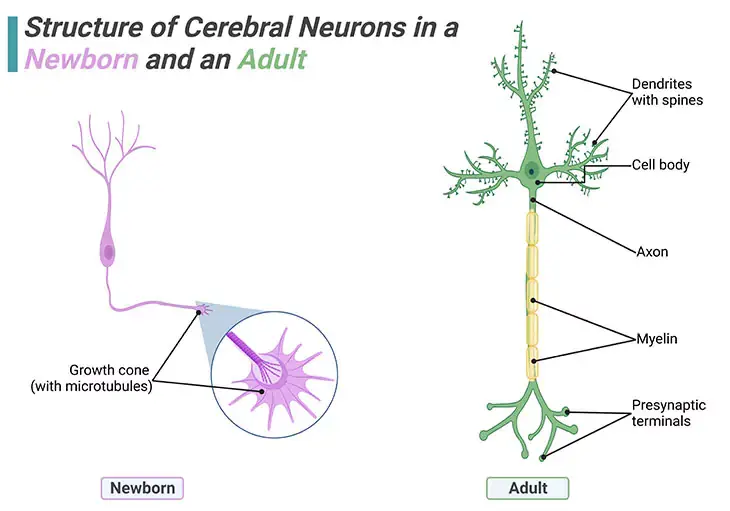
As you can see, the adult neuron has a much more elaborate structure. The two key developments are:
- Dendritic Arborization: The "branches" of the neuron (dendrites) grow and branch out extensively, allowing them to form connections with many more neighboring neurons.
- Myelination: The long transmitting fiber (axon) gets wrapped in a fatty sheath called myelin. Given your background in electronics, you can think of this as being perfectly analogous to the insulation on an electrical wire. It prevents signal leakage and dramatically speeds up the transmission of the electrical impulses that carry information through the brain.
This structural maturation enables a massive increase in the number and efficiency of connections, or synapses.
From Over-Connected to Super-Efficient
One of the most profound discoveries in modern neuroscience was the realization that brain development involves not just growth, but also a period of radical downsizing. A toddler's brain is, in one key respect, far more densely connected than a college student's.
This discovery was pioneered by pediatric neurologist Peter Huttenlocher. His meticulous work, counting synapses in brain tissue samples, revealed a surprising developmental trajectory. To appreciate the science-backed nature of this finding, it's worth reading about his work.
Peter Huttenlocher, pediatric neurologist, 1931-2013
This article from the University of Chicago provides an excellent summary of Huttenlocher's groundbreaking research. It's a great example of the foundational science that underpins our modern understanding of child development.
Please read the first three paragraphs, describing his key discoveries. Then, find the section that begins "Over the next 20 years" and read the two paragraphs that detail his methodology and findings on synaptic density in different brain regions. Pay close attention to the numbers—the initial density, the peak, and the final adult level.
Huttenlocher's work showed that the brain doesn't just add connections. Instead, it follows a two-stage process: a phase of rapid overproduction of synapses, called synaptogenesis, followed by a period of selective elimination, known as synaptic pruning.

This process leads to a fascinating paradox: a two-year-old's brain has trillions more synapses than an adult's. The following video provides a clear, concise explanation of this.
Synaptic Pruning - Early Brain Development | Neuroscience 101
This video from the "Psyched!" channel explains the concept of synaptic pruning.
Watch from the beginning until the explanation of synaptogenesis and pruning. The narrator clearly states the surprising fact that a two-year-old's brain has far more connections than an adult's and explains that pruning varies by brain region.
So, why does the brain create so many connections only to destroy a large portion of them? This process of overproduction and pruning makes the brain incredibly adaptable. The initial explosion of synapses provides a vast landscape of potential pathways. Experience then determines which of these connections are useful. The ones that are activated frequently are strengthened, while those that are neglected are pruned away. We will explore this "use it or lose it" principle in detail in the next lesson.
From an engineering perspective, this is like building a prototype on a breadboard with every possible connection available. Then, based on testing and performance requirements, you design a final, efficient printed circuit board (PCB) that contains only the necessary, optimized traces. The brain prunes its "circuits" for speed and efficiency.
The following video from UCLA Health gives a fantastic visual overview of these developmental processes, including synaptogenesis, pruning, and myelination.
How Does a Child's Brain Develop? | Susan Y. Bookheimer PhD | UCLAMDChat
In this video, Dr. Susan Bookheimer explains the key changes that happen during brain development. Her visual examples are particularly helpful.
First, watch the segment from three major changes. This section visually contrasts the newborn brain with the 2-year-old and adult brains, reinforcing the concept of connection density peaking and then pruning. Next, watch the segment on myelination, from myelination. The analogy to electrical wire insulation here is perfect for explaining how this process speeds up communication between brain regions. Notice the mention that at birth, only the visual and oral-motor pathways are significantly myelinated—essential for finding food and eating!
At 8 months old, your son is right in the middle of this explosive synaptogenesis. Huttenlocher's research noted that the visual cortex, for example, reaches its peak synaptic density between 8 and 12 months. Everything he sees is literally helping to wire his brain for vision.
The High Energy Cost of Building a Brain
As you might imagine, this process of growing dendrites, forming trillions of connections, and myelinating axons is incredibly energy-intensive. This brings us to the final key difference: the infant brain's staggering energy consumption.
A recent study used modern imaging techniques (PET and MRI scans) to calculate the brain's glucose usage from birth to adulthood. The findings were remarkable and provide a powerful explanation for some unique aspects of human childhood.
Metabolic costs and evolutionary implications of human brain ... - PMC
This research paper published in PNAS is a great example of the primary scientific literature that answers our questions. It can be dense, but the key findings are clear and powerful.
First, read the Significance and Abstract sections to get a high-level overview of the study's purpose and main conclusions. Next, navigate to the Results section. Read the first two paragraphs that summarize the core findings. Focus on the peak percentages of energy use. You can also look at "Fig. 1" to see this visually. Finally, read the first paragraph of the Discussion section, which puts these findings into context and highlights the inverse relationship between brain metabolism and body growth.
The study reveals two critical points:
-
Peak energy demand occurs in childhood, not infancy. The brain's demand for glucose, its primary fuel, doesn't peak at birth when the brain-to-body size ratio is largest. Instead, it peaks around age 4-5, when a child's brain can use up to 66% of the body's entire resting metabolic budget and over 40% of its total daily energy expenditure. For comparison, the adult brain uses about 20% of the body's resting metabolism. This peak corresponds precisely with the period of maximum synaptic density.
-
There is a trade-off between brain growth and body growth. The researchers found a strong inverse correlation: during periods when the brain's energy demands are highest, the rate of body growth is at its lowest. The body literally slows its physical growth to allocate the necessary resources to the monumental task of wiring the brain. This is why human children grow so slowly compared to other mammals.
Think of it as an energy budget for the complex system that is the human body. Much like you had to manage power distribution in your obstacle-avoiding robot project, the body must allocate its metabolic resources. In early childhood, building the brain's "central processor" is the absolute top priority.
Conclusion
In this lesson, we have established the foundational differences between the infant and adult brain. Let's summarize the key takeaways:
- It's about connections, not just size. The infant brain grows by forming an incredibly dense network of connections (synapses) between its neurons.
- More is not better. The brain of a two-year-old is much more densely connected than an adult's. This over-abundance is temporary. Through a process called synaptic pruning, unused or inefficient connections are eliminated, resulting in a faster, more specialized adult brain.
- Connectivity is optimized. The process of myelination insulates neuronal axons, acting like shielding on a cable to dramatically speed up signal transmission between different brain areas.
- Brain-building is costly. The processes of synaptogenesis and myelination are extremely energy-intensive. During peak development in early childhood, the brain consumes a massive share of the body's total energy budget, a cost that is paid for by a slower rate of physical growth.
You now have a picture of the infant brain as a dynamic, energy-hungry construction site, rapidly building and then refining a network of unparalleled complexity.
In our next lesson, we will delve deeper into the mechanisms that drive this process. We will explore the "use it or lose it" principle in more detail, examining how an infant's daily experiences—what they see, hear, and feel—actively guide the pruning process and sculpt the brain's final architecture.
Can't find a good explanation? Sign up and we'll make it for you
Sign up