
Welcome to your fast geography test-prep course. You will work through the 50 questions from your study guide in short, Blooket-style rounds: four choices, then the correct answer immediately revealed. This first round covers the meaning of geography, relative location, and the five themes of geography.
The key is to connect each test prompt to one “signal question.” For example, Where is it? signals location, while What is it like? signals place.
The five themes: your quick sorting system
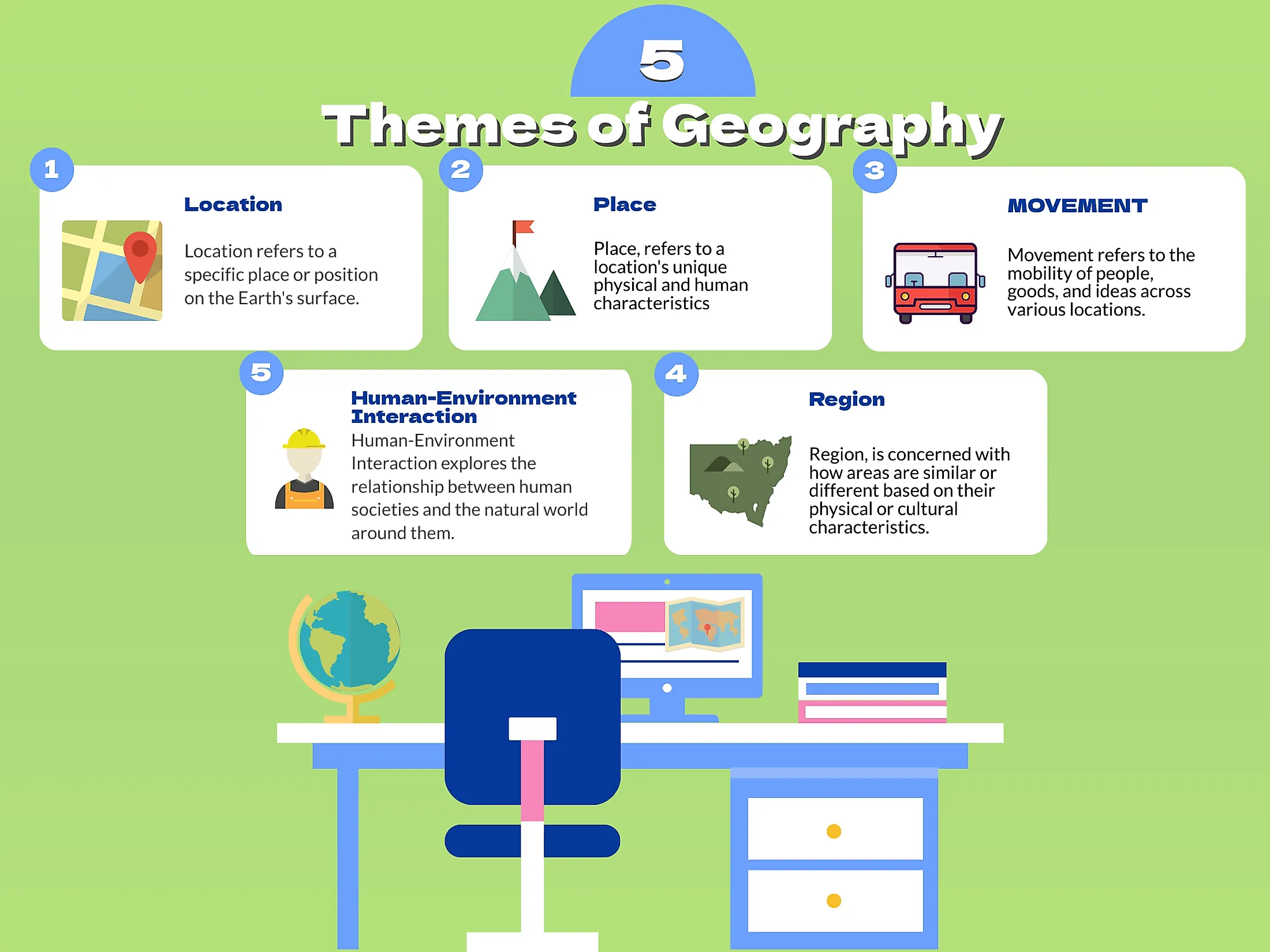
Geography is more than memorizing maps. It studies the distribution of physical features, such as mountains and climate, and human features, such as cities, languages, and trade. It also studies how these features connect and affect one another.
Use this sorting guide:
| Theme | Test-question clue | Meaning |
|---|---|---|
| Location | “Where is it?” | A place’s position on Earth |
| Place | “What is it like?” | Physical and human characteristics |
| Human-Environment Interaction | “How do people relate to the physical world?” | People depend on, adapt to, and change the environment |
| Movement | “How do people, goods, and ideas travel?” | Things moving between places |
| Region | “How are places alike or different?” | Areas grouped by shared traits |
A useful memory phrase is MR. HELP:
- Movement
- Region
- Human-Environment Interaction
- Location
- Place
For the test, do not worry about saying the themes in this order. Focus on matching the clue words in the question to the correct theme.
Location: absolute versus relative
Location means where something is. It can be described in two ways:
- Absolute location is an exact position, often given with latitude and longitude coordinates or a street address.
- Relative location describes where something is compared with another place or landmark. For example, “the school is north of the library” is a relative location.
Relative locations can change because the reference point can change. A restaurant might be “across from the old movie theater,” but if the theater closes and is replaced by apartments, people may describe the restaurant relative to the new landmark instead. The restaurant did not move; the useful description did.
For a quick explanation of absolute and relative location plus the five themes, watch this targeted segment:
Introduction to Geography and the Five Themes
“Introduction to Geography and the Five Themes” from Rueschhoff Teaches directly matches this round’s vocabulary. Watch it as a fast explanation before or after answering the questions.
Watch location for absolute versus relative location, especially the example of describing places with directions. Then watch the themes for Place, Region, Movement, and Human-Environment Interaction. Focus on the question each theme answers rather than the extra examples.
Blooket-style review: Questions 2, 6, and 23–27
Answer each one in your head first, then check the capital-letter reveal immediately below it.
2. What studies Earth’s physical and human features and their interactions?
A. Geology
B. Geography
C. Astronomy
D. Economics
ANSWER: GEOGRAPHY
Geography examines where things are, what places are like, and the relationships among people, places, and environments.
6. Relative locations can change.
A. True
B. False
C. Only on globes
D. Only in cities
ANSWER: TRUE
Relative location depends on a comparison point, landmark, route, or nearby place. Those comparisons can change over time.
23. Which theme asks how people relate to the physical world?
A. Movement
B. Place
C. Human-Environment Interaction
D. Region
ANSWER: HUMAN-ENVIRONMENT INTERACTION
This theme includes how people depend on nature, adapt to conditions, and modify environments. Farming, building dams, and wearing warm clothing in a cold climate are all examples.
24. Which theme asks, “What is it like there?”
A. Location
B. Place
C. Movement
D. Region
ANSWER: PLACE
Think of a place’s physical traits—landforms, climate, water, plants—and human traits—language, culture, population, and traditions.
25. Which theme studies how people, goods, and ideas travel?
A. Region
B. Place
C. Movement
D. Location
ANSWER: MOVEMENT
Movement includes migration, shipping products, travel, trade, and the spread of ideas or culture.
26. Which theme asks, “Where is it?”
A. Location
B. Place
C. Region
D. Human-Environment Interaction
ANSWER: LOCATION
Remember: location = where. It may be absolute, using coordinates, or relative, using another place as a reference.
27. Which theme asks how places are similar or different?
A. Movement
B. Region
C. Place
D. Location
ANSWER: REGION
A region groups places that share traits, such as climate, language, landforms, economic activity, or political boundaries.
Fast test-day distinction: Location, Place, and Region
These three choices are easy to mix up. Separate them by the exact wording of the prompt:
- “Where is it?”: LOCATION
- “What is it like?”: PLACE
- “How are places similar or different?”: REGION
For example:
- “Illinois is north of Kentucky” describes location.
- “Illinois has flat prairie land, farms, cities, and four seasons” describes place.
- “The Midwest includes areas with certain shared physical and cultural traits” describes a region.
You now have the seven answers for this round:
GEOGRAPHY, TRUE, HUMAN-ENVIRONMENT INTERACTION, PLACE, MOVEMENT, LOCATION, REGION.
The fastest way to remember the five themes is to attach each one to its question: where, what like, people and environment, movement, and similarity/difference. Next, you will use the same rapid-review format for globes, the Equator, the Prime Meridian, latitude, and hemispheres.
Can't find a good explanation? Sign up and we'll make it for you
Sign up