
Hello again. In the previous lesson, you rearranged formulas by applying balanced operations until a chosen variable stood alone. Linear inequalities use the same core technique, but the result is usually a range of possible values rather than one exact value.
This lesson develops the method for solving one-variable linear inequalities, interpreting the solution, and handling the one essential new rule: when you multiply or divide by a negative number, you must reverse the inequality sign. This matters whenever a data rule sets a threshold, such as keeping a cost below a budget or a model score above a required level.
An inequality describes a set of valid values
An equation such as
has one solution: exactly .
An inequality such as
has infinitely many solutions: every number smaller than , including , , , and . But itself does not work, because the inequality is strict.
The four comparison signs are:
| Sign | Meaning | Does the boundary value count? |
|---|---|---|
| less than | No | |
| greater than | No | |
| less than or equal to | Yes | |
| greater than or equal to | Yes |
For example:
includes , as well as every smaller number.
On a number line, a strict inequality uses an open circle at the boundary, while an inclusive inequality uses a filled circle. The solution is shaded to the left for “less than” and to the right for “greater than.”
Khan Academy’s short video gives a useful visual interpretation of an inequality as a region of the number line, then introduces the sign-reversal rule.
Watch Algebra: Solving Inequalities from Khan Academy to see why an inequality represents many possible values and why negative multiplication reverses its direction.
Watch the number line intuition, paying particular attention to the comparison between x>5 and -x<-5. Then watch worked solutions, which shows both a positive-coefficient example and a case that requires division by a negative number.
Solve them like equations—until a negative operation appears
A one-variable linear inequality has a variable only to the first power. Typical examples include:
The objective is the same as for a linear equation: isolate the variable. You may safely:
- add the same quantity to both sides;
- subtract the same quantity from both sides;
- multiply or divide both sides by a positive number;
- simplify expressions on either side.
Those operations preserve the direction of the comparison.
Consider:
Subtract from both sides:
Then divide both sides by , which is positive:
The sign remains because dividing by a positive value preserves order.
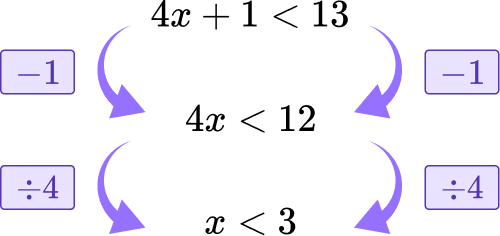
This is the same balancing logic used for equations. The difference is that instead of finding one value, you identify all values that make the comparison true.
A compact workflow is:
- Simplify each side if needed.
- Gather variable terms on one side and constants on the other.
- Isolate the variable.
- Reverse the inequality sign only if the final multiplication or division is by a negative quantity.
- Check one value that should work and one value that should not.
Why a negative reverses the sign
The crucial rule is:
When multiplying or dividing both sides of an inequality by a negative number, reverse the inequality sign.
For instance, is true. Multiply both values by :
The original smaller number, , becomes the larger number after negation, . Multiplying by a negative reflects numbers across zero, reversing their order.
Now solve:
First subtract from both sides:
Next divide both sides by . Because is negative, reverse to :
That is the solution.
A quick check confirms it:
- Try , which satisfies :
This is true.
- Try , which is outside the solution set:
This is false.
The sign reversal happens when you multiply or divide by a negative. It does not happen merely because a negative number appears in the expression.
For example, from
add to both sides:
The sign has not changed: you added a positive , rather than multiplying or dividing by a negative. Only in the next step does it reverse:
because dividing by is required.
OpenStax provides a concise statement of the comparison rules and then applies them to practical constraints.
5.3 Linear Inequalities in One Variable with Applications - Contemporary Mathematics | OpenStax
Read Linear Inequalities in One Variable with Applications from OpenStax. It formalizes the operations that preserve an inequality and connects the algebra to “at most” and “at least” situations.
In the section “Solving Linear Inequalities,” read the opening comparison to connect inequality solving to the equation methods from the previous lessons. Continue with the multiplication rule; focus on the distinction between positive and negative multipliers or divisors. Then, in “Solving Applications with Linear Inequalities,” read the application setup and the tablet-computer example that follows it. Notice how “maximum,” “under,” and “no more than” become an upper-bound inequality.
A multi-step inequality with variables on both sides
The same approach works when appears on both sides. Consider:
First collect the variable terms on one side. Subtract from both sides:
Then remove the constant from the left by subtracting :
Finally, divide by . This reverses the sign:
A check makes the result more trustworthy. Test , which lies below :
True.
Test , which lies outside the solution:
False.
Checking values is particularly useful while learning because it can catch the most common error: forgetting to reverse the sign after division by a negative coefficient.
Interpreting threshold rules in data work
Inequalities express constraints. A constraint says which inputs, outputs, or parameter values are acceptable.
Suppose a simple estimate of a storage requirement, in gigabytes, is
where is the number of data units being stored. If the available storage is at most GB, the constraint is
Solve it:
So the model says that data units is the largest allowable value. Since counts units, values such as may not make sense in context; a real application may require a whole-number decision.
In programming, the inequality itself can be evaluated directly. But algebra tells you the entire range of valid inputs before you test individual cases.
def storage_is_within_limit(n):
    storage_gb = 0.8 * n + 2
    return storage_gb <= 10

for n in [8, 10, 11]:
    print(n, storage_is_within_limit(n))
The output should show that and satisfy the limit, while does not. This matches the solved condition .
Later in machine learning, inequalities will appear in filtering data, defining decision thresholds, and specifying optimization constraints. For now, the important skill is recognizing that a solved inequality gives a range, not a single prediction or parameter value.
Common pitfalls
Forgetting the sign reversal
From
the correct result is
because division by reverses to .
Reversing the sign after addition or subtraction
From
add to both sides:
The sign does not reverse. Addition and subtraction, even subtraction of a negative number, do not reverse the comparison.
Treating a strict boundary as included
If
then is not a solution. By contrast, does satisfy
Dividing by a variable of unknown sign
At this stage, avoid dividing an inequality by an unknown variable such as . In
the correct direction depends on whether is positive or negative, and division is impossible if . The inequalities in this lesson use numerical coefficients, so you can always determine whether the sign must reverse.
Key takeaways
A linear inequality is solved with the same balanced-operation method used for linear equations, but its answer is a set of possible values.
- Add or subtract the same quantity on both sides without changing the sign.
- Multiply or divide by a positive number without changing the sign.
- Multiply or divide by a negative number and reverse the sign.
- Use and for strict bounds; use and when the boundary is allowed.
- Check a value inside the solution set and one outside it when you want to verify your work.
Next, the course shifts briefly from comparisons to compact notation for repeated addition: finite sums written with sigma notation.
Can't find a good explanation? Sign up and we'll make it for you
Sign up