
Good to see you again. In the last lesson, you learned that MDF is made by bonding fine wood fibres with resin under heat and pressure. Plywood is also an engineered board, but its structure is completely different: it is made from thin sheets of real wood, called veneers, rather than loose fibres.
This lesson will help you describe the plywood manufacturing process in the correct order, especially the key idea that adjacent veneer layers have their wood grain running in alternating directions, usually at . That detail explains why plywood is strong and stable.
The core idea: layers, not fibres
A veneer is a very thin sheet of wood. Plywood is made by gluing several veneers together to form one board. It normally has at least three layers, and it often has an odd number of layers, such as three, five, or seven.
The crucial manufacturing feature is cross-graining:
- the grain of one veneer runs in one direction;
- the grain of the veneer next to it runs across it, usually at ;
- the next layer changes direction again.
For example, a three-layer plywood board may be arranged like this:
| Layer | Direction of grain |
|---|---|
| Top veneer | Left to right |
| Middle veneer | Front to back |
| Bottom veneer | Left to right |
The top and bottom layers match, while the middle layer crosses them. This balanced structure helps the board stay flat.
Sources and origins - Timbers - Eduqas - GCSE Design and Technology Revision - Eduqas - BBC Bitesize
Read this short BBC Bitesize explanation to secure the definition of plywood and the meaning of laminating.
In the plywood paragraph, read the plywood explanation. Focus on the phrases “at right angles,” “laminating,” and “different directions.” Notice the contrast in the following MDF paragraph: MDF uses fibres, whereas plywood uses layers.
Making the veneers
Plywood manufacturing begins with suitable logs. The bark is removed and the logs are cut into manageable lengths.
A machine called a veneer lathe then makes the thin sheets. The log rotates while a sharp blade peels a continuous thin layer from its outside—rather like unrolling a very large roll of paper. This process is called rotary peeling.
The long strip of peeled wood is cut into veneer sheets. These sheets are dried because wood that contains too much moisture may warp and will not bond as well with adhesive.
How Is Plywood Made? The Process of Layering Wood Veneers
Watch “How Is Plywood Made? The Process of Layering Wood Veneers” from History of Simple Things for a visual walkthrough from log to finished panel.
Start with rotary peeling to see how a spinning log becomes thin veneer sheets. Then watch drying and stacking, focusing on why the veneers are dried and placed with their grains at right angles. Finish with gluing and pressing to see how adhesive, heat, and pressure turn separate veneers into a single plywood board.
Gluing and arranging the layers
Once the veneers are dry, adhesive or resin is spread over them. The sheets are then stacked carefully. This is the stage where plywood gains its distinctive structure.
Each adjacent layer is placed so that its grain runs perpendicular to the grain in the layer beside it:
It is important not to write that every veneer “has a different grain.” A clearer and more accurate statement is:
The grain direction alternates so that each neighbouring veneer is at right angles to the next one.
The supplied illustration shows this arrangement clearly.
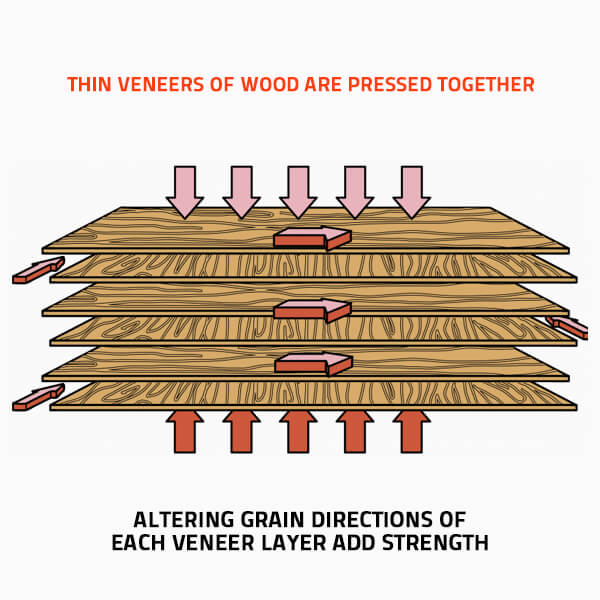
The arrows in the illustration represent the pressing force. The grain pattern shown on each sheet changes direction from one layer to the next.
Pressing the veneers into plywood
The glued stack of veneers is placed in a press. It is compressed under pressure, usually with heat.
These two parts have different jobs:
- Pressure holds the veneers tightly together, removes air gaps, and helps make a flat board of even thickness.
- Heat helps the adhesive cure or set.
- Adhesive/resin bonds the separate wood veneers into one solid panel.
After pressing, the plywood is allowed to cool. It can then be trimmed to size and sanded to produce a smoother finished surface.
The overall process is:
- Prepare logs.
- Peel the logs into thin wood veneers.
- Cut and dry the veneers.
- Spread adhesive on the veneers.
- Stack the veneers with alternating grain directions.
- Apply heat and pressure to bond them into a plywood sheet.
- Trim and sand the finished board if needed.
Why alternate the grain directions?
Wood is naturally stronger in the direction of its grain than across it. If every veneer in plywood faced the same way, the panel would be much weaker across the grain and more likely to bend, split, or warp in that direction.
By crossing the grain directions, plywood spreads strength in more than one direction. This is why it is generally:
- stronger and stiffer than a single thin piece of wood;
- less likely to warp or twist;
- more resistant to splitting;
- useful where a stable sheet material is needed.
This is also the key reason the manufacturing process matters. The layers are not simply piled up for thickness: their alternating directions are deliberately designed to improve the board.
An exam-ready description
For a “describe how plywood is manufactured” question, make sure your answer includes:
- thin wood veneers;
- adhesive or resin;
- alternating grain directions, usually at right angles;
- heat and pressure to bond the layers.
A strong answer could be:
Plywood is made by peeling logs into thin sheets of wood called veneers. The veneers are cut and dried, then coated with adhesive. Several veneers are stacked together so that the grain direction of each layer is at right angles to the layer next to it. The layers are pressed using heat and pressure, which cures the adhesive and bonds the veneers into one strong, flat board. The board can then be trimmed and sanded.
For a shorter response:
Plywood is manufactured by gluing thin wood veneers together. The grain of each veneer is arranged at right angles to the next layer, and heat and pressure bond the layers into a strong sheet.
Avoid these common mistakes
| Mistake | Better wording |
|---|---|
| “Plywood is made from wood fibres.” | Plywood is made from thin wood veneers. |
| “The layers all face the same way.” | Adjacent veneer layers have alternating grain directions. |
| “The wood is melted together.” | Adhesive bonds the veneers when heat and pressure are applied. |
| “Plywood is solid wood.” | Plywood is an engineered board made from layers of wood veneer. |
A quick memory chain for the exam is:
log → thin veneer → dry → glue → cross-grain layers → heat and pressure → plywood
Key takeaways
Plywood is made from thin wood veneers, not MDF-style wood fibres. Logs are peeled into veneers, the veneers are dried and glued, then stacked with the grain of neighbouring layers at to each other. Finally, heat and pressure cure the adhesive and form a strong, flat plywood panel.
The phrase most worth remembering is: “thin veneers are glued together with alternating grain directions.”
Next, you will move from how MDF and plywood are made to the practical question of their properties—starting with the features of MDF that matter when choosing material for a jewellery box.
Can't find a good explanation? Sign up and we'll make it for you
Sign up