
Hello. This first lesson begins the MDF and Plywood Essentials module. Since your exam is tomorrow, the aim is to build an accurate, exam-ready explanation rather than memorise isolated keywords.
By the end, you should be able to describe the journey from wood to an MDF board and, crucially, explain what the wood fibres, resin, heat, and pressure each do.
MDF: a manufactured wood board
MDF stands for medium-density fibreboard. It is an engineered or composite material: instead of being cut directly from one tree trunk like a solid wooden plank, it is manufactured by combining many tiny wood fibres with a bonding substance called resin.
The essential idea is:
Wood is broken into fine fibres. The fibres are coated with resin, formed into a sheet, then heated and pressed into a dense board.
That sentence contains the core of a strong exam answer. To make it a full description, you need to show the stages in the correct order and explain the purpose of heat and pressure.
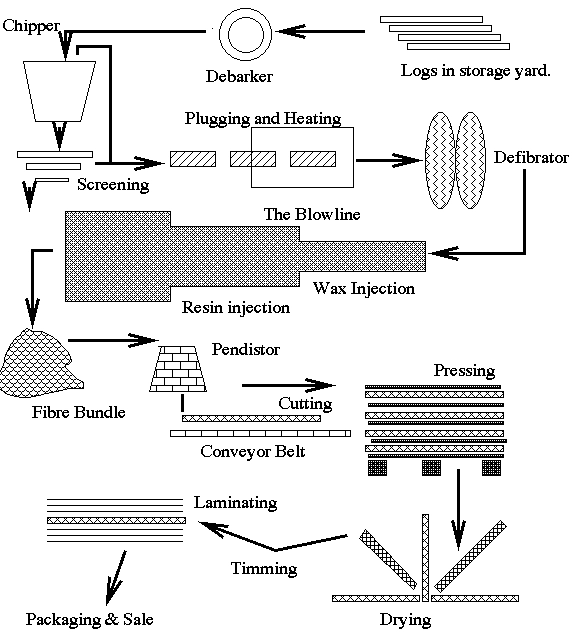
The flowchart includes extra industrial details, such as wax injection, cutting, laminating, and packaging. For this learning outcome, focus especially on the route from logs or wood pieces to fibres, then resin, then hot pressing.
From wood to fine fibres
Manufacturers can begin with logs, offcuts, wood chips, or other suitable wood material. The wood first has to be cleaned and prepared:
- Debarking: bark is removed from logs.
- Chipping and screening: wood is cut into small chips. Chips that are too large or too small can be removed or processed again.
- Steaming and refining: the chips are heated with steam to soften them. They pass through a refiner, where rotating discs separate the chips into very fine wood fibres.
This distinction matters:
- Chips are small pieces of wood.
- Fibres are much finer, hair-like strands separated from the wood structure.
Using fine, even fibres helps MDF become smooth and uniform. A board made from uneven lumps would have a rougher surface and weaker areas.
Watch “Manufacturing of a Fiberboard” from Institut für Holztechnologie Dresden. It gives a short visual sequence of the processes that turn wood pieces into fibres and then into a pressed board. Although it refers generally to fibreboard, the core fibre–resin–pressing stages are the same ideas you need for MDF.
Watch the complete selected sequence in order. Begin with wood preparation, where the logs are reduced to screened pieces. Then watch making and coating fibres: notice the steaming, refining, adhesive application, and drying. Finish with forming and pressing, concentrating on how a loose layer of fibres becomes a rigid board.
Resin, heat, and pressure: what makes the board
Once the wood has been turned into fibres, the fibres are dried to control their moisture content and are coated or mixed with synthetic resin. Resin is a type of adhesive. It is distributed through the fibres so that the board can bond throughout its thickness, not merely on the outer surface.
The resin-coated fibres are spread evenly on a moving belt to make a loose, thick layer called a mat. At this point it is not yet a board: it is still mostly loose fibres with air spaces between them.
The mat enters a hot press. This is the crucial stage:
- Heat causes the resin to cure or set, turning it into a strong bond.
- Pressure squeezes the fibres tightly together, removes much of the trapped air, and gives the panel its set thickness.
- Together, heat and pressure turn the loose fibre mat into a dense, solid MDF sheet.
It would be inaccurate to say simply that “the wood melts.” Wood does not melt into MDF. Instead, the resin bonds the fibres, while the press compacts them into a sheet.
After pressing, the large MDF boards are cooled, cut to size, and often sanded to create the flat, smooth surface associated with MDF. These later stages improve the board’s usability, but the main manufacturing transformation has already happened in the hot press.
MDF Panels | Medium Density Fiberboard | Composite Panel Association
Read the opening section of the Composite Panel Association’s “MDF Panels for Decorative Surfacing.” It gives a concise, formal definition of MDF that is useful for exam vocabulary.
Under the heading “MDF Panels for Decorative Surfacing,” read from the sentence beginning the definition of MDF. Focus on the words “cellulosic fibers,” “synthetic resin,” and “heat and pressure.” These are the technical terms that explain both what MDF contains and how it is made.
A reliable manufacturing sequence
For a Year 9 answer, use this sequence:
| Stage | What happens | Why it happens |
|---|---|---|
| Prepare wood | Logs or waste wood are debarked, chipped, and screened. | Produces manageable, clean pieces. |
| Make fibres | Chips are steamed and refined into fine fibres. | Fine fibres help make MDF even and smooth. |
| Add resin | Fibres are dried and coated with adhesive resin. | Resin will bond the fibres together. |
| Form a mat | Coated fibres are spread into an even layer. | Creates the starting shape of the board. |
| Hot press | Heat cures the resin; pressure compacts the fibres. | Produces a solid, dense MDF panel. |
| Finish board | Boards are cooled, cut, and sanded. | Produces usable sheets with smooth surfaces. |
Different factories may arrange small details differently—for example, when exactly they dry fibres or add special additives such as wax. But the core manufacturing principle remains the same:
Turning the process into an exam answer
A description question needs connected sentences, not just a list such as “wood, resin, heat, pressure.” Use process verbs: chipped, refined, mixed, spread, pressed, cured, cooled.
Here is a model response:
MDF is made from wood that is chipped and then steamed and refined into fine fibres. The fibres are dried and mixed or sprayed with synthetic resin, which acts as an adhesive. The resin-coated fibres are spread into a mat and placed in a hot press. Heat causes the resin to set, while pressure compresses the fibres and removes air spaces, forming a dense, smooth board. The finished MDF is then cooled, cut to size, and sanded if needed.
For a shorter answer, keep the four required ingredients clear:
MDF is manufactured by refining wood into fibres, mixing the fibres with resin, and spreading them into a mat. The mat is heated and compressed under pressure. The heat cures the resin and the pressure bonds the fibres into a dense board.
Common mistakes to avoid
- “MDF is made from layers of wood.” This describes plywood, not MDF.
- “Resin is painted on the surface.” Resin is mixed through or coated over the fibres before pressing.
- Leaving out heat or pressure. Both have separate jobs: heat sets the resin; pressure compacts the fibres.
- Calling MDF solid wood. It is a manufactured composite board made from wood fibres.
A useful quick-recall routine before the exam is to say this chain aloud without looking:
chips → fibres → resin → mat → heat and pressure → MDF board
Key takeaways
MDF is a composite board made by turning wood into fine fibres and bonding those fibres with resin. The fibres are formed into a mat, then placed in a hot press. Heat cures the resin, while pressure compacts the fibres into a dense, smooth sheet.
For an exam response, describe the stages in order and explain the role of each of the four key terms: wood fibres, resin, heat, and pressure.
Next, you will look at how plywood is manufactured. That will make the contrast clear: MDF is made from bonded fibres, whereas plywood is made from thin layers of wood veneer arranged with alternating grain directions.
Can't find a good explanation? Sign up and we'll make it for you
Sign up